voestalpine Railway Systems
UNILIGHT LED PPI
Controllers, recorders & signal conditioning
Process & PID controllers
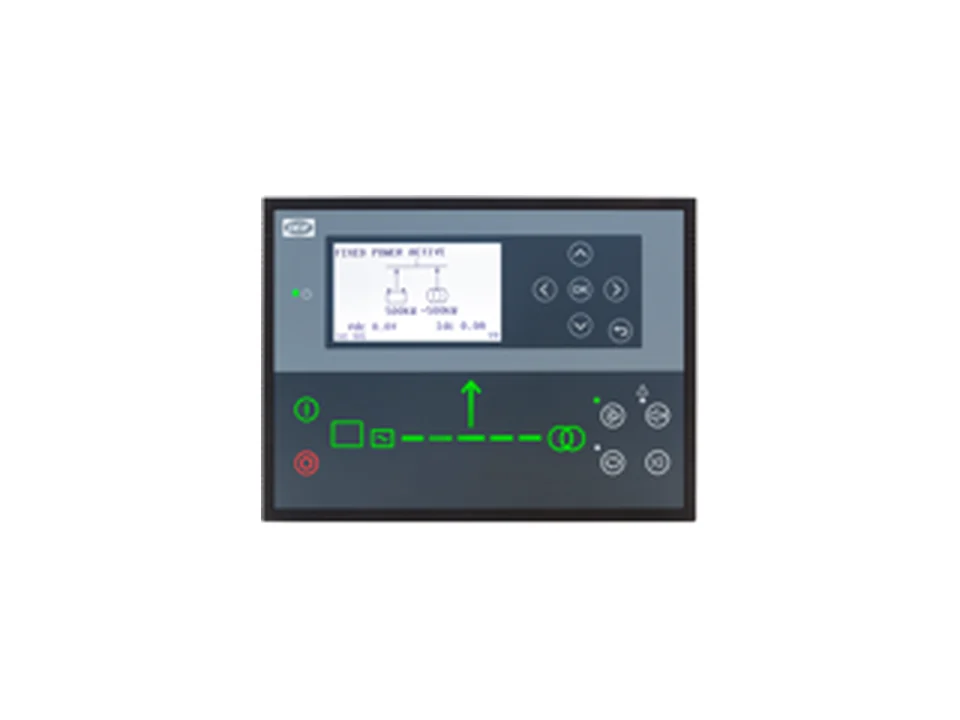
The ASC-4 Wind is a programmable automatic sustainable controller for integrating wind power into power plants or hybrid microgrid applications. It can integrate either a single wind turbine or an entire wind park, and it is offered as a fully customised solution for specific projects. Retrofit control solutions for existing wind turbines of various makes are among the listed applications.
The controller communicates with the wind turbines or the wind park via Modbus. It acts as the link between the power management system of the wind park and the central power and energy management system (PMS/EMS) of the plant. In this role it balances the power sources in the system.
Built-in Q factor control stabilises the power factor. The controller also manages breaker control and start and stop commands for the wind sources, and a curtailment counter records the energy curtailed. The system can handle up to 32 gensets and up to 16 sustainable plants.
The ASC-4 Wind is designed for DIN rail mounting in the switchboard. Its functions are aligned with the grid connection requirements VDE AR-N 4110 and VDE AR-N 4105, EN 50549-1:2019 and ENA EREC G99. The controller is UL approved, and TÜV approval is pending.
Key features listed for the controller are the integration of a single turbine or an entire wind park, Modbus communication, built-in Q factor control, a curtailment counter, suitability for hybrid microgrid applications and a fully customised solution for each project.
Typical applications named are wind power integration, hybrid microgrids, PMS/EMS systems and retrofit control solutions for existing wind turbines.
When enquiring, please describe the plant: number and type of wind turbines, the other power sources and gensets in the system, the existing power management system and the grid code that applies.
List input types and the destination of each output. Match panel cutout, supply and communication options before choosing a replacement.
For an installed instrument, copy the complete ordering code and its suffixes from the nameplate. Identify the part that will remain in service and the part that needs to be replaced. A photograph of the connection face or terminal markings helps resolve differences between versions that share the same housing.
For a new installation, describe what the instrument must measure or control and where the reading will be used. Give the normal operating conditions separately from short peaks. Include units with every numerical value. A drawing with the available space, orientation and access for removal gives the supplier a practical starting point.
Add the quantity for each position and identify any accessories that belong with it. Where a particular drawing, material certificate or calibration record is required, mention it with the line item. Submit the list with the destination country so that the response can cover the requested configuration and delivery.