voestalpine Railway Systems
UNILIGHT LED PPI
Controllers, recorders & signal conditioning
Indicators & totalisers
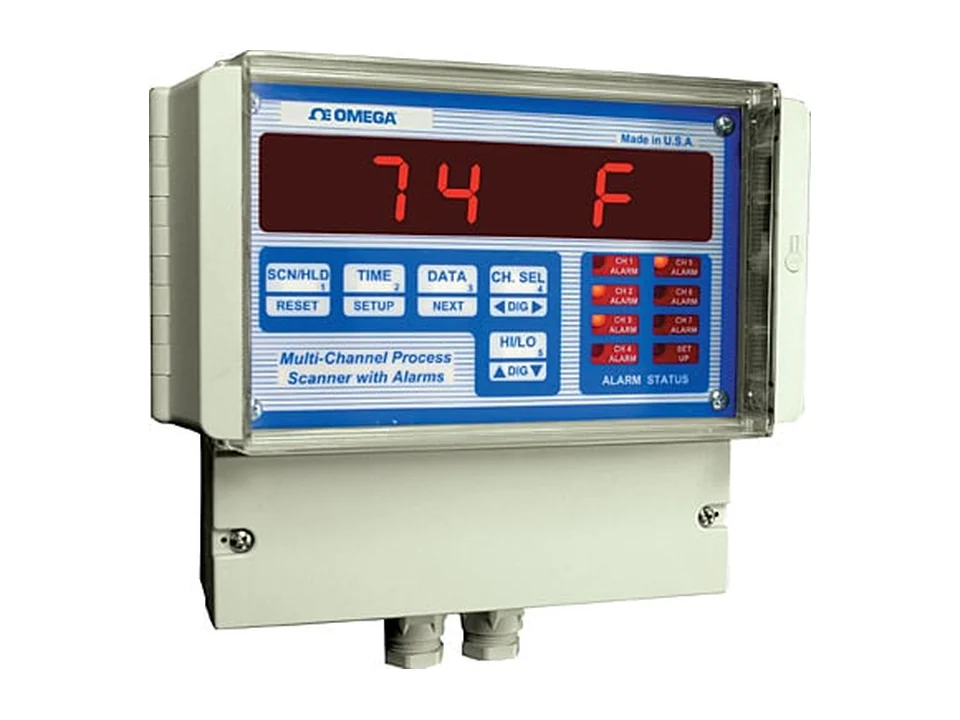
The DPS3300 series are wall-mount multi-channel process scanners that monitor the signals of several transducers with a single device. They are available with four or seven channels and accept thermocouples, RTDs, thermistors and analogue process signals, so temperature, pressure or strain values can be displayed one after another on one instrument.
The scanner uses a 20,000-count A/D converter with dual-slope integrating conversion at approximately seven conversions per second. It scans through the channels automatically at a fixed rate of two channels per second and shows the channel number together with the process value in engineering units, for example °C, °F or psi. How long each channel stays on the display is programmable from 1 to 999 seconds.
Supported inputs are thermocouple types J, K, T, E, R, S and B, Pt100 RTDs, thermistors of 2252 Ω at 25 °C, 4–20 mA, 0–100 mV and 0–10 V DC. Example ranges are −200 to 1190 °C for type J, −170 to 1365 °C for type K, −155 to 400 °C for type T and −185 to 915 °C for type E. Resolution is 1 °C or °F, 0.1 °C for thermistors and up to 9.999 for process signals. Inputs can be dedicated or programmable, and the temperature unit is selectable.
The value is shown on a red seven-segment LED display with seven digits, 20 mm high. As options, the scanner can be fitted with SPST relay outputs or open-collector outputs, up to seven in the 7-channel version, and with a built-in buzzer. Standard supply is 120 V AC; 220 V AC at 50/60 Hz and 8–15 V DC at 900 mA are optional.
The enclosure has a polycarbonate lid and a polystyrene case and is sealed to IP65. Wiring is connected to screw terminals accessible through the sealed plastic cover. The unit measures 192 × 160 × 103 mm and weighs 1.4 kg. Models DPS3304, DPS3307, DPS3314 and DPS3317 cover the channel counts and input versions.
Applications named for the scanner are industrial process monitoring, temperature mapping, pressure and strain monitoring and kiln hot spot detection. Please send the number of channels, the input types, the required outputs and the supply voltage with your enquiry.
DPS3304, DPS3307, DPS3314, DPS3317
List input types and the destination of each output. Match panel cutout, supply and communication options before choosing a replacement.
For an installed instrument, copy the complete ordering code and its suffixes from the nameplate. Identify the part that will remain in service and the part that needs to be replaced. A photograph of the connection face or terminal markings helps resolve differences between versions that share the same housing.
For a new installation, describe what the instrument must measure or control and where the reading will be used. Give the normal operating conditions separately from short peaks. Include units with every numerical value. A drawing with the available space, orientation and access for removal gives the supplier a practical starting point.
Add the quantity for each position and identify any accessories that belong with it. Where a particular drawing, material certificate or calibration record is required, mention it with the line item. Submit the list with the destination country so that the response can cover the requested configuration and delivery.