voestalpine Railway Systems
UNILIGHT LED PPI
Controllers, recorders & signal conditioning
Signal conditioners & barriers
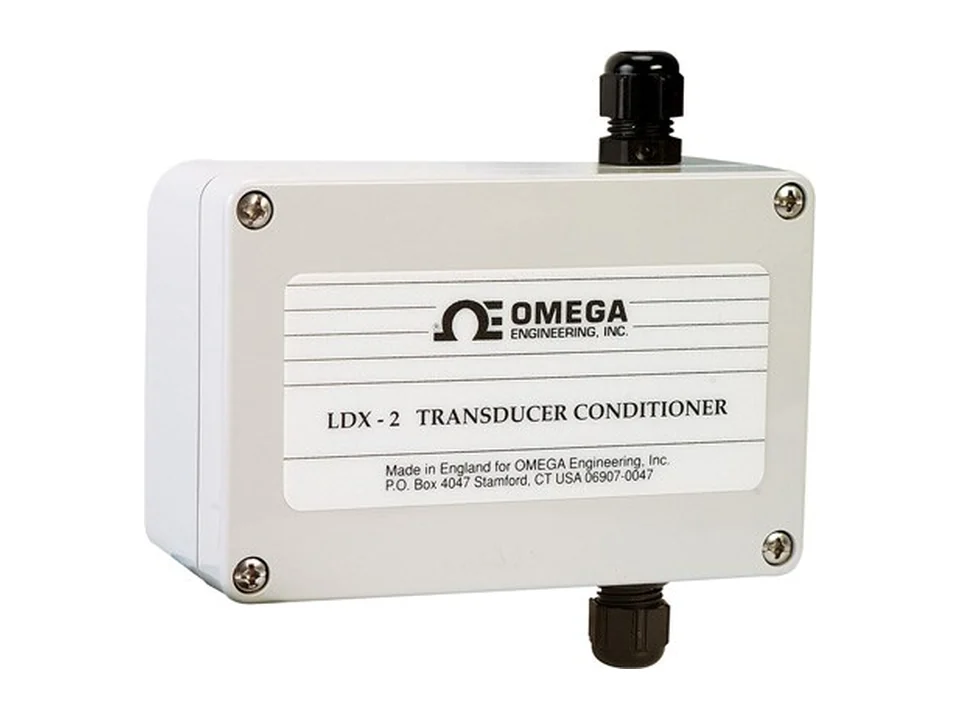
LDX-2 is a loop-powered signal conditioner for inductive AC LVDT displacement transducers. It contains an onboard oscillator that drives the primary winding of the transducer and conditions the transducer output into a milliamp current signal. In this way an LVDT can be connected directly to a standard current loop and its signal transmitted over long distances.
The conditioner powers the AC LVDT and converts the resulting signal into a 4–20 mA output in two-wire connection or 0–20 mA in three-wire connection. Inside, amplifier, demodulator and filter circuits process the signal. Selectable gains and transducer configurations accommodate different calibration requirements: the gain range is 3.5:1 switched and 5:1 adjustable, and the excitation frequency can be switched between 5 kHz and 13 kHz. The loop-powered architecture is designed for low noise; input noise is 1.4 µV RMS from 0 to 1.5 Hz, referred to input.
The input range covers transducer sensitivities of 30 to 530 mV/V. Accuracy is ±0.02 %, and non-linearity is better than 0.02 %. Output ripple is below 50 µA peak-to-peak at 10 kHz. The oscillator, the output and the supply are protected against open and short circuits.
The housing is sealed to IP65 and NEMA 12. Wires are connected to screw terminals, accessed through two cable ports for cables of 1 to 5 mm (0.04 to 0.2 in) diameter. The unit is 120.65 mm high and 54.86 mm long and can be mounted with two screws and nuts through holes in the base or on a DIN 46277-1 rail. The operating temperature range is 0 to 70 °C. The conditioner carries CE marking and is RoHS compliant.
Options are the output configuration (4–20 mA two-wire or 0–20 mA three-wire), the switchable gain and the switchable excitation frequency, which are selected according to the LVDT used and the required output.
Listed applications are automated manufacturing, industrial displacement measurement and applications with long transmission distances.
Please tell us the type and sensitivity of the LVDT, the required output and the supply conditions, and we will confirm the configuration with our quotation.
LDX-2-LVDT-Sig-Cond
List input types and the destination of each output. Match panel cutout, supply and communication options before choosing a replacement.
For an installed instrument, copy the complete ordering code and its suffixes from the nameplate. Identify the part that will remain in service and the part that needs to be replaced. A photograph of the connection face or terminal markings helps resolve differences between versions that share the same housing.
For a new installation, describe what the instrument must measure or control and where the reading will be used. Give the normal operating conditions separately from short peaks. Include units with every numerical value. A drawing with the available space, orientation and access for removal gives the supplier a practical starting point.
Add the quantity for each position and identify any accessories that belong with it. Where a particular drawing, material certificate or calibration record is required, mention it with the line item. Submit the list with the destination country so that the response can cover the requested configuration and delivery.