voestalpine Railway Systems
UNILIGHT LED PPI
Controllers, recorders & signal conditioning
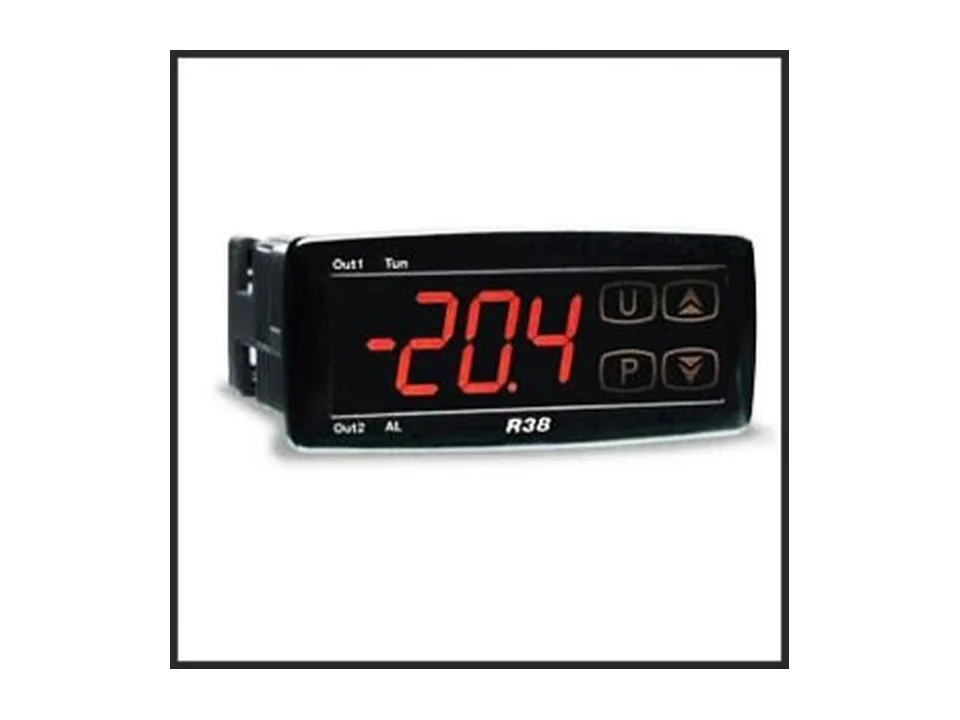
Process & PID controllers
The R38 is an entry-level compact digital temperature controller for flush panel mounting in industrial machines and equipment that require precise temperature regulation. It accepts thermocouple, resistance thermometer and thermistor sensors and switches heating or cooling loads through relays or a logic output for solid-state relays.
Supported inputs are thermocouples of type J and K from −40 to 999 °C, Pt 100 and Pt 1000 resistance thermometers from −50 to 850 °C, a KTY 81-121 PTC sensor from −50 to 150 °C and a 103AT-2 NTC thermistor from −50 to 110 °C. Readings are shown with 0.1 °C resolution, with automatic change of scale; temperatures can also be displayed in °F.
The controller processes the sensor signal and acts through up to two SPDT relays rated 8 A at 250 V AC, or through a logic voltage to drive SSRs. Control modes include PID with autotuning and several ON/OFF configurations with single or double action. Further functions are soft start, a start-up delay and a compressor protection timer. Parameters can be protected by a password or keyboard lock, and Modbus RTU communication is available through a TTL port.
Two versions differ in the keypad: the R38 has a standard mechanical keyboard, the R38S a sensitive touch keyboard. Power supply options are 12 V AC/DC, 24 V AC/DC and 100 to 240 V AC, with a maximum consumption of 6 VA. The device is Class II, with a rated impulse voltage of 2.5 kV and overvoltage category II.
The front panel is rated IP65 and the terminals IP20. The panel cut-out is 71 × 29 mm. The controller carries the CE mark and refers to EN 60584-1 for thermocouples, EN 60751 for RTDs, EN 61326-1 for EMC and EN 61010-1 for safety.
Typical applications listed are soldering and sealing, hot glue gluing, packaging and blister packing machines, T-shirt printing, holding ovens and thermostatic baths. Please specify the sensor type, power supply, number of outputs and keyboard version in your enquiry.
R38, R38S
List input types and the destination of each output. Match panel cutout, supply and communication options before choosing a replacement.
For an installed instrument, copy the complete ordering code and its suffixes from the nameplate. Identify the part that will remain in service and the part that needs to be replaced. A photograph of the connection face or terminal markings helps resolve differences between versions that share the same housing.
For a new installation, describe what the instrument must measure or control and where the reading will be used. Give the normal operating conditions separately from short peaks. Include units with every numerical value. A drawing with the available space, orientation and access for removal gives the supplier a practical starting point.
Add the quantity for each position and identify any accessories that belong with it. Where a particular drawing, material certificate or calibration record is required, mention it with the line item. Submit the list with the destination country so that the response can cover the requested configuration and delivery.