voestalpine Railway Systems
UNILIGHT LED PPI
Controllers, recorders & signal conditioning
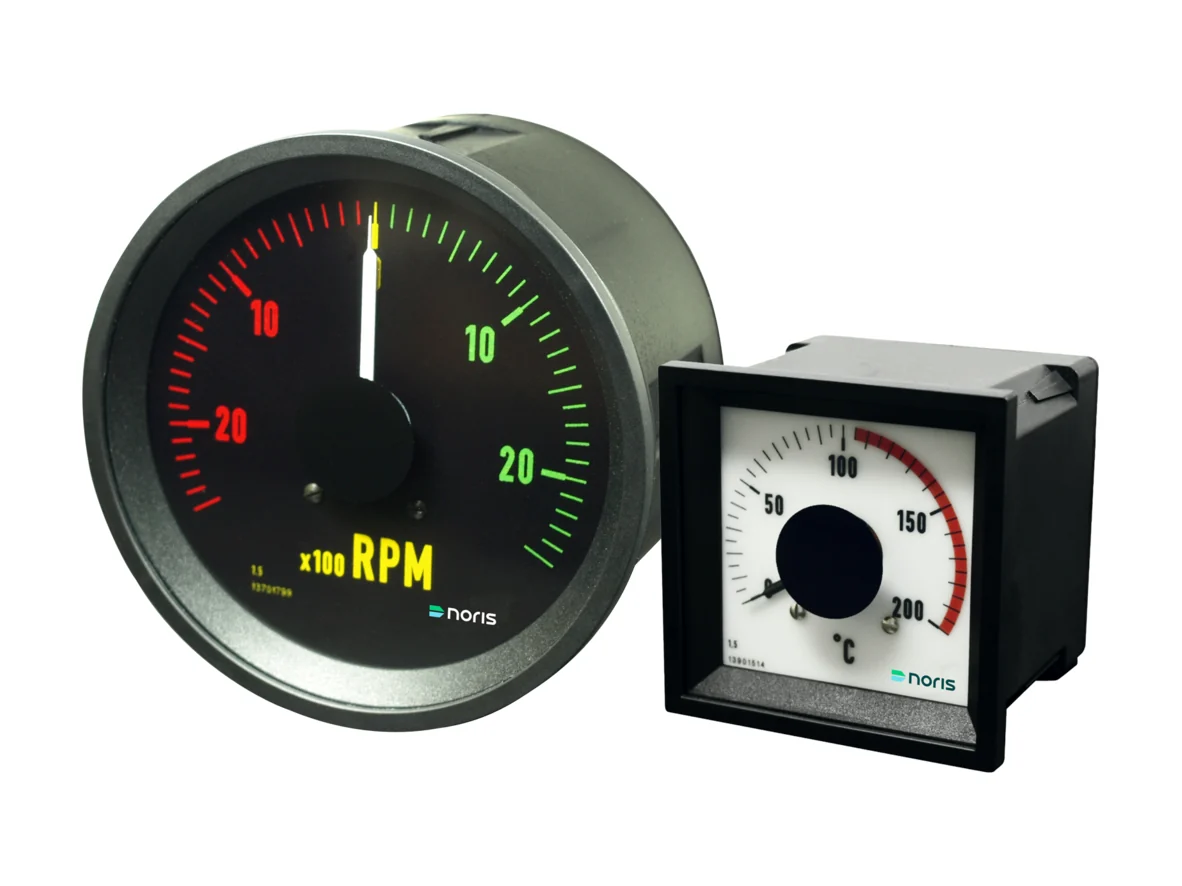
Indicators & totalisers
SIR3 and SIQ3 are analogue indicators with a moving-coil movement, built for places where electronic displays are hard to read or not robust enough: ship bridges and engine rooms, rail vehicles, special vehicles, machinery and outdoor installations. SIR3 has a round housing and SIQ3 a square one; both connect directly to a current or voltage signal and need no separate electronics to drive the pointer.
The pointer travels over a 240° scale, which gives a long scale length and good readability at a glance. Accuracy class is 1.5 to IEC 60051. Standard inputs are 0–20 mA, 4–20 mA, −20…0…+20 mA, 0–10 V, 2–10 V and −10…0…+10 V DC, AC voltage up to 250 V and customer-specific ranges; a centre-zero movement of ±1 mA is available. Scale design, pointer and dial print can be customised, including units, colour bands and marks.
The housing is glass-fibre-reinforced plastic that is UV-stabilised and resistant to salt spray, with a float glass front. The front is sealed to IP66, IP67 and IP68 (1 m for 24 hours), the rear to IP30 as standard. Round sizes are Ø 60, 80, 100 and 130 mm; square sizes are 72, 96 and 144 mm. Six white LEDs light the dial evenly; they are powered from 12 or 24 V DC and can be dimmed with a standard PWM dimmer so that the instrument matches the bridge or cab lighting.
The indicators are tested for demanding environments: operating temperature from −25 to +70 °C, salt spray to IEC 60068-2-52, vibration to IEC 60068-2-6, shock to EN 61373 category 2, dry cold and dry heat, and ESD and burst immunity to IEC 61000-4 and EN 50121-3-2. They comply with DNV requirements for shipbuilding and with EN 50155 for railway electronics. Mounting is tool-free with fastening screws, a dovetail key and a hand knob; the electrical connection is an 8-pin connector.
Typical fields of use are shipbuilding and megayachts, transport technology, defence, machinery and meteorology. Please specify housing shape and size, input signal and scale in your enquiry.
SIR3-060-I2-1234, SIQ3-096-U2-1234
List input types and the destination of each output. Match panel cutout, supply and communication options before choosing a replacement.
For an installed instrument, copy the complete ordering code and its suffixes from the nameplate. Identify the part that will remain in service and the part that needs to be replaced. A photograph of the connection face or terminal markings helps resolve differences between versions that share the same housing.
For a new installation, describe what the instrument must measure or control and where the reading will be used. Give the normal operating conditions separately from short peaks. Include units with every numerical value. A drawing with the available space, orientation and access for removal gives the supplier a practical starting point.
Add the quantity for each position and identify any accessories that belong with it. Where a particular drawing, material certificate or calibration record is required, mention it with the line item. Submit the list with the destination country so that the response can cover the requested configuration and delivery.