Bürkert Fluid Control Systems
Type 8189
Level
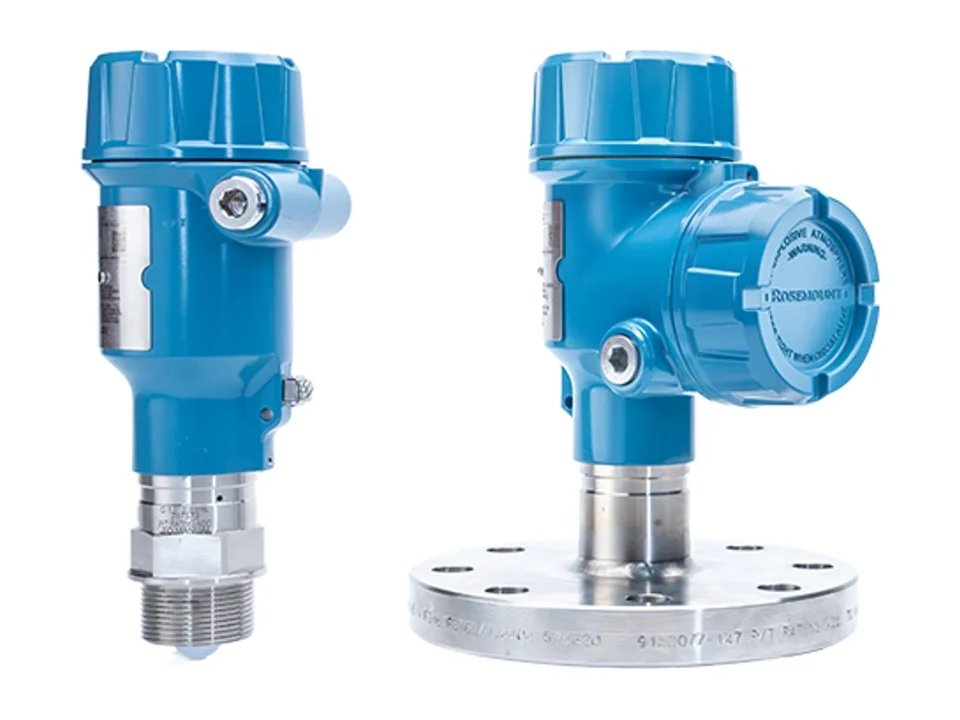
Radar level transmitters
The 3408 is a family of non-contacting radar level transmitters for measuring the level of liquids and solids. It operates at 80 GHz and is used both for reliable continuous level measurement and for overfill protection.
The transmitter emits 80 GHz radar signals towards the surface of the product and evaluates the reflected echo to determine the level. Smart Echo Supervision technology automatically suppresses false echoes from nozzles and internal obstructions in the vessel. The transmitter can be installed on nozzles as small as ¾ inch (20 mm).
The measuring range is up to 30 m (98 ft). Two versions are available. The wired version has a 4–20 mA HART output and an accuracy of ±1 mm (±0.04 in), with optional Bluetooth for configuration. The wireless version communicates via WirelessHART to IEC 62591 with an accuracy of ±3 mm (±0.1 in), and is offered with multiple wireless antennas and power modules.
The transmitter is SIL 2 certified to IEC 61508 and offers advanced diagnostics and remote proof testing, which supports its use in safety functions such as overfill protection. Commissioning is assisted by guided setup tools and wizard-based configuration; the device can be configured remotely from the control room and integrates with control systems and asset management tools.
Hazardous area approvals include ATEX, IECEx, FM and CSA, and TÜV and NAMUR conformity are listed.
Options include a dual compartment housing, Bluetooth connectivity, an LCD display, a diagnostics package, process seal, lens and ATAP antennas, and, for the wireless version, a choice of antennas and power modules.
Applications listed for the 3408 are chemical, water and wastewater, food and beverage, power, mining and bulk material handling. Please state the medium, measuring range, process connection, required output and hazardous area classification in your enquiry.
Identify the vessel height, nozzle position and surface conditions. A point alarm and a continuous level reading require different outputs.
For an installed instrument, copy the complete ordering code and its suffixes from the nameplate. Identify the part that will remain in service and the part that needs to be replaced. A photograph of the connection face or terminal markings helps resolve differences between versions that share the same housing.
For a new installation, describe what the instrument must measure or control and where the reading will be used. Give the normal operating conditions separately from short peaks. Include units with every numerical value. A drawing with the available space, orientation and access for removal gives the supplier a practical starting point.
Add the quantity for each position and identify any accessories that belong with it. Where a particular drawing, material certificate or calibration record is required, mention it with the line item. Submit the list with the destination country so that the response can cover the requested configuration and delivery.