ELGAS s.r.o.
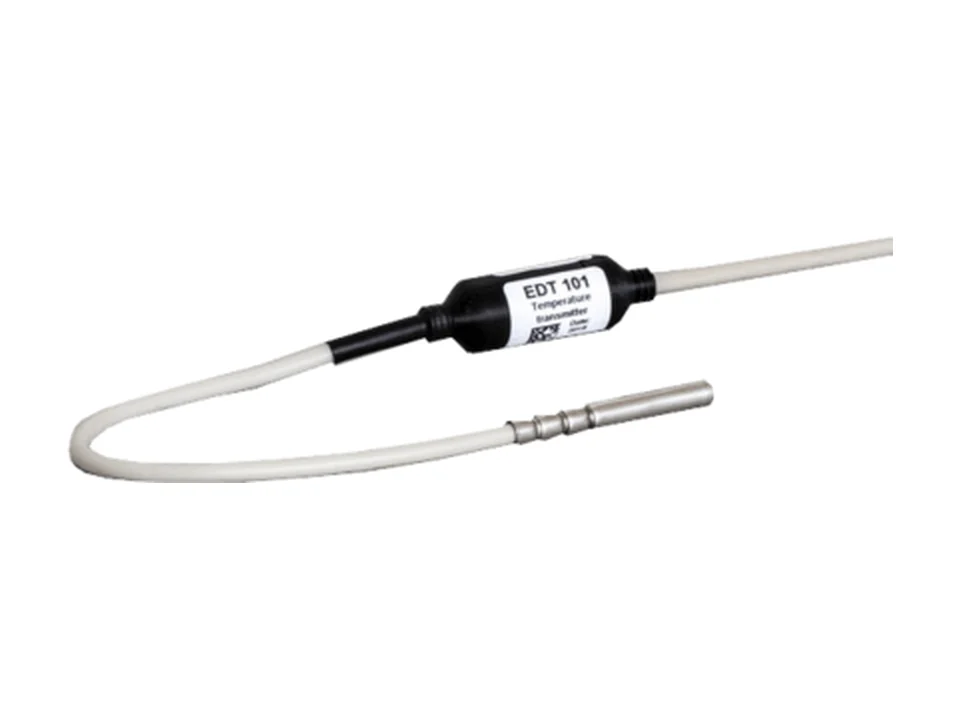
EDT 101
Temperature
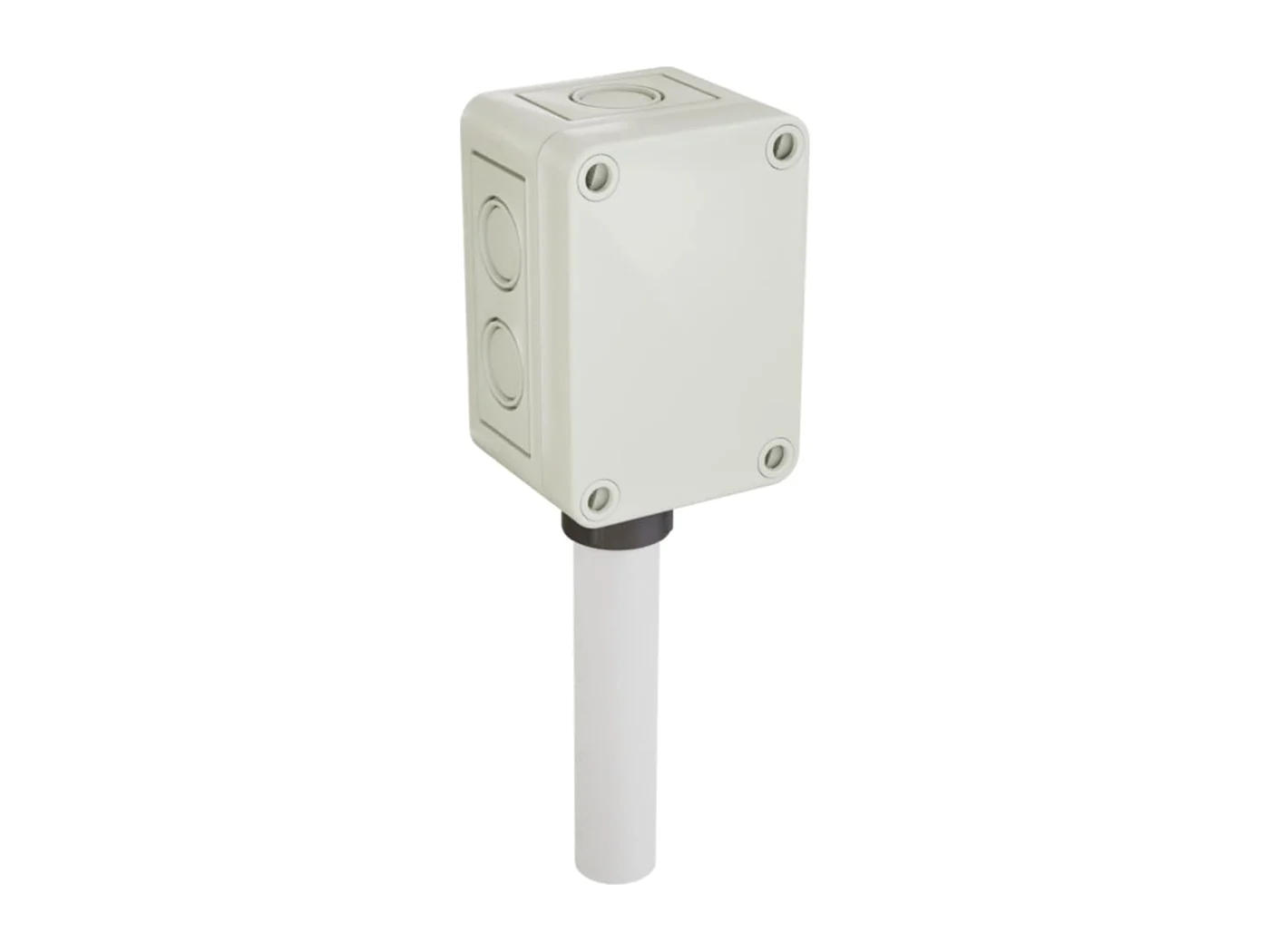
Temperature transmitters
A/TT100-O is a family of single-point outdoor temperature sensors and transmitters that report ambient air temperature to a building automation system (BAS) or controller. The outside air temperature is a basic input for many control strategies, and the transmitter provides it as a standard analogue signal.
The sensing element is a platinum RTD with a positive temperature coefficient according to DIN EN 60751 (IEC 751). The transmitter converts its resistance into a two-wire, loop-powered 4–20 mA signal or, as an option, into a three-wire voltage output of 1–5 V DC or 2–10 V DC. These signals are used to drive economiser, reset and freeze-protection strategies.
The measuring range is −40 to 85 °C. Accuracy is ±0.2 % for spans below 260 °C and ±0.5 % for spans above 500 °F (260 °C). The calibrated span can be selected between 50 °F and 300 °F. The device operates from 0 to 100 % relative humidity; storage is permitted from −40 to 71 °C.
Element options are TT100 (100 Ω), TT1K (1000 Ω) and matched TTM100 and TTM1K elements. Three enclosures are available: a PC/ASA Euro enclosure (-EH), a polystyrene NEMA 4X enclosure (-4X) and an aluminium bell box (-BB). Enclosure ratings of NEMA 3R, 4R and 4X are listed depending on the version. A potted option with a ruggedised epoxy-coated build is offered for extreme environments. Wiring is connected to screw terminals, the enclosures have 1/2-inch NPT threaded hubs, and the sensor uses PTFE-insulated 14-inch leads and a PVC fitting. NIST certification with three or five points can be ordered.
The units are designed to be mounted out of direct sunlight, on the north side of a building, under an eave or in an intake hood, so that the reading represents the air temperature rather than solar heating. Recalibration is available for transmitters returned to the factory. The products comply with RoHS2 and WEEE, and enclosure materials are rated UL94-V0 or V2.
Listed applications are outside air temperature sensing, economiser control, cold storage facilities, warehouses and high-moisture environments. Please state the element, output signal, enclosure and any potting or certification requirement in your enquiry.
A/TT100-O-1-EH, 142557, A/TT100-O-2-BB, 130413, A/TT100-O-4-4X, 118434, A/TT100-O-2-EH, 142558, A/TTM100-O-2-BB, A/TTM100-O-4-4X, 131180, A/TT1K-O-1-EH, 138289, A/TT1K-O-2-BB, 118636, A/TT1K-O-4-4X, 118640, A/TTM1K-O-4, 118972, A/TTM1K-O-4-BB, 133615, A/TTM1K-O-4-4X, 118969, NIST TTM CERT-5PT., 129743
Match the sensing element, insertion length and wiring to the existing input. Separate the process temperature from the ambient temperature at the connection head.
For an installed instrument, copy the complete ordering code and its suffixes from the nameplate. Identify the part that will remain in service and the part that needs to be replaced. A photograph of the connection face or terminal markings helps resolve differences between versions that share the same housing.
For a new installation, describe what the instrument must measure or control and where the reading will be used. Give the normal operating conditions separately from short peaks. Include units with every numerical value. A drawing with the available space, orientation and access for removal gives the supplier a practical starting point.
Add the quantity for each position and identify any accessories that belong with it. Where a particular drawing, material certificate or calibration record is required, mention it with the line item. Submit the list with the destination country so that the response can cover the requested configuration and delivery.