ifm electronic
LDH313
Gas analysis
Process gas analysers & chromatographs
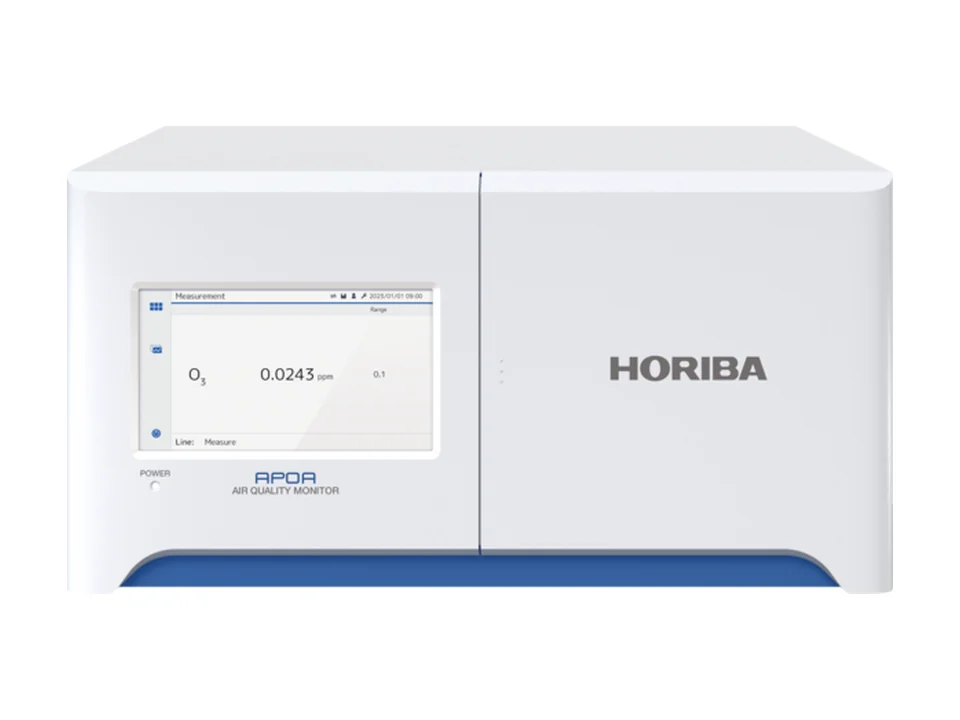
APOA-380 is an analyser for continuous measurement of ozone (O3) in ambient air and in background gases. It belongs to the AP-380 series and is designed for air quality monitoring, for industrial process and environmental tasks, for environmental countermeasures and for research and testing laboratories. A wall-mounted version, APOA-380WM, is available in the same series.
The measurement is based on cross-modulation non-dispersive ultraviolet absorption (NDUV). A UV LED serves as the light source. A heated ozone decomposer acts as a reference gas purifier: by comparing the sample with ozone-free reference gas, the analyser minimises interference from changes in moisture and provides stable, real-time continuous readings.
Seven measuring ranges can be selected, from 0–0.1 ppm up to 0–10 ppm (0.1, 0.2, 0.5, 1.0, 2.0, 5.0 and 10 ppm). The lower detection limit (2σ) is below 0.3 ppb. Repeatability and linearity are each ±1.0 % of full scale, zero drift is below 0.5 ppb and span drift below 0.5 % of full scale over 24 hours, and the response time T95 is under 60 seconds. Results can be shown in ppb, µg/m³, ppm or mg/m³; the sample flow is approximately 0.6 l/min.
The instrument is operated via a 7-inch colour LCD with touch panel and can also be operated remotely from a PC, tablet or smartphone. Standard communication includes two Ethernet ports with Modbus TCP, one RS-232C port with Modbus RTU and a USB flash drive port. Options include analogue outputs (for example DC 4–20 mA or DC 0–10 V), relay contact outputs, digital inputs and a wireless connection device. Power supply is AC 100–240 V ±10 %, 50/60 Hz, with a consumption of 60 W.
The analyser is designed for 0–40 °C and relative humidity up to 85 %. It measures 430 × 568 × 221 mm (W × D × H) and weighs approximately 14 kg. Its modular design allows fast replacement of modules in the field, and the housing can be adapted for stationary, wall-mount, mobile or portable installation. Further options are a calibration unit, a flow sensor and mounting parts such as brackets and slide rails.
The analyser holds QAL1 certification (TÜV), U.S. EPA designation EQOA-0506-160, MCERTS (CSA Group) and conformity with Korean NIER regulations, and carries CE, UKCA, RoHS, FCC and WEEE marking. Referenced standards include EN 14625, EN 15267-1, EN 15267-2 and VDI 4202-1.
Please send the required measuring range, the installation type and the output signals you need with your enquiry.
APOA-380, APOA-380WM
Identify the target gas, background gas and concentration units. State whether the sampling system is already installed or belongs in the enquiry.
For an installed instrument, copy the complete ordering code and its suffixes from the nameplate. Identify the part that will remain in service and the part that needs to be replaced. A photograph of the connection face or terminal markings helps resolve differences between versions that share the same housing.
For a new installation, describe what the instrument must measure or control and where the reading will be used. Give the normal operating conditions separately from short peaks. Include units with every numerical value. A drawing with the available space, orientation and access for removal gives the supplier a practical starting point.
Add the quantity for each position and identify any accessories that belong with it. Where a particular drawing, material certificate or calibration record is required, mention it with the line item. Submit the list with the destination country so that the response can cover the requested configuration and delivery.