voestalpine Railway Systems
UNILIGHT LED PPI
Controllers, recorders & signal conditioning
Recorders & data loggers
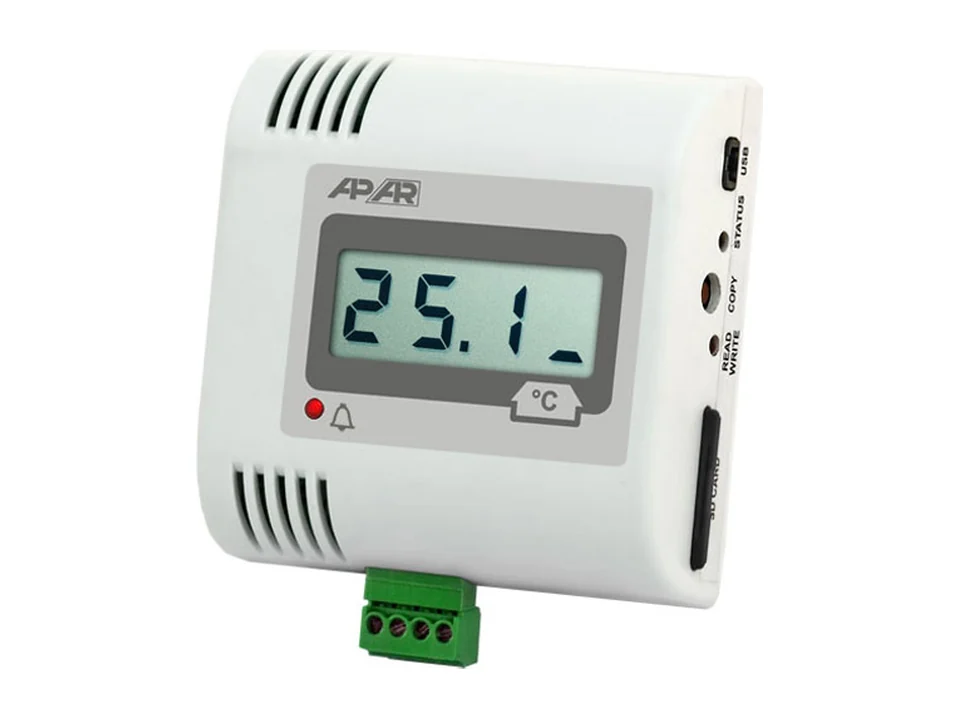
This family of data loggers and recorders covers the monitoring and archiving of temperature, humidity and other process parameters, from small battery-powered recorders to multi-channel panel instruments. The range includes temperature and humidity recorders AR236.B, temperature recorders AR232.B, AR233 and AR234, the AR200.B data logger with control and timer functions, and the multi-channel recorders AR207, AR208, AR407 and AR408. The family is also used for air quality parameters such as CO2, PM2.5 and PM10.
The devices measure physical quantities with integrated or external probes, process the signals and store the data in internal memory or on SD cards or USB sticks. Current values are shown on LCD or OLED displays, alarms can be programmed with LED and sound signalling, and remote access is possible through a web server or via a mobile app over optional Bluetooth Low Energy. The measured medium for the climate recorders is air or neutral gases without dust.
AR236.B measures humidity from 0 to 100 %RH and temperature from −30 to 80 °C with ±2 %RH and ±0.3 °C accuracy and stores up to 94k records. AR232.B measures temperature from −30 to 80 °C (version /1) or −50 to 120 °C (version /2) with ±0.3 °C accuracy and stores up to 104k records. AR233 and AR234, the latter with an LCD screen, have 0.1 °C resolution and memory for up to 80,000 records. These recorders are battery-powered, and probes are available integrated or on a 1.5 m cable.
The universal-input models accept Pt100 and Ni100 RTDs, thermocouples J, K, S, B, R, T, E and N, 0–20 mA, 0–10 V, 0–60 mV and 0–700 Ω. Accuracy is ±0.1 % of range ±1 digit for RTD, current, voltage, millivolt and resistance inputs and ±0.2 % for thermocouples. AR200.B has two universal inputs, three alarm/control outputs, a 128 × 64 OLED display, a built-in 24 V DC/50 mA supply for transmitters and interfaces for USB, RS-485 Modbus RTU, Ethernet Modbus TCP and MQTT. AR207 has 8 or 16 inputs and AR208 8 universal inputs; AR207, AR208, AR407 and AR408 have four control outputs and USB, RS-485 and Ethernet interfaces.
Housings include 96 × 48 mm and 96 × 96 mm panel housings, wall-mounted and portable wall-mounted versions. Protection is IP65 for AR236.B, AR232.B, AR200.B, AR208 and AR408, IP30 or IP65 for AR207 and AR407, and IP20 for AR233 and AR234.
Please tell us the parameters and number of channels to be recorded, the sensor types, the required interfaces and the preferred housing, and we will propose the matching model.
AR236.B, AR232.B, AR200.B, AR207, AR208, AR233, AR234, AR407, AR408
List input types and the destination of each output. Match panel cutout, supply and communication options before choosing a replacement.
For an installed instrument, copy the complete ordering code and its suffixes from the nameplate. Identify the part that will remain in service and the part that needs to be replaced. A photograph of the connection face or terminal markings helps resolve differences between versions that share the same housing.
For a new installation, describe what the instrument must measure or control and where the reading will be used. Give the normal operating conditions separately from short peaks. Include units with every numerical value. A drawing with the available space, orientation and access for removal gives the supplier a practical starting point.
Add the quantity for each position and identify any accessories that belong with it. Where a particular drawing, material certificate or calibration record is required, mention it with the line item. Submit the list with the destination country so that the response can cover the requested configuration and delivery.