ifm electronic
VVB3
Mechanical & physical measurement
Proximity & presence sensors
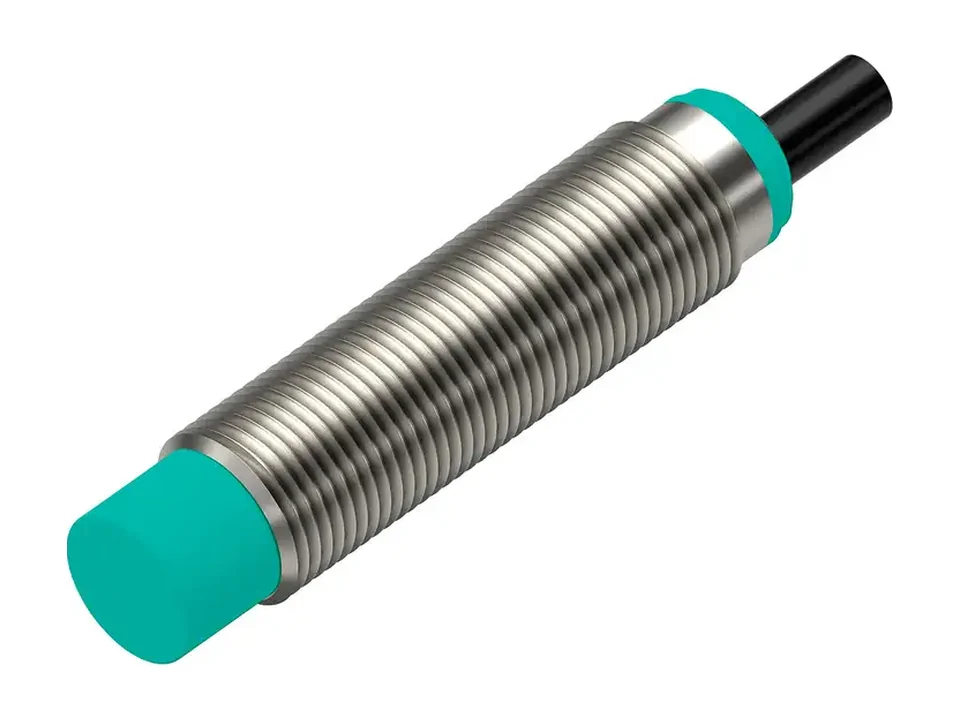
The NBN8-12GM50-E2 is an inductive proximity sensor in a cylindrical M12 threaded housing, designed for non-flush installation and for use in harsh industrial environments. It detects metal targets without contact and switches a PNP output when a target enters the sensing range.
The sensor generates an alternating electromagnetic field at its sensing face; a metal object in this field changes the oscillator conditions and the output switches. Active shielding technology is used to maintain high switching distances regardless of installation conditions. The rated operating distance is 8 mm and the assured operating distance 0 to 6.48 mm, referred to a mild steel target of 24 × 24 × 1 mm. For other metals the reduction factors are 0.4 for aluminium, 0.35 for copper, 0.79 for stainless steel 304 and 0.49 for brass. Hysteresis is typically 5 %.
The sensor is a 3-wire DC device with a normally open PNP output. It operates from 6 to 36 V DC and switches loads of up to 200 mA, with a voltage drop of no more than 1 V, an off-state current of at most 20 µA and a no-load supply current of at most 10 mA. Switching frequency is up to 1650 Hz, and the sensor is ready within 10 ms after power-on. It is protected against reverse polarity and has pulsing short-circuit protection. A yellow LED indicates the switching state.
The housing is made of white-bronze-coated brass with a PBT sensing face, and the sensor is connected by a 2 m cable. Ingress protection ratings from IP65 to IP69 are stated, and the sensor is designed for high shock resistance and an extended ambient and storage temperature range of −40 to 85 °C. It is mounted with M12 nuts at a tightening torque of no more than 10 Nm; two self-locking nuts are included.
The sensor conforms to EN IEC 60947-5-2 and to PWIS conformity VDMA 24364-C1/T100°C-W. It has protection class II, a rated insulation voltage of 36 V and a rated impulse withstand voltage of 500 V. Approvals are cULus (class 2 power source, enclosure type 1), CCC and DNV for marine use. Safety-related data are MTTFd 1607 years and a mission time of 20 years with 0 % diagnostic coverage.
Typical uses given for the sensor are harsh industrial environments, marine applications and equipment designs with damping elements. Please state the quantity and any required cable length in your enquiry.
NBN8-12GM50-E2
Include the sensing target, mounting clearance and direction of travel or force. Record the connector pinout from the existing device.
For an installed instrument, copy the complete ordering code and its suffixes from the nameplate. Identify the part that will remain in service and the part that needs to be replaced. A photograph of the connection face or terminal markings helps resolve differences between versions that share the same housing.
For a new installation, describe what the instrument must measure or control and where the reading will be used. Give the normal operating conditions separately from short peaks. Include units with every numerical value. A drawing with the available space, orientation and access for removal gives the supplier a practical starting point.
Add the quantity for each position and identify any accessories that belong with it. Where a particular drawing, material certificate or calibration record is required, mention it with the line item. Submit the list with the destination country so that the response can cover the requested configuration and delivery.