ifm electronic
UGT / UIT
Object detection and machine safety
Photoelectric sensors
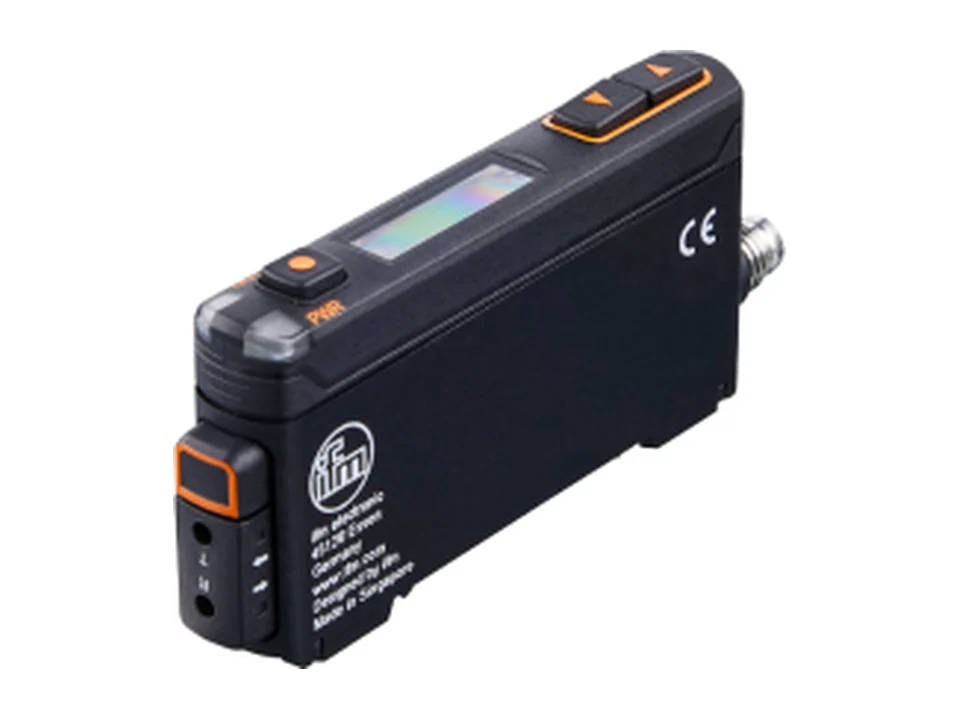
The OCF is a fibre-optic sensor designed for detecting tiny or transparent objects where installation space is very limited. The amplifier is mounted on a DIN rail, while flexible fibre-optic cables carry the light to the actual sensing point, which keeps the electronics away from the point of detection.
The sensor transmits light through a flexible fibre-optic cable to the sensing point. When an object interacts with the light signal, the change is analysed by the integrated amplifier and converted into a switching signal. Six operating modes are available to adapt the detection to the task. The device works with two channels and has two switching outputs.
IO-Link connectivity provides diagnostics and intelligent maintenance functions, so that the sensor status can be read and the sensor parameterised from the control system. Locally, setup is carried out with three buttons and an OLED display, with the menu available in nine languages.
Installation is tool-free: the amplifier snaps onto the DIN rail with spring-loaded latching lugs, and the fibres are inserted and held by a fibre locking system. The fibre optics can be bent to a radius of 1 mm and are rated for one million bending cycles. Depending on the type of fibre, temperatures up to 290 °C can be tolerated at the sensing point, and resistance to aggressive media is stated.
Three families of fibre optics are offered: highly flexible acrylic fibres, chemically resistant glass fibres and temperature-resistant fibres. The fibre is selected according to the flexibility, chemical resistance or temperature resistance required at the sensing point.
Applications named for the OCF include the detection of tiny objects, for example screws in a spiral conveyor; the detection of very fast objects, for example on bottling lines; level control in transparent containers; and position monitoring in demanding environments.
For an offer, please describe the detection task and the required fibre type (acrylic, glass or temperature-resistant), length and quantity.
Identify the target, working distance and output expected by the machine. For a protective device, supply the approved safety function and mounting drawing so the exact replacement can be checked.
For an installed instrument, copy the complete ordering code and its suffixes from the nameplate. Identify the part that will remain in service and the part that needs to be replaced. A photograph of the connection face or terminal markings helps resolve differences between versions that share the same housing.
For a new installation, describe what the instrument must measure or control and where the reading will be used. Give the normal operating conditions separately from short peaks. Include units with every numerical value. A drawing with the available space, orientation and access for removal gives the supplier a practical starting point.
Add the quantity for each position and identify any accessories that belong with it. Where a particular drawing, material certificate or calibration record is required, mention it with the line item. Submit the list with the destination country so that the response can cover the requested configuration and delivery.