voestalpine Railway Systems
UNILIGHT LED PPI
Controllers, recorders & signal conditioning
Recorders & data loggers
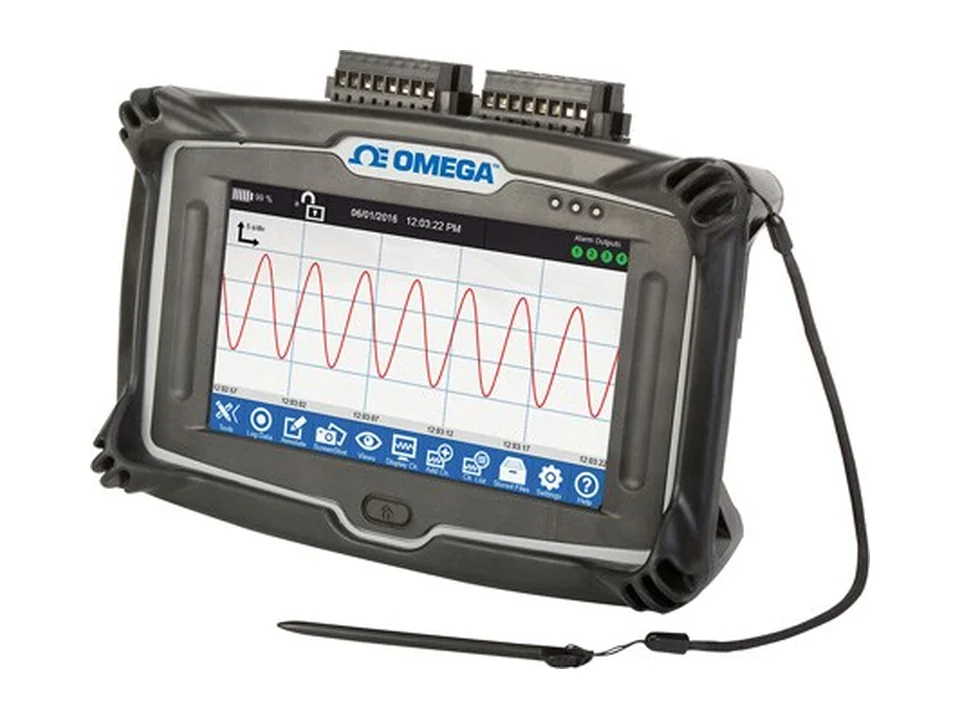
OM-DAQXL is a family of standalone data loggers with 8 or 16 universal analogue inputs and a 7-inch colour touch screen. Each channel can be configured individually for thermocouples, RTDs, thermistors, strain gauges, DC voltage, DC current or frequency and pulse signals, so a single unit can record a complete test: temperatures at several points, pressure and flow transmitters, a load cell and a pulse output from a meter.
Inputs are digitised with 24-bit resolution. The logging rate depends on the number of active channels: up to 125 samples per second with one channel, 25 per second with four, 10 per second with eight and 5 per second with sixteen. A selectable moving-average filter per channel reduces noise on slow signals. Stated accuracy is ±0.1 % for voltage and current, ±(0.15 % of reading + 1.1 °C) for type J and K thermocouples and ±(0.25 % of reading + 1 °C) for RTDs.
The logger works without a PC. Channels, alarms and recording are set up on the touch screen with the supplied stylus, curves are viewed live, and data is stored to an SD card or USB stick. Four SPDT relay outputs and four open-collector digital outputs can switch on high, low, window or open-sensor alarms, and four digital inputs are available. A built-in Li-ion battery keeps the logger running during power interruptions or short mobile tests.
Models with the -EW suffix add Ethernet and Wi-Fi. With the accompanying gateway software they publish data over OPC UA/DA to SCADA and historian systems and over MQTT to cloud platforms, which makes the logger a simple way to bring legacy sensors into an IIoT system. For offline evaluation, files are opened on a computer for analysis and reports.
The unit stands on a bench or is fixed to a wall. Accessories include region-specific power cords, terminal blocks, spare rubber boots, SD cards, USB cables, digital I/O cables, ferrites for thermocouple inputs and thermocouples. The logger is suited both to standalone recording and to applications where data is analysed on a computer or sent to IIoT and cloud systems. Tell us the number and type of signals you need to record, and we will confirm the right model with your quotation.
OM-DAQXL-1-*, OM-DAQXL-2-*, OM-DAQXL-1-EW-*, OM-DAQXL-2-EW-*, OM-DAQXL-ADAPTOR-NA, OM-DAQXL-STYLUS, OM-DAQXL-TB8, PT-USB-1, USB-WIFI, OM-DAQXL-BATTERY, SD32GB, OM-DAQXL-RB, OM-DAQXL-USB, OM-DAQXL-CABLE6, 5TC-TT-K-20-36, OM-DAQXL-RF, OM-DAQXL-ADAPTOR-*, USB-WIFI-AP
List input types and the destination of each output. Match panel cutout, supply and communication options before choosing a replacement.
For an installed instrument, copy the complete ordering code and its suffixes from the nameplate. Identify the part that will remain in service and the part that needs to be replaced. A photograph of the connection face or terminal markings helps resolve differences between versions that share the same housing.
For a new installation, describe what the instrument must measure or control and where the reading will be used. Give the normal operating conditions separately from short peaks. Include units with every numerical value. A drawing with the available space, orientation and access for removal gives the supplier a practical starting point.
Add the quantity for each position and identify any accessories that belong with it. Where a particular drawing, material certificate or calibration record is required, mention it with the line item. Submit the list with the destination country so that the response can cover the requested configuration and delivery.