Bürkert Fluid Control Systems
Type 8189
Level
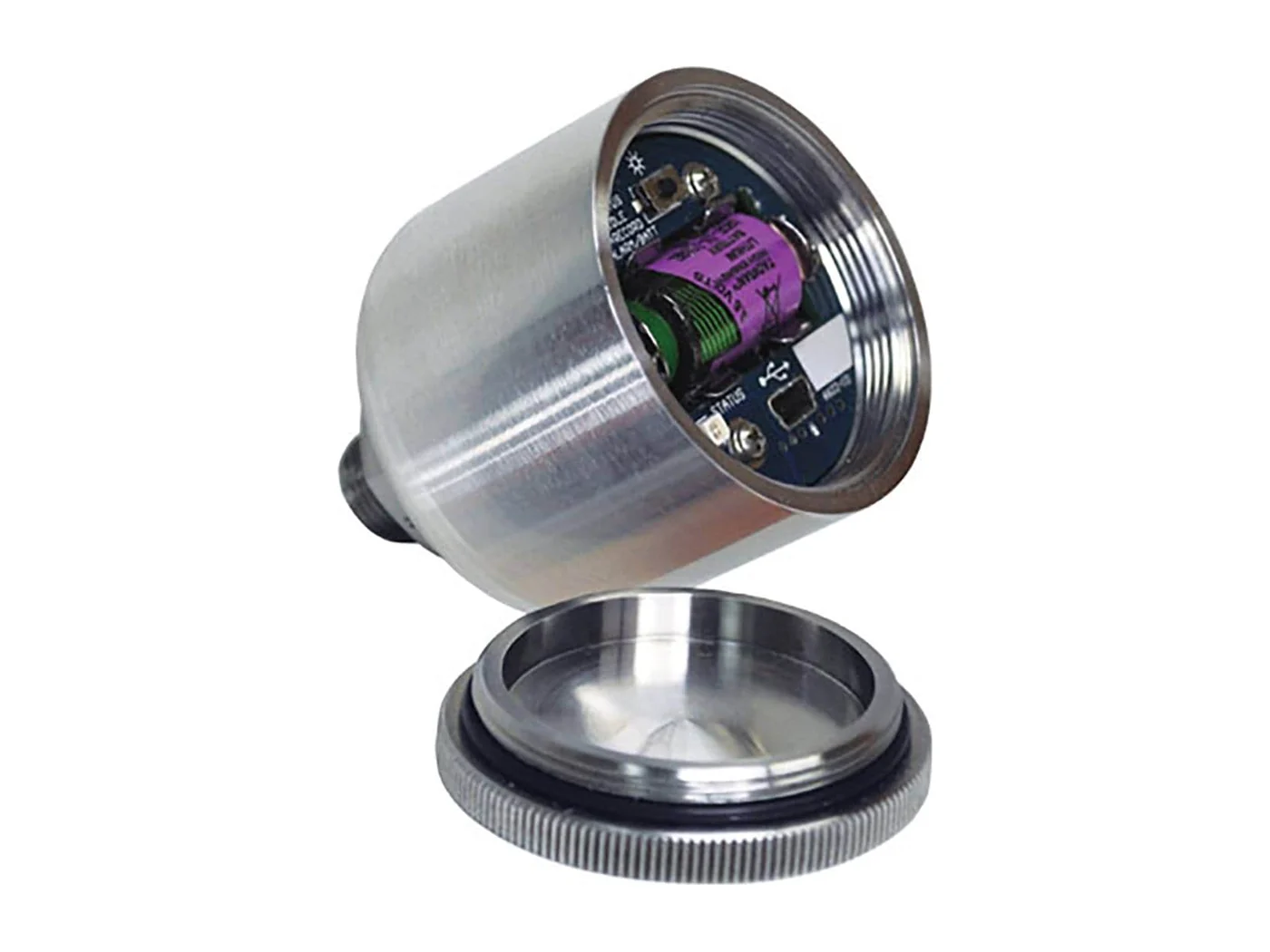
Hydrostatic level probes
The OM-PR series are battery-powered, stand-alone data loggers for pressure and temperature. They are housed in a rugged, watertight 316L stainless steel enclosure rated IP67 and can be submerged or installed directly on pipes and vessels, so measurements can be recorded at places where no power supply or cabling is available.
Each logger records pressure, temperature or both. Pressure versions cover absolute ranges of 35, 150, 350, 550, 2000 and 5800 psia, and vacuum versions 760 and 380 Torr. Temperature is measured from −20 to 85 °C. Calibration accuracy is ±1 % for pressure and ±2 °C for temperature; an optional traceable calibration certificate is available for each range.
The memory holds up to 64,000 samples, or 32,000 per channel when both pressure and temperature are recorded. The sample rate is set by the user from 2 seconds to 24 hours, and several trigger modes allow logging to start automatically. Two programmable alarms indicate when values exceed limits. The logger is configured and read out with the included Windows software over a direct USB connection.
The internal 3.6 V lithium battery lasts up to five years depending on the sample rate, and the battery and seals can be replaced by the user. The pressure port is a 1/4 in NPT male thread, and a garden hose adaptor is available for quick connection to taps and hoses. The logger is compact, 50 mm in diameter and 56 mm high, and is CE marked and RoHS compliant.
Typical applications are unattended field studies, work on water supply and distribution systems, tracking pressure in heat exchangers and other equipment. Please state the pressure range, whether temperature is also needed and whether a calibration certificate is required.
OM-PR35, OM-PR35-NIST, OM-PR150, OM-PR150-NIST, OM-PR350, OM-PR350-NIST, OM-PR550, OM-PR550-NIST, OM-PR2000, OM-PR2000-NIST, OM-PR5800, OM-PR5800-NIST, OM-PR380V, OM-PR380V-NIST, OM-PR760V, OM-PR760V-NIST, OM-PR-BATT, OM-PR-ADAPTOR, OM-PR-SEAL, OM-PR-COVER, OM-PR-USB-CABLE
Identify the vessel height, nozzle position and surface conditions. A point alarm and a continuous level reading require different outputs.
For an installed instrument, copy the complete ordering code and its suffixes from the nameplate. Identify the part that will remain in service and the part that needs to be replaced. A photograph of the connection face or terminal markings helps resolve differences between versions that share the same housing.
For a new installation, describe what the instrument must measure or control and where the reading will be used. Give the normal operating conditions separately from short peaks. Include units with every numerical value. A drawing with the available space, orientation and access for removal gives the supplier a practical starting point.
Add the quantity for each position and identify any accessories that belong with it. Where a particular drawing, material certificate or calibration record is required, mention it with the line item. Submit the list with the destination country so that the response can cover the requested configuration and delivery.