Bürkert Fluid Control Systems
Type 8189
Level
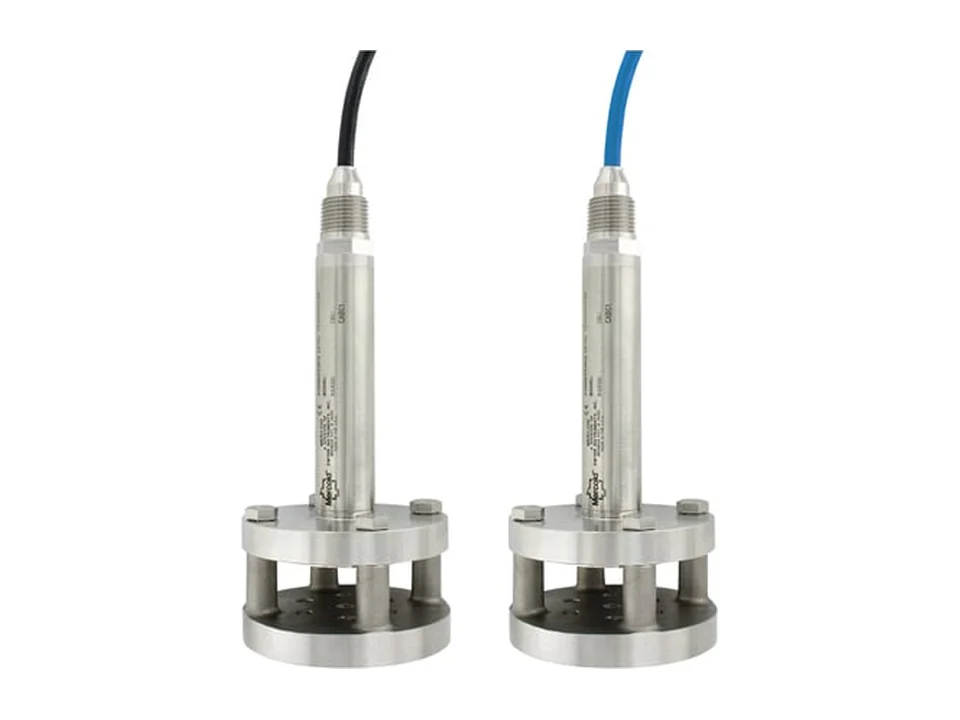
Hydrostatic level probes
The PBLT2 series is a submersible level transmitter for liquid level measurement in demanding applications: wastewater, sewage, slurry, sludge pits, sumps, reservoirs, oil tanks and chemical storage. It is suspended in the tank below the lowest level to be measured, or it can be laid on its side on the tank bottom.
The transmitter uses a piezoresistive sensing element that measures the hydrostatic pressure of the liquid column above it relative to atmospheric pressure. A vented cable brings atmospheric pressure to the reference side of the sensor, so changes in barometric pressure do not affect the reading. The sensor sits behind a large-diameter 316 stainless steel diaphragm seal, and a 316 SS cage protects it; this design prevents clogging by solids. A maintenance-free filter is included.
Accuracy is ±0.25 % of full scale, the thermal effect is ±0.02 % FS/°F and the response time is 50 ms. The temperature limit is 0 to 200 °F (−18 to 93 °C), and the proof pressure is twice the full scale. Custom sensor ranges can be ordered. Some media require factory review before ordering.
The output is a 2-wire 4–20 mA DC signal with a supply of 13–30 V DC and a maximum loop resistance of 900 Ω. Built-in lightning and surge protection guards the electronics against overvoltage on long cable runs. Connection is by pigtail leads, with a 1/2″ NPT connection; ETFE or polyurethane cable can be selected, in custom lengths. The transmitter weighs 2.0 kg.
The PBLTX version is intrinsically safe, marked II 1 G Ex ia IIC T4 Ga and II 1 D Ex ia IIIC T135 °C Da, and approved for Class I, Div. 1, Groups A, B, C, D; Class II, Div. 1, Groups E, F, G; and Class III, Div. 1. Certifications include cULus, ATEX, IECEx, UKCA and CE, according to IEC/EN 60079-0, IEC/EN 60079-11, UL 913 and CAN/CSA C22.2 No. 60079-0 and No. 60079-11.
With your enquiry, please state the medium, measuring range, cable material and length, and whether the intrinsically safe version is required.
PBLT2, PBLTX
Identify the vessel height, nozzle position and surface conditions. A point alarm and a continuous level reading require different outputs.
For an installed instrument, copy the complete ordering code and its suffixes from the nameplate. Identify the part that will remain in service and the part that needs to be replaced. A photograph of the connection face or terminal markings helps resolve differences between versions that share the same housing.
For a new installation, describe what the instrument must measure or control and where the reading will be used. Give the normal operating conditions separately from short peaks. Include units with every numerical value. A drawing with the available space, orientation and access for removal gives the supplier a practical starting point.
Add the quantity for each position and identify any accessories that belong with it. Where a particular drawing, material certificate or calibration record is required, mention it with the line item. Submit the list with the destination country so that the response can cover the requested configuration and delivery.