Landis+Gyr
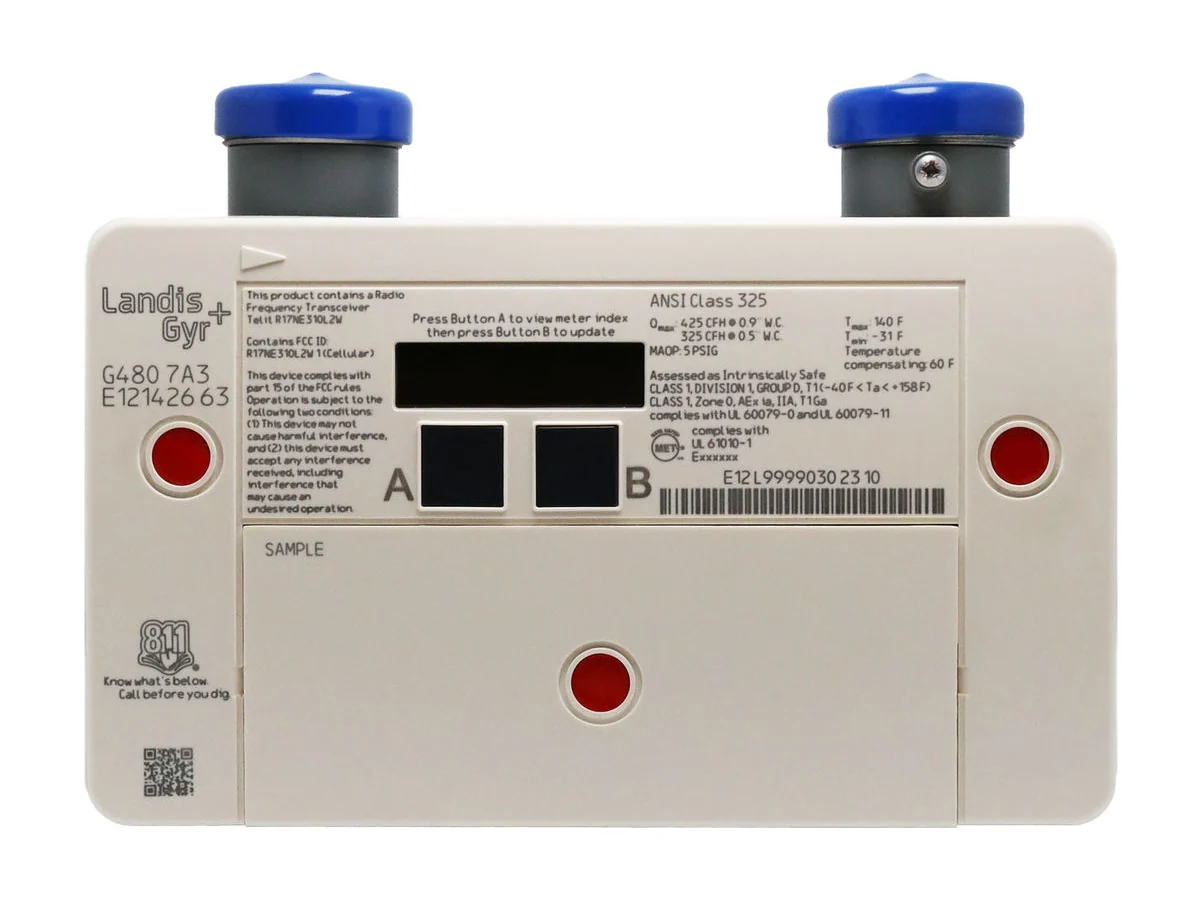
Surent G480
Flow
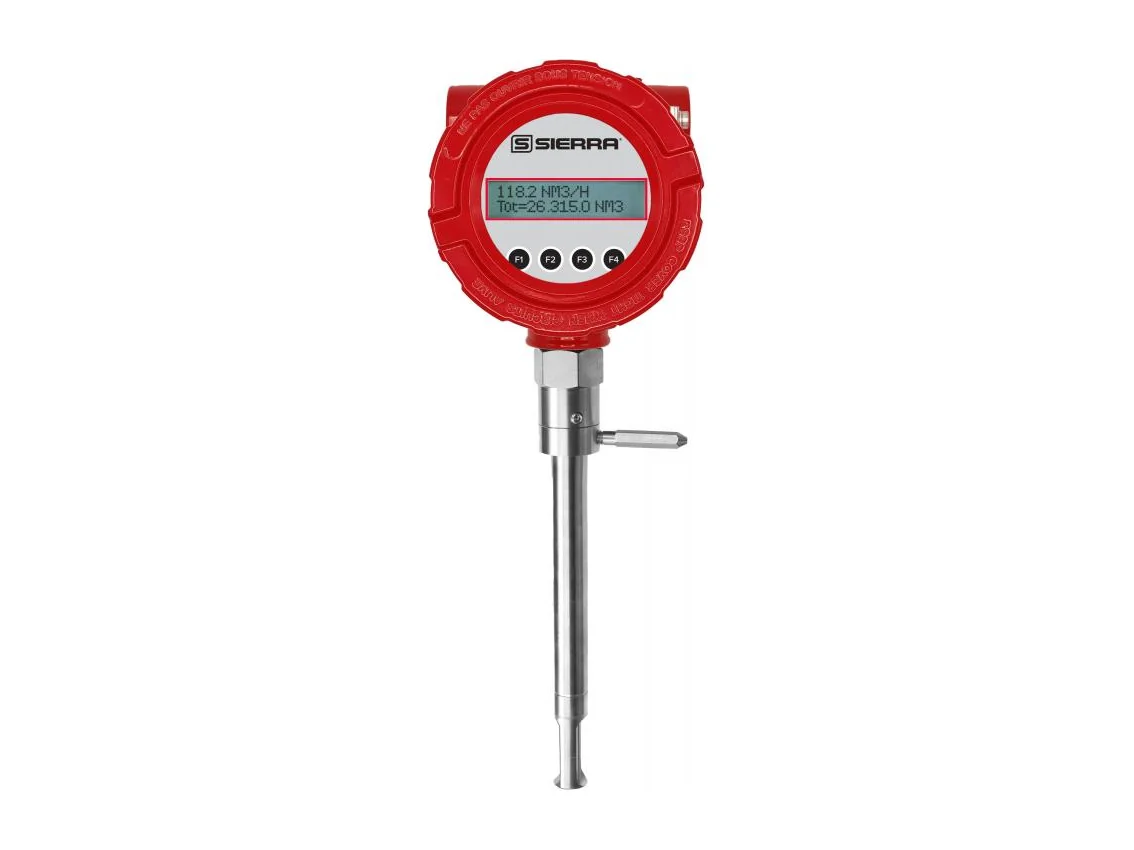
Thermal mass meters & flow controllers
The PowerMass TM500 is an industrial thermal mass flow meter for the direct measurement of gas mass flow. Built-in conversions also give the flow as corrected volumetric flow, and the instrument calculates totalised flow and measures gas temperature at the same time.
Thermal mass flow meters use a heated sensor in the gas stream: the heat carried away by the flowing gas depends on its mass flow. The TM500 uses DigiSense sensor technology, in which the sensor interfaces directly with the microprocessor. Correlation algorithms allow the meter to be calibrated on a single gas, while other gases can be selected in the field from the Gas-Mix menu.
For air and nitrogen, accuracy is ±1.0 % of reading plus ±0.2 % of full scale; for other gases it is ±1.5 % of reading plus ±0.5 % of full scale. Repeatability is ±0.2 % of full scale. The velocity range is 15 to 60,000 SFPM (0.07 to 280 NMPS), with a turndown of up to 1000:1 and typically 100:1. Response time is 0.8 seconds for one time constant. Calibration traceability to NIST is listed.
The meter is powered with 12 to 24 V DC. It has two galvanically isolated 4–20 mA outputs, a pulse output and a switch input; HART and Modbus RTU over RS-485 are optional. A USB connection is standard and works with the TM500-View software. An integrated data logger stores 40 daily totals, and the TM-Cal function validates the calibration in situ.
Insertion, inline and remote styles are available, with probe diameters of 3/4 in and 1/2 in and a 316 stainless steel sensor. Maximum gas pressure is 740 psig (51 barg) for insertion meters and 150 psig (10 barg) for hot-tap installation; for inline meters it ranges from 230 psig (16 barg) to 740 psig (51 barg) depending on material (316 SS or carbon steel) and connection (NPT, 150 lb or 300 lb flanges). The sensor operates from −40 °C to 121 °C and the enclosure from −40 °C to 70 °C. The enclosure is NEMA 4X / IP67, and the meter carries FM/FMc, ATEX, IECEx and UKEX hazardous area approvals and the CE mark.
Listed applications are hydrogen gas flow, natural gas distribution, boiler efficiency, burner control, fuel/air ratio, emissions measurement, and allocation and billing.
For selection, please send the gas or gas mixture, flow range, pipe size, pressure and temperature, the required style and outputs, and the area classification.
State the minimum, normal and peak flow with units. Pipe bore, fluid properties and the available straight run affect the choice of measuring principle.
For an installed instrument, copy the complete ordering code and its suffixes from the nameplate. Identify the part that will remain in service and the part that needs to be replaced. A photograph of the connection face or terminal markings helps resolve differences between versions that share the same housing.
For a new installation, describe what the instrument must measure or control and where the reading will be used. Give the normal operating conditions separately from short peaks. Include units with every numerical value. A drawing with the available space, orientation and access for removal gives the supplier a practical starting point.
Add the quantity for each position and identify any accessories that belong with it. Where a particular drawing, material certificate or calibration record is required, mention it with the line item. Submit the list with the destination country so that the response can cover the requested configuration and delivery.