ifm electronic
LDH313
Gas analysis
Process gas analysers & chromatographs
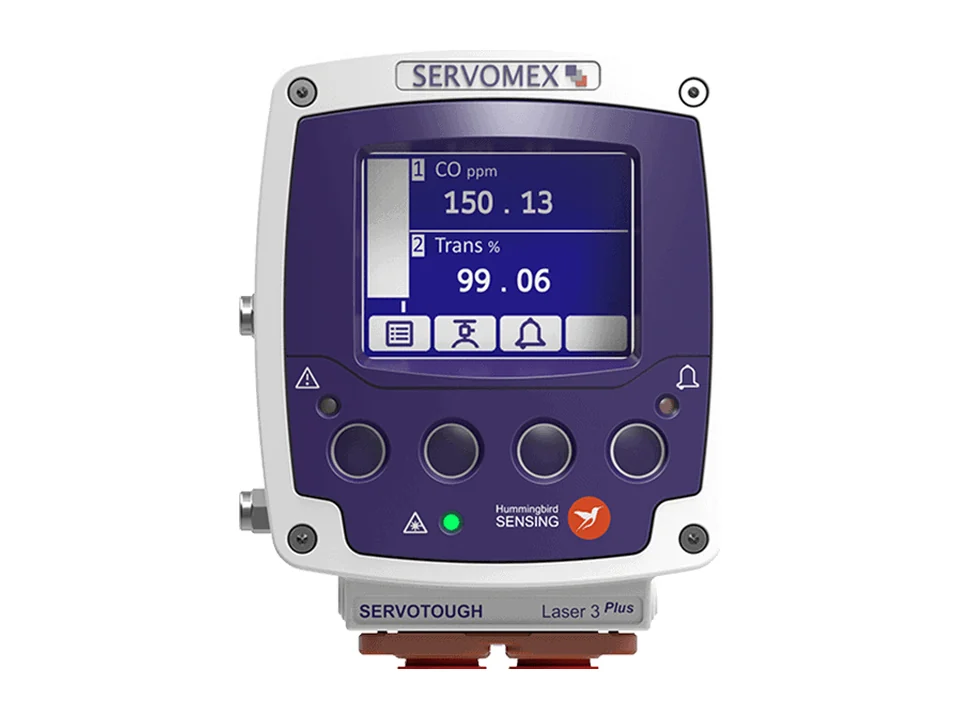
SERVOTOUGH Laser 3 Plus Combustion is a compact tunable diode laser (TDL) gas analyser for in-situ measurement of oxygen, carbon monoxide and methane. It is designed for combustion and process control and for safety applications on process heaters and furnaces, where the gas composition is measured directly across the duct or chamber.
The analyser consists of a transmitter and a receiver mounted opposite each other on the process. The laser beam crosses the gas and the absorption at the selected wavelength is evaluated using wavelength modulation spectroscopy (WMS). A line lock cuvette keeps the laser locked on the absorption line, which gives stable, repeatable results with minimal drift. There are no moving parts and no sample conditioning system.
Versions are available for O₂, for CO and for CO combined with CH₄, with results in % or ppm. The analyser tolerates process temperatures of up to 1300 °C, and path lengths from 0.5 to 25 m are covered. The calibration interval is 12 months.
Measured values are transmitted using Modbus over Ethernet. An on-board display allows configuration without a laptop, and the system can be installed by a single engineer. The transmitter measures 131 × 164 × 302.4 mm and weighs less than 3.0 kg; the receiver measures 110 × 146 × 247.6 mm and weighs less than 2.0 kg. The enclosures are rated IP66.
For hazardous areas the analyser has ATEX category 3 approval for gases and an ATEX approval for dust, and IECEx certification for Zone 2 and Zone 21; North American Class I Division 2 and Zone 2 approval for gas and dust is stated as pending. The instrument is CE marked and rated for SIL 2 applications.
Typical applications are process heaters, furnaces, combustion control and safety functions. Please send the gas components required, the path length, process temperature and area classification with your enquiry.
Identify the target gas, background gas and concentration units. State whether the sampling system is already installed or belongs in the enquiry.
For an installed instrument, copy the complete ordering code and its suffixes from the nameplate. Identify the part that will remain in service and the part that needs to be replaced. A photograph of the connection face or terminal markings helps resolve differences between versions that share the same housing.
For a new installation, describe what the instrument must measure or control and where the reading will be used. Give the normal operating conditions separately from short peaks. Include units with every numerical value. A drawing with the available space, orientation and access for removal gives the supplier a practical starting point.
Add the quantity for each position and identify any accessories that belong with it. Where a particular drawing, material certificate or calibration record is required, mention it with the line item. Submit the list with the destination country so that the response can cover the requested configuration and delivery.