voestalpine Railway Systems
UNILIGHT LED PPI
Controllers, recorders & signal conditioning
Signal conditioners & barriers
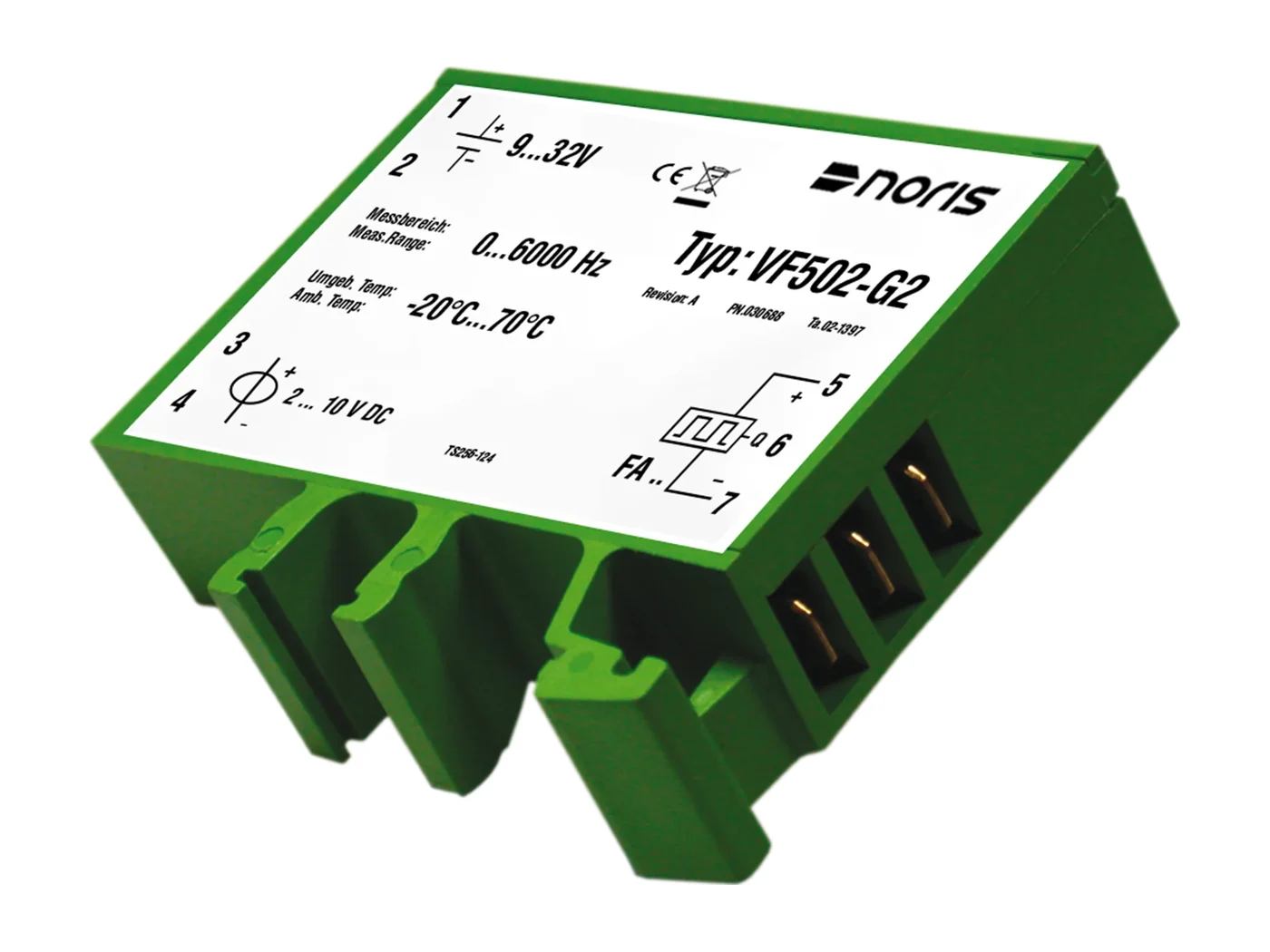
The VF5 is a measuring transducer that converts electrical frequency values in the form of square-wave signals into standardised analogue output signals. Its typical source is a speed sensor delivering a frequency proportional to rotational speed; the VF5 turns that frequency into a linear voltage or current that a controller or display can process directly. The series is designed for the shipbuilding industry, marine applications, machine controllers and other harsh environments.
The transducer receives the frequency signal, processes it and outputs a standard signal proportional to the input. Galvanic isolation is provided between the sensor input, the operating voltage and the output. The upper end of the measuring range can be fine-adjusted with a sealed, integrated trimming potentiometer, and an integrated LED indicates operating status.
Three input frequency ranges are available: VF500 covers 10–100 Hz with an end value adjustable between 50 and 100 Hz, VF501 covers 20–1,000 Hz with an end value of 100 to 1,000 Hz, and VF502 covers 200–10,000 Hz with an end value of 1,000 to 10,000 Hz. A custom upper-range frequency can be specified. Each range is offered with four output versions: 0–10 V (G1), 2–10 V (G2), 0–20 mA (I1) and 4–20 mA (I2). Voltage outputs are short-circuit proof with a maximum load current of 20 mA; current outputs accept a load resistance of 0 to 500 Ω.
The unit operates from 9 to 32 VDC. Electrical connection is by gold-plated DIN EN 46244 tab connectors (A6.3 × 0.8). The compact body, 70 × 46 × 17.5 mm and 55 g, allows side-by-side snap-fit mounting on TS32 G-rail or TS35 top-hat rail in any position. The housing is made of flame-inhibiting, self-extinguishing thermoplastic polyester to fire protection class V0, with IP20/IP00 protection. Operating temperature is −20 to +70 °C, storage −45 to +85 °C.
The design meets the EMC requirements of IEC 61000-4 and EN 61000-6-2/-4, as well as vibration, shock and climatic tests to IEC 60068 and the requirements of DIN EN 50155. It carries CE marking and type approvals from DNV, BV and LR.
Please state the input frequency range, required end value and output signal when sending your enquiry.
VF500-G1, VF500-G2, VF500-I1, VF500-I2, VF501-G1, VF501-G2, VF501-I1, VF501-I2, VF502-G1, VF502-G2, VF502-I1, VF502-I2
List input types and the destination of each output. Match panel cutout, supply and communication options before choosing a replacement.
For an installed instrument, copy the complete ordering code and its suffixes from the nameplate. Identify the part that will remain in service and the part that needs to be replaced. A photograph of the connection face or terminal markings helps resolve differences between versions that share the same housing.
For a new installation, describe what the instrument must measure or control and where the reading will be used. Give the normal operating conditions separately from short peaks. Include units with every numerical value. A drawing with the available space, orientation and access for removal gives the supplier a practical starting point.
Add the quantity for each position and identify any accessories that belong with it. Where a particular drawing, material certificate or calibration record is required, mention it with the line item. Submit the list with the destination country so that the response can cover the requested configuration and delivery.