Bürkert Fluid Control Systems
Type 8189
Level
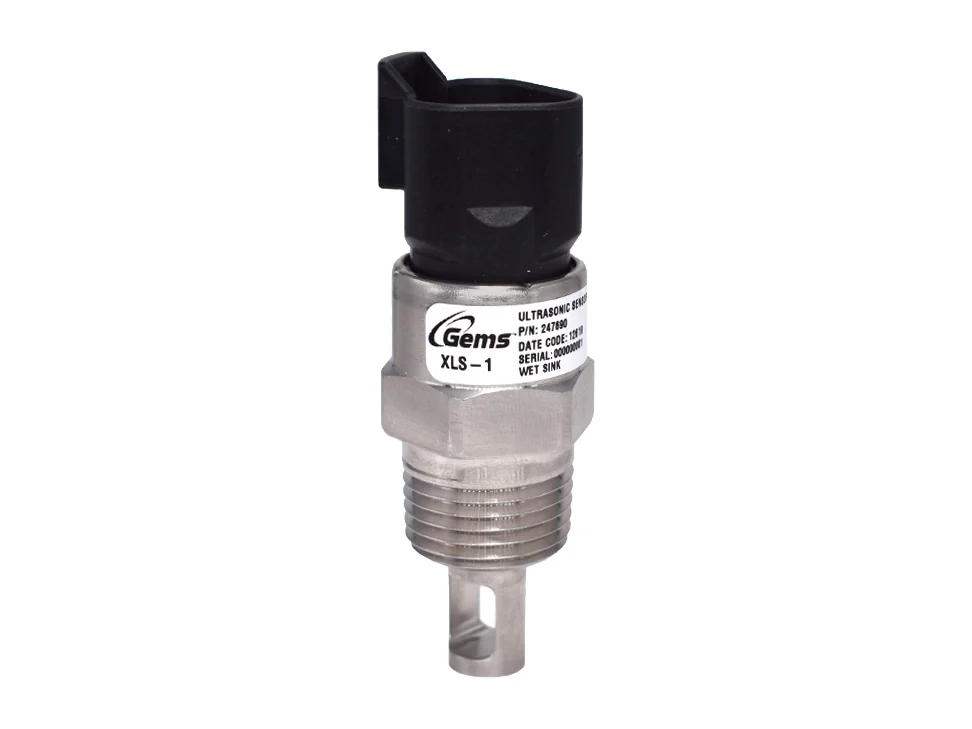
Ultrasonic level transmitters
XLS-1 is an ultrasonic single-point level sensor for non-contact detection of liquid level. It is intended for generators, water tanks, radiators, printers and harsh industrial applications, where it signals whether liquid is present at the sensor position. The sensor ignores condensation on its face and does not detect foam as liquid.
Detection is based on ultrasonic technology and microcontroller-based electronics. The sensor has no moving parts and therefore requires no maintenance. Depending on the liquid level relative to the sensor, it switches an open-collector output. The actuation condition is selected when ordering: the output can be active when the sensor is wet or when it is dry, in sourcing or sinking configuration.
The output is rated 30 V DC and 30 mA maximum, in sinking or sourcing form. Supply voltage is 5–28 V DC or 5–20 V DC, depending on version. The sensor withstands an operating pressure of up to 250 psi and operates from −40 to 125 °C (−40 to 257 °F).
Wetted and housing materials are 316L stainless steel and 30 % glass-filled polyester. A wide choice of mounting threads is available: 1/2"-14 NPT, 1/2"-20 to SAE J1926-3, 1/4"-18 NPT, G1/4 BSPP, M12 × 1.5 to ISO 6149-3 and M12 × 1.0. Electrical connection is by an integral 3-pin DT04-3P connector, a 12-inch three-conductor 18 AWG PVC cable or 12-inch XLPE leads. The unit is rated IP67 to IEC 60529, and the sensor itself IP6K9K to DIN 40050-9. It weighs 227 g.
The sensor is tested for vibration and shock to IEC 60068-2-6, IEC 60068-2-27 and MIL-STD-202G, and for EMC to IEC 61326-1 and EN 61000-4. It carries CE, RoHS and cULus marks. Alternative O-ring materials and versions for qualified OEM volumes are available on request.
Please specify the mounting thread, actuation condition, supply voltage and electrical connection, and we will identify the matching part number for your quotation.
250995, 250870, 250010, 250890, 250825, 250990, 250835, 247760, 247725, 256540, 247680, 251005, 247785, 250940, 247715, 247815, 247765, 250975, 247695, 250935, 251040, 250895, 250920, 247775, 250840, 247670, 247690, 247700, 247660, 247740, 247780, 247800, 247750, 247790, 247810, 247730, 247675, 247745, 247805, 247735, 250015, 250830, 250820, 250850, 250930, 250950, 250970, 251030, 251020, 251050, 251070, 251090, 250845, 250815, 250875, 250925, 250945, 250855, 251035, 251025, 251045, 250915, 250955
Identify the vessel height, nozzle position and surface conditions. A point alarm and a continuous level reading require different outputs.
For an installed instrument, copy the complete ordering code and its suffixes from the nameplate. Identify the part that will remain in service and the part that needs to be replaced. A photograph of the connection face or terminal markings helps resolve differences between versions that share the same housing.
For a new installation, describe what the instrument must measure or control and where the reading will be used. Give the normal operating conditions separately from short peaks. Include units with every numerical value. A drawing with the available space, orientation and access for removal gives the supplier a practical starting point.
Add the quantity for each position and identify any accessories that belong with it. Where a particular drawing, material certificate or calibration record is required, mention it with the line item. Submit the list with the destination country so that the response can cover the requested configuration and delivery.