BAUR
DTL C
Electrical test & measurement
Insulation & earth testers
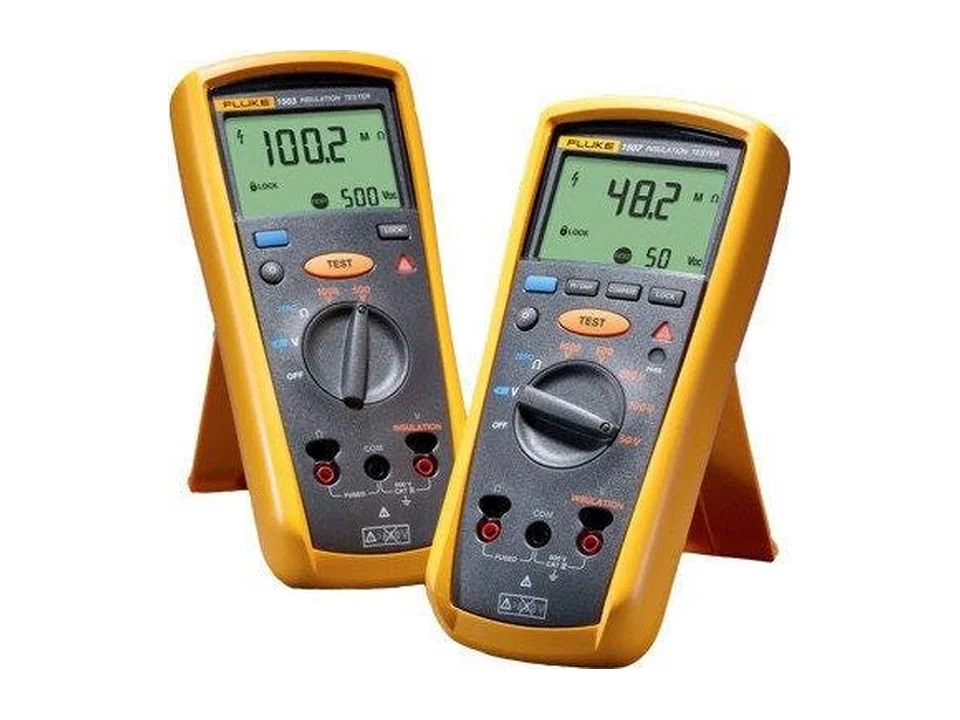
The 1507 is a compact, versatile handheld insulation resistance tester for advanced industrial and electrical insulation testing. It belongs to the 150X series and is intended for electrical contractors and for industrial and commercial electricians who carry out troubleshooting, commissioning and preventative maintenance.
The instrument applies a selectable DC test voltage to the insulation under test and measures the resulting insulation resistance. Five test voltages are available: 50 V, 100 V, 250 V, 500 V and 1000 V. The measuring range extends from 0.01 MΩ to 10 GΩ. For assessing the condition of insulation, the tester automatically calculates the polarisation index and the dielectric absorption ratio. A compare function gives a pass/fail result, which speeds up repetitive tests.
Safety functions are built in. Live circuit detection prevents a test from starting if a voltage above 30 V is present, and capacitive voltage is discharged automatically after the test. The instrument is rated for a maximum of 600 V AC rms or DC on any terminal, CAT IV 600 V up to 2000 m and CAT III 600 V up to 3000 m.
Besides insulation tests, the 1507 measures AC and DC voltage from 0.1 V to 600 V and resistance from 0.01 Ω to 20.00 kΩ. A low-ohm earth bond continuity test with 200 mA covers bonding checks, with an earth bond resistance range of 20.00 Ω to 20.00 kΩ.
The tester is battery-powered and measures 5.0 × 10.0 × 20.3 cm, with a weight of 550 g. It is rated IP40 and operates from −20 to 55 °C; storage is permitted from −40 to 60 °C. It complies with IEC/EN 61010-1 2nd edition, ANSI/ISA 82.02.01, CAN/CSA-C22.2 No. 61010-1-04, MIL-PRF-28800F and EN 61326-1, and carries CSA and TÜV approvals.
A remote test probe is included. Further accessories are test leads, test probes, alligator clips and a magnetic hanging system. Contact us with the required quantity and the accessories you need, and we will prepare a quotation.
1507
Match the instrument to the circuit and measurement category. Include the wiring arrangement and ratios of any external current or voltage transformers.
For an installed instrument, copy the complete ordering code and its suffixes from the nameplate. Identify the part that will remain in service and the part that needs to be replaced. A photograph of the connection face or terminal markings helps resolve differences between versions that share the same housing.
For a new installation, describe what the instrument must measure or control and where the reading will be used. Give the normal operating conditions separately from short peaks. Include units with every numerical value. A drawing with the available space, orientation and access for removal gives the supplier a practical starting point.
Add the quantity for each position and identify any accessories that belong with it. Where a particular drawing, material certificate or calibration record is required, mention it with the line item. Submit the list with the destination country so that the response can cover the requested configuration and delivery.