BAUR
DTL C
Electrical test & measurement
Power quality analysers
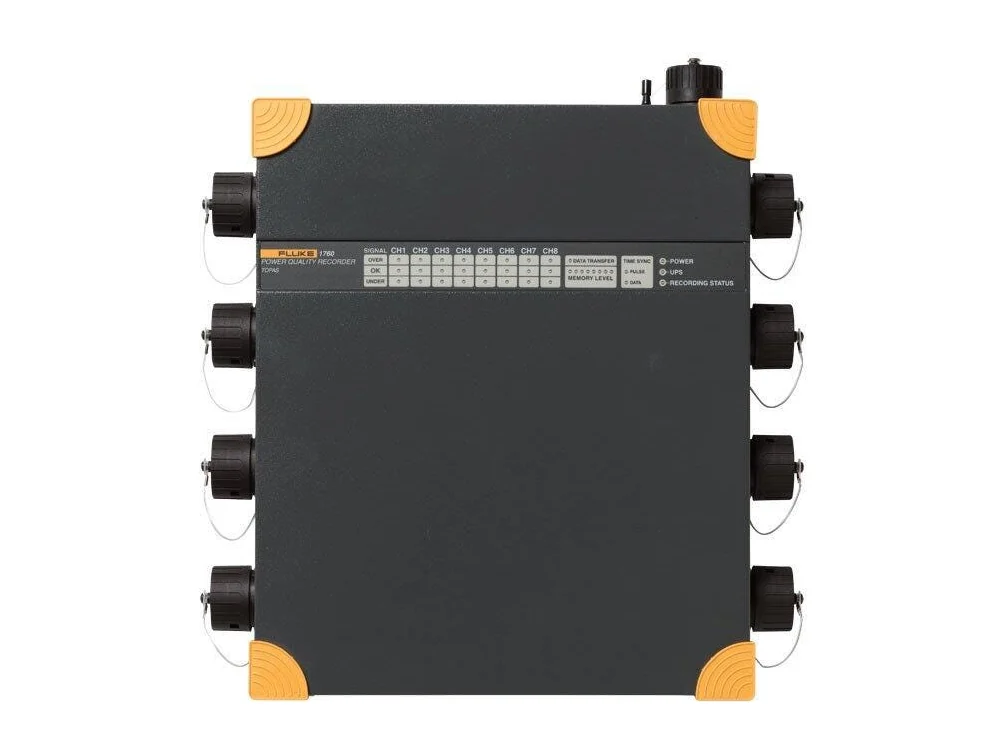
The 1760 is a portable three-phase power quality recorder for utilities, industrial plants and service companies that need detailed, legally defensible analysis of supply quality. It is fully compliant with IEC 61000-4-30 Class A, so measurements of voltage, frequency, unbalance, harmonics and events made by different Class A instruments are directly comparable, and supply quality can be evaluated against EN 50160.
The recorder has eight galvanically isolated inputs that can be configured as four voltage and four current channels or as eight voltage channels. All channels are sampled synchronously by 16-bit converters with a common quartz-controlled clock, after passive low-pass and anti-aliasing filters. Intrinsic uncertainty of voltage measurement is 0.1 %; harmonics up to the 50th order are measured to class I of EN 61000-4-7. Inputs have an impedance of 1 MΩ and 5 pF and withstand 1000 V rms continuously.
Fast phenomena are captured as well. Transients up to 6000 V peak are recorded, and with the fast transient option events up to 10 MHz are sampled. A GPS time synchronisation module stamps all data with absolute time, so events recorded at several locations can be correlated and the source of a disturbance traced through the network.
Data is stored in 2 GB of internal flash memory, enough for long-term recording campaigns. The solid-state design has no moving parts. An internal uninterruptible power supply keeps the recorder running for 40 minutes during an outage, which is essential for recording the outage itself. Communication is via Ethernet and RS-232, and the included analysis software produces statistics, event lists and compliance reports for root-cause analysis.
Voltage is measured with standard 600 V or 1000 V probes or high-voltage dividers; current with clamps, flexible current probes from 100 A to 6000 A, clip-on current transformers or shunts for 20 mA and 5 A secondary circuits. A watertight transit case is available. The recorder is powered with 83–264 V AC or 100–375 V DC and is rated IP40.
Typical applications are quality-of-service compliance measurements, disturbance and fault analysis, power and load studies, harmonic analysis, voltage dip and swell detection and long-term statistical assessment of networks. Please state the network voltage and the current ranges you need, and we will propose a complete set with probes.
1760 Basic, 1760 INTL, 1760 US, 1760TR INTL, 1760TR US, 1760TR Basic, 1760
Match the instrument to the circuit and measurement category. Include the wiring arrangement and ratios of any external current or voltage transformers.
For an installed instrument, copy the complete ordering code and its suffixes from the nameplate. Identify the part that will remain in service and the part that needs to be replaced. A photograph of the connection face or terminal markings helps resolve differences between versions that share the same housing.
For a new installation, describe what the instrument must measure or control and where the reading will be used. Give the normal operating conditions separately from short peaks. Include units with every numerical value. A drawing with the available space, orientation and access for removal gives the supplier a practical starting point.
Add the quantity for each position and identify any accessories that belong with it. Where a particular drawing, material certificate or calibration record is required, mention it with the line item. Submit the list with the destination country so that the response can cover the requested configuration and delivery.