Böning Automationstechnologie GmbH & Co. KG
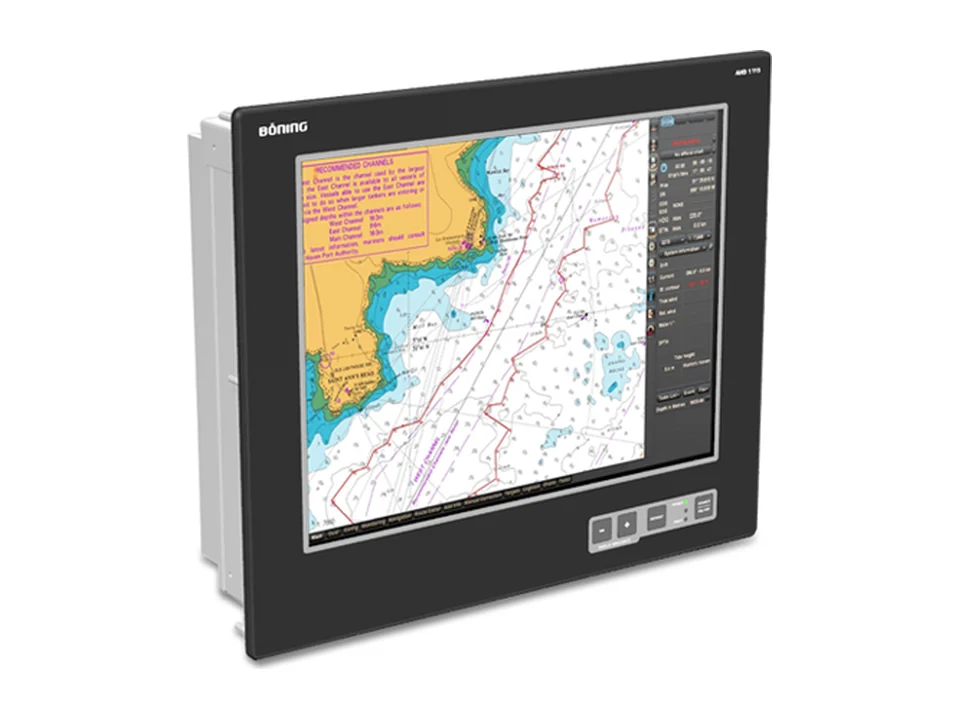
AHD 514 OP / AHD 514 OP B
Industrial automation & edge AI
Programmable logic controllers
The AMC 600 is a modular programmable automation controller (PAC) for robust control in land, marine and wind power applications. It is built from a compact rack fitted with CPU, I/O and communication modules, with EtherCAT-based I/O, so the system can be sized to the number and type of signals in each application.
Racks are available with 4 to 14 module slots, designated Rack6‧4 to Rack6‧14. The CPU module is the PCM6‧1 with a dual-core 1.2 GHz processor or the PCM6‧2 with a quad-core 1.6 GHz processor. The controller runs a Linux-based operating system with the CODESYS V3 runtime, and applications are programmed to IEC 61131-3.
EtherCAT is the native protocol, with a cycle time of 1 ms. Modules can be connected in daisy-chain or star topologies, with redundancy. Further protocols supported are PROFINET, Modbus TCP and Modbus RTU, OPC UA and CAN/CANopen, over Ethernet, CAN, RS-422 and RS-485 interfaces. The I/O range includes digital, analogue, mixed, relay, temperature, interface and communication modules (DIO, DIM, DOM, AIO, AOM, AIM, MIM, ROM, TIM, IFM, CMM).
The system operates from −40 to 70 °C and can be stored from −40 to 85 °C, at altitudes up to 4000 m. Protection is IP30, and the modules are conformal coated for environmental protection. Installation category is III at 600 V, pollution degree 2. Environmental and EMC testing refers to IEC 60068-2-1, -2 and -30, IEC 61000-6-4, IEC 60255-26 and the EN 61000-4 series. The controller is class approved by DNV-GL and LR and carries CE, UKCA and UL marks.
Rack depth is 113.9 mm and height 122.0 mm; length ranges from 182.4 mm for four slots to 436.4 mm for fourteen, with weights from 715 g to 1500 g. Pre-assembled racks are available, and on-site assembly is optional.
Applications named include wind power plants, marine and offshore vessels, data centres, hospitals, telecom, airports, infrastructure and fish farms. Please send an I/O list and the required protocols with your enquiry.
4921260022-R, PCM6‧1, PCM6‧2, SIM6‧1, SIM6‧2, SIM6‧3, SIM6‧4, SIM6‧5, PDM6‧1, PDM6‧2, DIO6‧1, DIO6‧2, DIM6‧1, DIM6‧3, DOM6‧1, DOM6‧3, AIO6‧1, AIO6‧2, AOM6‧2, AIM6‧1, AIM6‧2, MIM6‧1, MIM6‧2, ROM6‧1, ROM6‧2, TIM6‧1, IFM6‧1, IFM6‧2, CMM6‧x
List the field signals, controller family and runtime environment. For edge processing, specify the workload, interfaces and available cabinet space.
For an installed instrument, copy the complete ordering code and its suffixes from the nameplate. Identify the part that will remain in service and the part that needs to be replaced. A photograph of the connection face or terminal markings helps resolve differences between versions that share the same housing.
For a new installation, describe what the instrument must measure or control and where the reading will be used. Give the normal operating conditions separately from short peaks. Include units with every numerical value. A drawing with the available space, orientation and access for removal gives the supplier a practical starting point.
Add the quantity for each position and identify any accessories that belong with it. Where a particular drawing, material certificate or calibration record is required, mention it with the line item. Submit the list with the destination country so that the response can cover the requested configuration and delivery.