Druck
PACE6000-ADC
Calibration
Multifunction process calibrators
The APMC-370 is a modular air pollution multigas calibrator for the manual, remote or automatic calibration of gas analysers. It is used in air pollution monitoring stations, for quality assurance in the laboratory and in the production of gas analysers.
The calibrator produces test gas by dilution: a calibration gas is mixed with zero gas (dilution air) in a defined ratio set by digital thermal mass flow controllers (MFCs), which are factory calibrated. An internal 32-bit CPU controls the flow rates and stores the calibration routines. As an option, a UV tube in a temperature-controlled oven generates ozone for the calibration of ozone analysers.
The calibration gas MFCs cover 5–50 mL/min and 25–250 mL/min, and the zero gas MFC 0.08–5 L/min. MFC accuracy is ±0.8 % of the current value plus ±0.2 % of full scale, with reproducibility below 0.2 % of reading and pressure sensitivity of 0.1 %/bar. The overall system has a reproducibility better than ±2 %, linearity and precision better than 1 %, a control time of 3 to 5 seconds and stability below ±0.1 % FS. The inlet pressure is 2 bar and warm-up time 30 minutes. With the ozone option, concentrations up to about 500 ppb at 1 L/min are generated; the ozone oven can be set from 40 to 75 °C with 0.1 °C accuracy.
Multipoint calibration is supported with eight cycles of up to 20 points each. The unit is operated via a 640 × 480 pixel touch-screen LCD and has an integrated data logger whose data can be transferred via Ethernet.
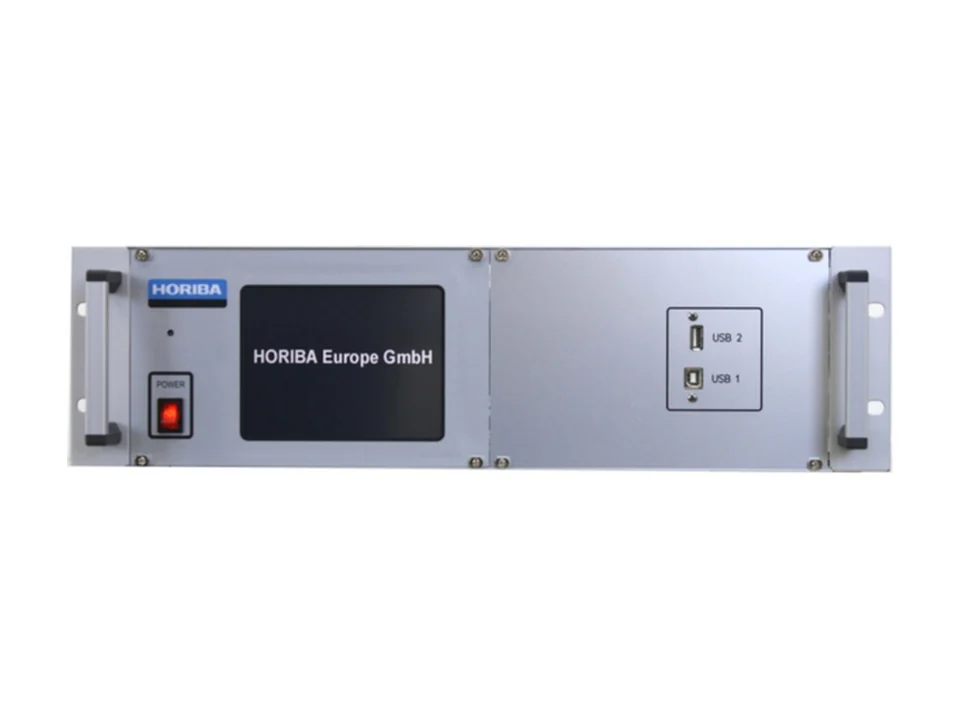
Gas connections are a 3 mm Swagelok-type inlet and a 6 mm PVDF screw outlet. The calibrator is available as a 19-inch rack unit with 3 height units or as a portable version, and it is powered from 110–230 V, 50–60 Hz. It conforms to RoHS, REACH and EMC requirements and to EN norms and US EPA requirements.
Because the design is modular, additional mass flow controllers can be fitted (up to eight in total), together with an ozone oven with UV tube, an internal zero gas calibration system and a permeation oven.
When enquiring, please state the gases and concentration levels to be generated, the number of MFCs, whether ozone generation is required, and the rack or portable version.
Identify the instrument under test and the points to reproduce. State the required uncertainty, reference conditions and certificate format.
For an installed instrument, copy the complete ordering code and its suffixes from the nameplate. Identify the part that will remain in service and the part that needs to be replaced. A photograph of the connection face or terminal markings helps resolve differences between versions that share the same housing.
For a new installation, describe what the instrument must measure or control and where the reading will be used. Give the normal operating conditions separately from short peaks. Include units with every numerical value. A drawing with the available space, orientation and access for removal gives the supplier a practical starting point.
Add the quantity for each position and identify any accessories that belong with it. Where a particular drawing, material certificate or calibration record is required, mention it with the line item. Submit the list with the destination country so that the response can cover the requested configuration and delivery.