Druck
PACE6000-ADC
Calibration
Multifunction process calibrators
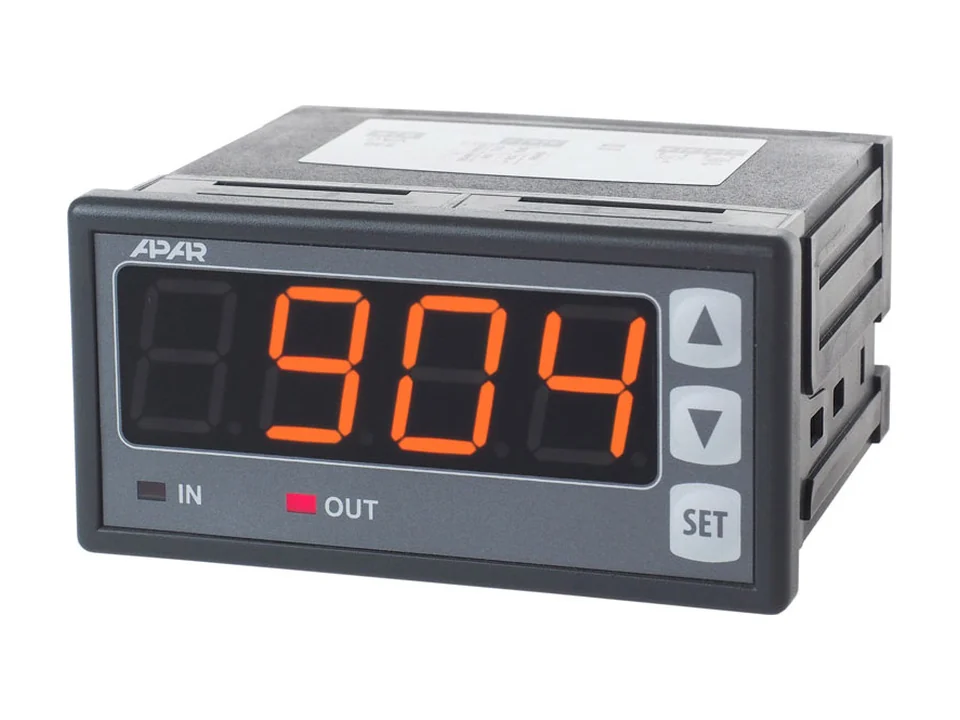
The AR911, AR915.B and AR904.B form a family of portable and panel-mounted signal generators and programming device-meters for testing and simulating industrial process signals. They are used to check devices with current or voltage inputs, for example proportional valves, actuators, inverters, motors, transducers and PLC input cards, and, with the AR915.B, temperature measuring channels.
All three devices work by generating or measuring standard analogue signals. Outputs are programmable, and the devices offer soft start and stop of the output (ramping) as well as triangular waveform generation, so that a connected device can be driven smoothly through its range or cycled repeatedly. Configuration parameters are programmable, and the design is stated to have high resistance to industrial interference.
The AR911 is a handheld programming device-meter with one analogue input/output that works either in setting or in measuring mode. It handles 0/4–20 mA signals as input or as active or passive output and 0/2–10 V signals. Current resolution is 10 µA as standard and up to 2 µA programmable; voltage resolution is 1 mV. The housing is rated IP43 and measures 162 × 89 × 25 mm.
The AR915.B is a maintenance temperature calibrator. It has a universal input/output for Pt100 and Ni100 resistance thermometers, thermocouples of types J, K, S, B, R, T and E and resistance signals. Stated ranges include Pt100 from −100 to 850 °C, Ni100 from −50 to 170 °C, type T from −25 to 350 °C and type J from −40 to 800 °C. It is a handheld unit rated IP43, measuring 136 × 80 × 25 mm.
The AR904.B is a programming device-meter in a 96 × 48 mm panel housing with IP65 front protection. Its programmable analogue input and output can be of voltage or current type, with 0/4–20 mA signals and selectable current change ranges of 3.8–21 mA, 0–21 mA, 21–3.8 mA and 21–0 mA. Input resistance is 47 Ω. It is available with or without an RS-485 interface.
The devices have LCD or seven-segment LED displays, are battery powered (AA cells) or externally supplied, and offer a USB interface with optional RS-485 and Modbus RTU. Weights range from 140 to 230 g. They meet PN-EN 61000-6-2, PN-EN 61000-6-4 and PN-EN 61010-1.
Please indicate which model you need, the signal types and ranges to be simulated or measured, and whether the RS-485 interface is required.
AR911, AR915.B, AR904.B
Identify the instrument under test and the points to reproduce. State the required uncertainty, reference conditions and certificate format.
For an installed instrument, copy the complete ordering code and its suffixes from the nameplate. Identify the part that will remain in service and the part that needs to be replaced. A photograph of the connection face or terminal markings helps resolve differences between versions that share the same housing.
For a new installation, describe what the instrument must measure or control and where the reading will be used. Give the normal operating conditions separately from short peaks. Include units with every numerical value. A drawing with the available space, orientation and access for removal gives the supplier a practical starting point.
Add the quantity for each position and identify any accessories that belong with it. Where a particular drawing, material certificate or calibration record is required, mention it with the line item. Submit the list with the destination country so that the response can cover the requested configuration and delivery.