ifm electronic
LDH313
Gas analysis
Flue gas & emissions analysers
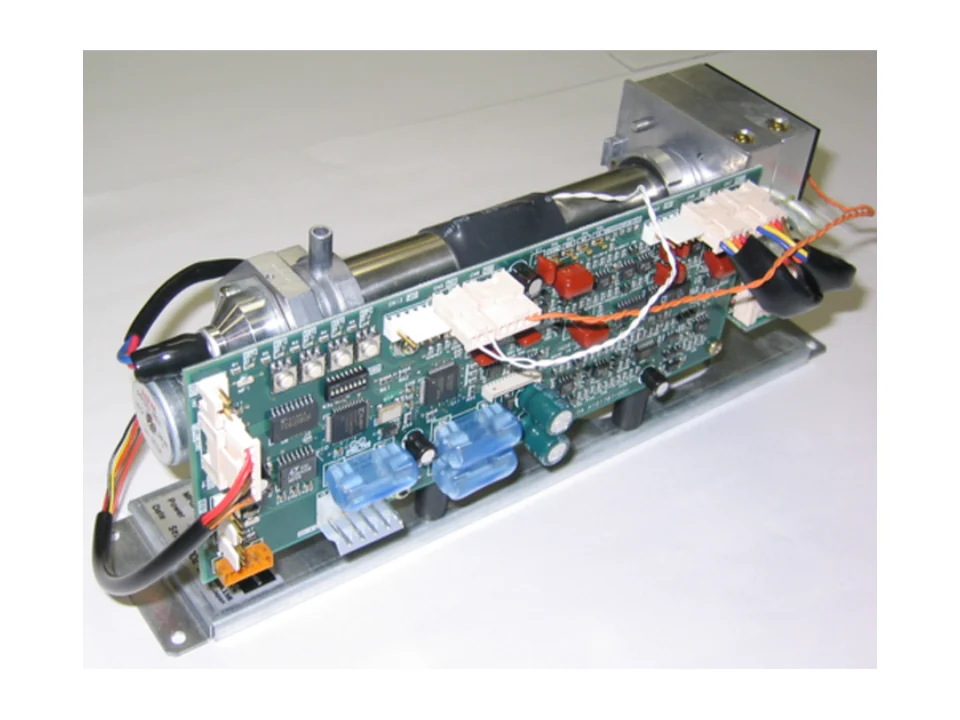
The BE-220FSD is an OEM detector module that measures the concentration of nitric oxide (NO) in automotive exhaust gas. It is supplied for integration by equipment manufacturers into emission analysers used for vehicle inspection and maintenance testing, and it can be connected to the BE-150 bench via a serial line.
The module works on the non-dispersive infrared (NDIR) principle. The sample gas passes through a measuring cell irradiated with infrared light, and the absorption at the wavelength characteristic of NO is evaluated to determine its concentration. The detector delivers the NO value both as digital data and as an analogue voltage.
The measuring range is 0 to 5000 ppm vol with a resolution of 1 ppm vol. The response time is T90 < 4.5 seconds. The sample flow required is 2 to 3 L/min, and the warm-up time after switching on is 15 minutes. The detector meets OIML Class 0 and complies with the BAR-97 and GB18285-2018 specifications for exhaust emission measurement.
For data transfer the module offers an RS-232C digital interface and an analogue output that can be set to 0–5 V or −1.8 to +2.2 V. It requires DC supply voltages of +12 V, −12 V and +5 V.
The unit is compact, measuring 261 mm wide, 73 mm deep and 102 mm high, and weighs approximately 850 g. It conforms to RoHS, REACH and EMC requirements.
As an OEM component, the BE-220FSD is intended for integration into complete systems; it can be combined with the BE-150 bench through its serial interface. For custom solutions or other components, the manufacturer's specialists can be contacted through us.
The applications named for this detector are automotive inspection, maintenance testing and emission gas analysis.
When requesting an offer, please describe the host system in which the module will be integrated, the required output type and the expected quantity.
Identify the target gas, background gas and concentration units. State whether the sampling system is already installed or belongs in the enquiry.
For an installed instrument, copy the complete ordering code and its suffixes from the nameplate. Identify the part that will remain in service and the part that needs to be replaced. A photograph of the connection face or terminal markings helps resolve differences between versions that share the same housing.
For a new installation, describe what the instrument must measure or control and where the reading will be used. Give the normal operating conditions separately from short peaks. Include units with every numerical value. A drawing with the available space, orientation and access for removal gives the supplier a practical starting point.
Add the quantity for each position and identify any accessories that belong with it. Where a particular drawing, material certificate or calibration record is required, mention it with the line item. Submit the list with the destination country so that the response can cover the requested configuration and delivery.