Landis+Gyr
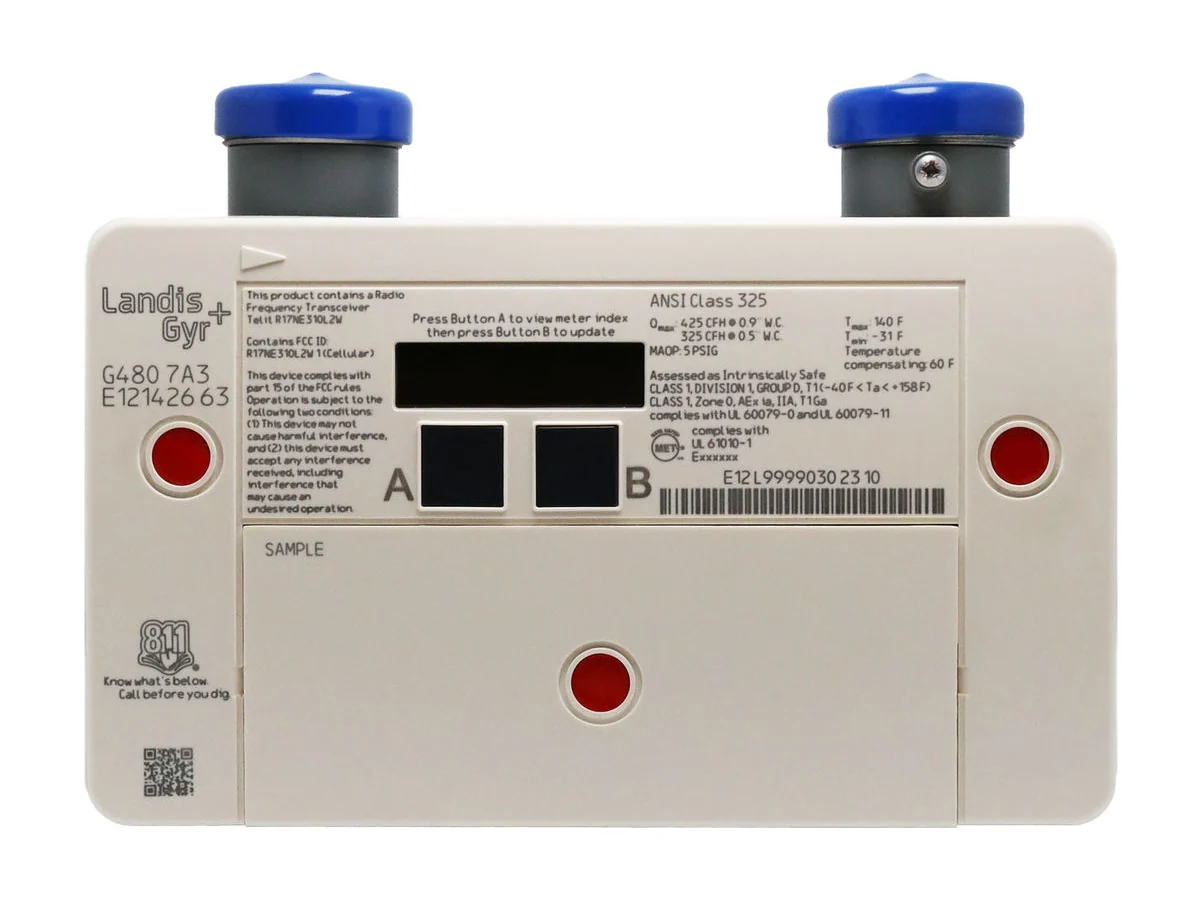
Surent G480
Flow
Turbine & positive displacement meters
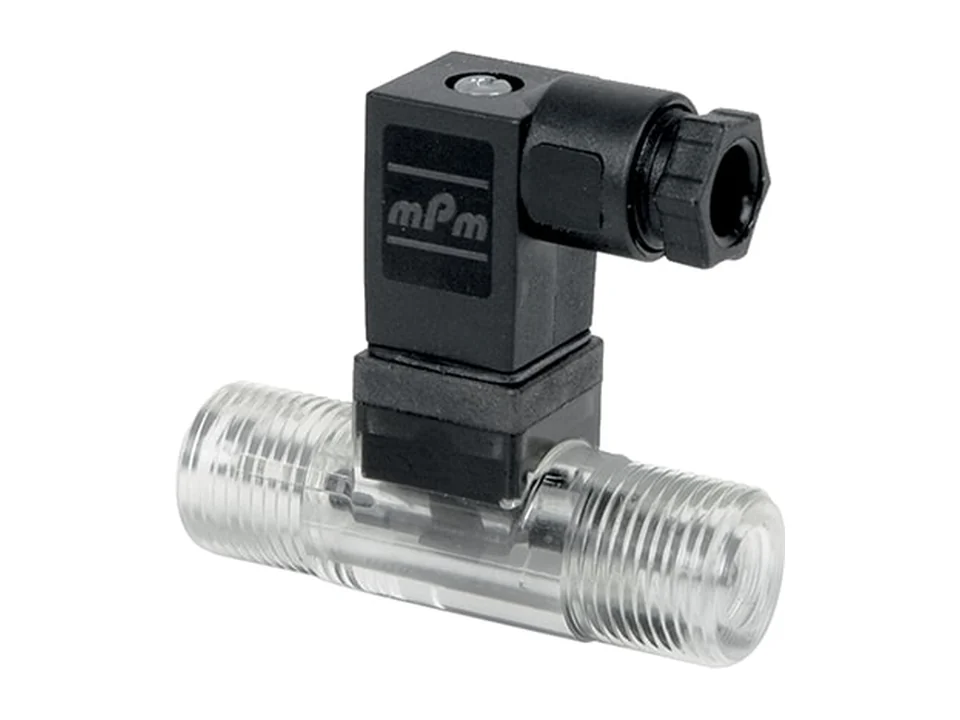
The BV1000, BV2000 and BV3000 are compact turbine flow meters for low-viscosity liquids, both aggressive and non-aggressive. They are designed to be built into machines and systems where space is limited and a reliable pulse signal for flow or dosing is needed. The three sizes share one design: BV1000 with the smallest bore and the highest resolution, BV2000 for the middle range and BV3000 with the largest bore for the highest flow.
The liquid turns a bladed turbine inside the housing. A magnetic pickup senses the rotation and generates pulses at a frequency proportional to the angular velocity of the turbine, and therefore to the flow rate. The output is an NPN open-collector pulse signal, up to 20 mA with an external pull-up resistor, which can be counted directly by a PLC or controller or converted into an analogue value. The meter is supplied with 5 to 24 V DC and draws about 8 mA.
Flow ranges are 0.1–2.5 l/min for BV1000, 0.5–35 l/min for BV2000 and 5–65 l/min for BV3000. Resolution reaches 22,000 pulses per litre for the smallest model, which allows very small volumes to be dosed accurately, and decreases to 210 pulses per litre for BV3000. Accuracy is ±3 % and repeatability better than 0.5 %. Viscosity should be between 0 and 16 cSt, and a 20–40 µm filter upstream is recommended. The meters can be installed in any orientation.
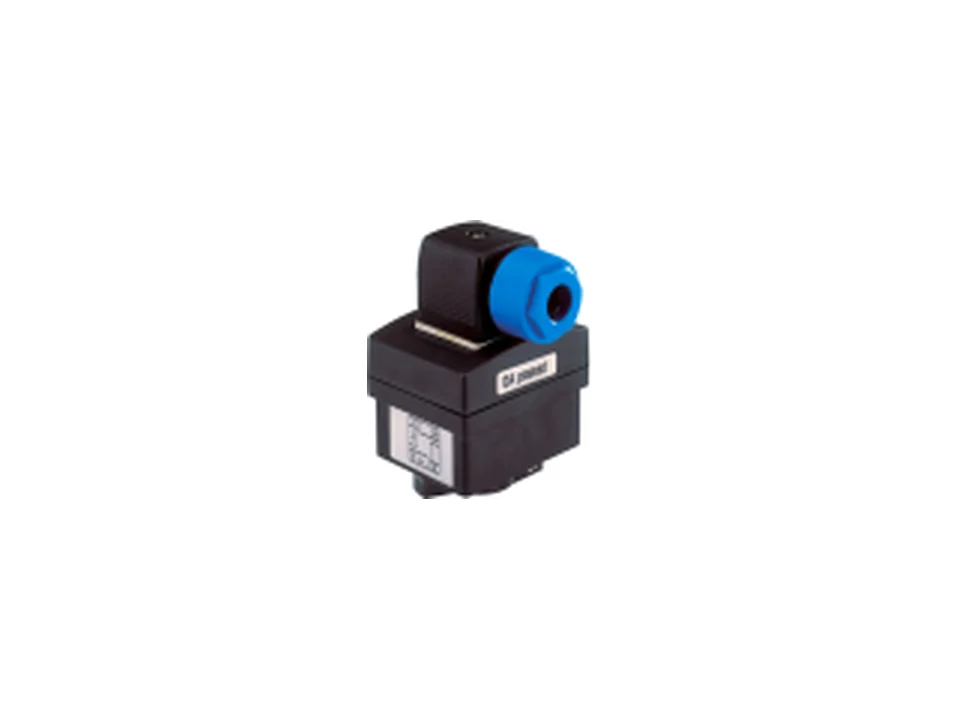
The bodies are made of PA12 (Trogamid) or brass CuZn38Al-C, with graphite/PTFE bearings. Operating pressure is up to 25 bar, burst pressure 200 bar, and the temperature range is −20 to 100 °C. Connections are 1/4, 3/8 or 3/4 in NPT or G threads; the electrical connection is a free cable with three AWG 24 wires or a 3-pin Mini DIN connector. The meters are certified to NSF/ANSI 61 and 372 for drinking water and hold KTW, W270 and FDA conformity, so they can be used with potable water and food.
Typical media are water, demineralised water, alkaline solutions and oils. Applications include coffee and vending machines, dispensers, bakery equipment and steamers; sterilisers, dental and dialysis equipment; dosing and bottling in chemical and pharmaceutical plants; cooling circuits, washing machines, water treatment and solar systems; and fuel consumption measurement in vehicles. Please specify the model, body material, connection and cable or connector version.
BV1000TRN025A, BV1000TRN025B, BV2000TRG050A, BV2000TRG050B, BV2000TRG075A, BV2000TRG075B, BV2000TRG100A, BV2000TRG100B, BV2000TRG150A, BV2000TRG150B, BV2000TRG250A, BV2000TRG250B, BV2000TRG350A, BV2000TRG350B, BV2000TRN050A, BV2000TRN050B, BV2000TRN075A, BV2000TRN075B, BV2000TRN100A, BV2000TRN100B, BV2000TRN150A, BV2000TRN150B, BV2000TRN250A, BV2000TRN250B, BV2000TRN350A, BV2000TRN350B, BV3000TRN650A, BV3000TRN650B
State the minimum, normal and peak flow with units. Pipe bore, fluid properties and the available straight run affect the choice of measuring principle.
For an installed instrument, copy the complete ordering code and its suffixes from the nameplate. Identify the part that will remain in service and the part that needs to be replaced. A photograph of the connection face or terminal markings helps resolve differences between versions that share the same housing.
For a new installation, describe what the instrument must measure or control and where the reading will be used. Give the normal operating conditions separately from short peaks. Include units with every numerical value. A drawing with the available space, orientation and access for removal gives the supplier a practical starting point.
Add the quantity for each position and identify any accessories that belong with it. Where a particular drawing, material certificate or calibration record is required, mention it with the line item. Submit the list with the destination country so that the response can cover the requested configuration and delivery.