Landis+Gyr
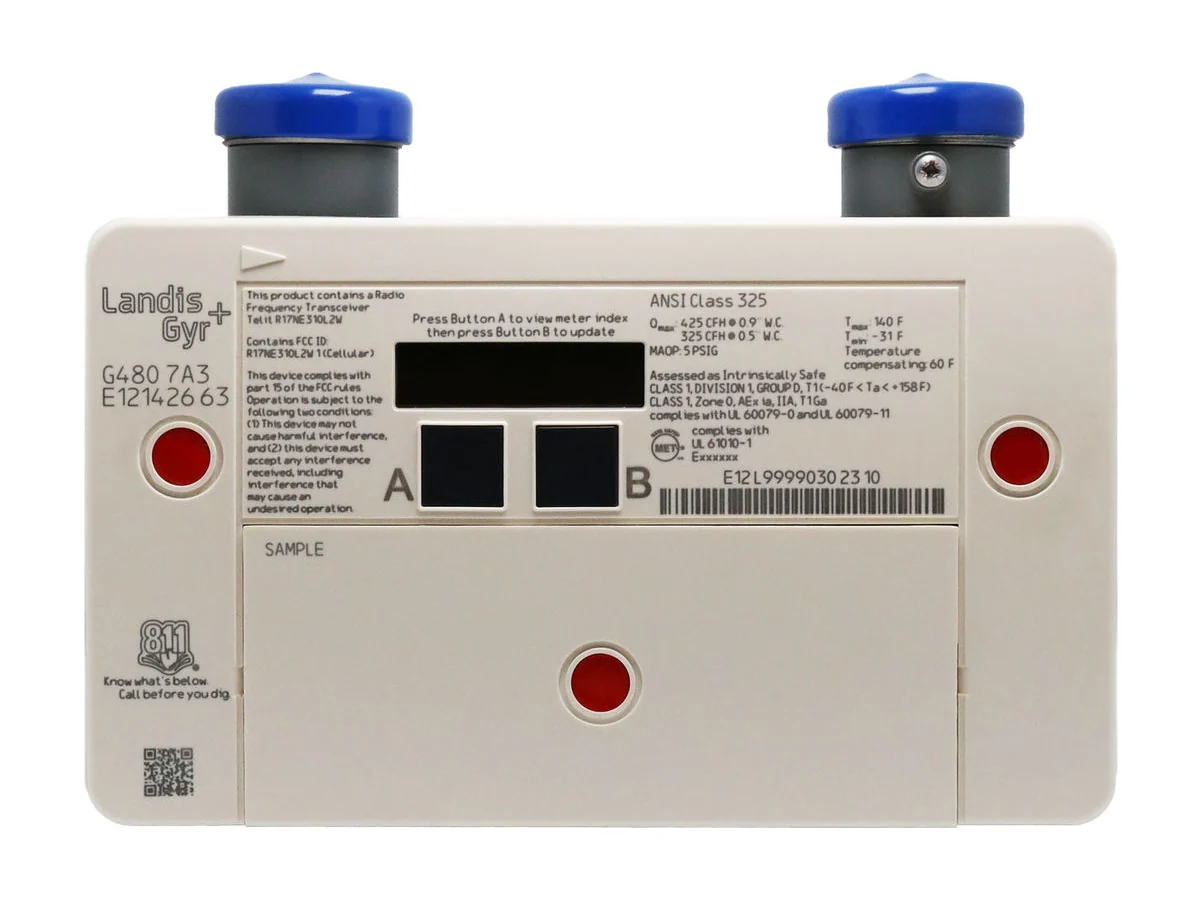
Surent G480
Flow
Vortex flowmeters
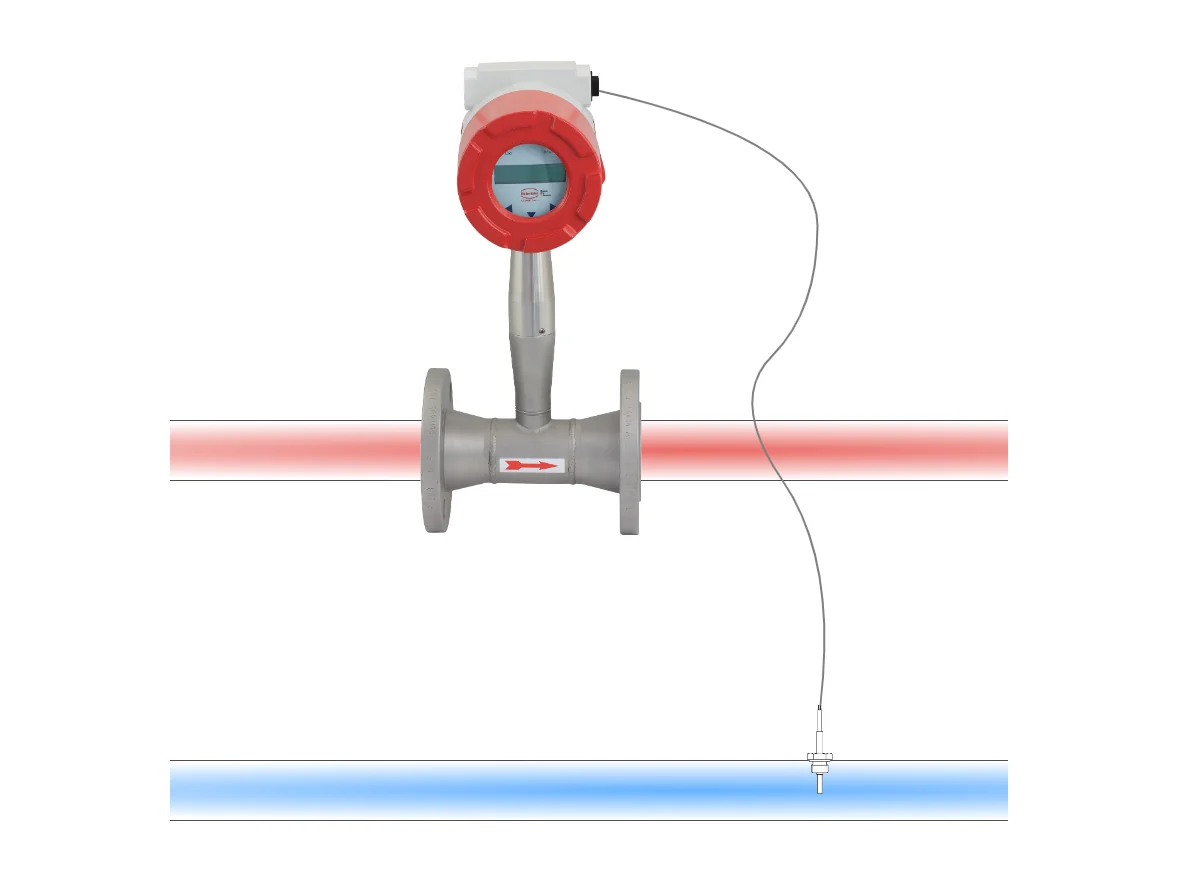
The DVH series is a multivariable inline vortex flow meter for liquids, gases and steam. Three sensing elements are integrated in one instrument: a vortex shedding velocity sensor, an RTD temperature sensor and a solid-state pressure transducer. Measuring all three at a single location allows the meter to calculate mass flow, density and energy consumption directly and to compensate for changes in process conditions.
In a vortex meter, a bluff body in the flow sheds vortices alternately on both sides at a frequency proportional to the flow velocity; the sensor counts these vortices. From velocity, the DVH derives volume flow; with temperature and pressure it computes density and mass flow, and for steam and hot water it can monitor energy. The sensor is of fully welded design for durability.
Accuracy for volume flow is ±0.7 % of rate for liquids and ±1 % for gas and steam; for mass flow ±1 % (liquid) and ±1.5 % (gas and steam). Temperature is measured to ±1 °C and pressure to ±0.3 % of full scale; density accuracy is ±0.3 % of rate for liquids and ±0.5 % for gas and steam. The response time is adjustable from 1 to 100 s.
The standard version handles process temperatures from −40 to 260 °C, and a high-temperature version reaches 400 °C. Maximum operating pressure is 100 bar absolute (1500 psia). Ambient temperature range is −40 to 60 °C. Pipe sizes from DN15 (1/2″) to DN200 (8″) are covered, with flange or wafer mounting.
Outputs are 4–20 mA, a solid-state alarm relay (40 V DC) and a 50 ms totaliser pulse (40 V DC), and HART and Modbus communication are available. Power supply options are 12–36 V DC in 2-wire or 4-wire connection and 100–240 V AC, 50/60 Hz. The meter carries ATEX (II 2 G Ex d IIB + H2 T6; II 2 D Ex tD A21 IP66 T85 °C), IECEx and FM approvals (Class I, Div. 1, Groups B, C, D; Class II/III, Div. 1, Groups E, F, G), with IP66 / Type 4X protection.
Four models are offered: DVH-V for volume flow, DVH-T with integrated temperature, DVH-P multivariable and DVH-M for energy monitoring. Typical applications are chemical and pharmaceutical manufacturing, steam generators and hydroelectric plants, water management and wastewater treatment, and energy monitoring of steam and hot water. Please send the medium, flow range, pressure, temperature and pipe size with your enquiry.
DVH, DVH-V, DVH-T, DVH-P, DVH-M
State the minimum, normal and peak flow with units. Pipe bore, fluid properties and the available straight run affect the choice of measuring principle.
For an installed instrument, copy the complete ordering code and its suffixes from the nameplate. Identify the part that will remain in service and the part that needs to be replaced. A photograph of the connection face or terminal markings helps resolve differences between versions that share the same housing.
For a new installation, describe what the instrument must measure or control and where the reading will be used. Give the normal operating conditions separately from short peaks. Include units with every numerical value. A drawing with the available space, orientation and access for removal gives the supplier a practical starting point.
Add the quantity for each position and identify any accessories that belong with it. Where a particular drawing, material certificate or calibration record is required, mention it with the line item. Submit the list with the destination country so that the response can cover the requested configuration and delivery.