Bürkert Fluid Control Systems
Type 8189
Level
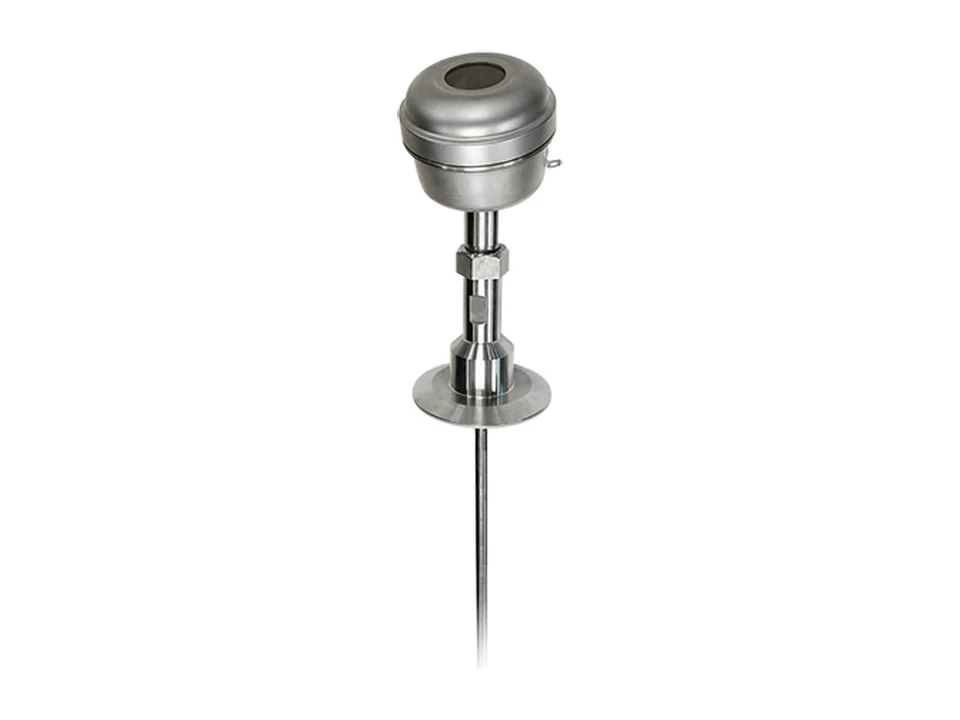
Radar level transmitters
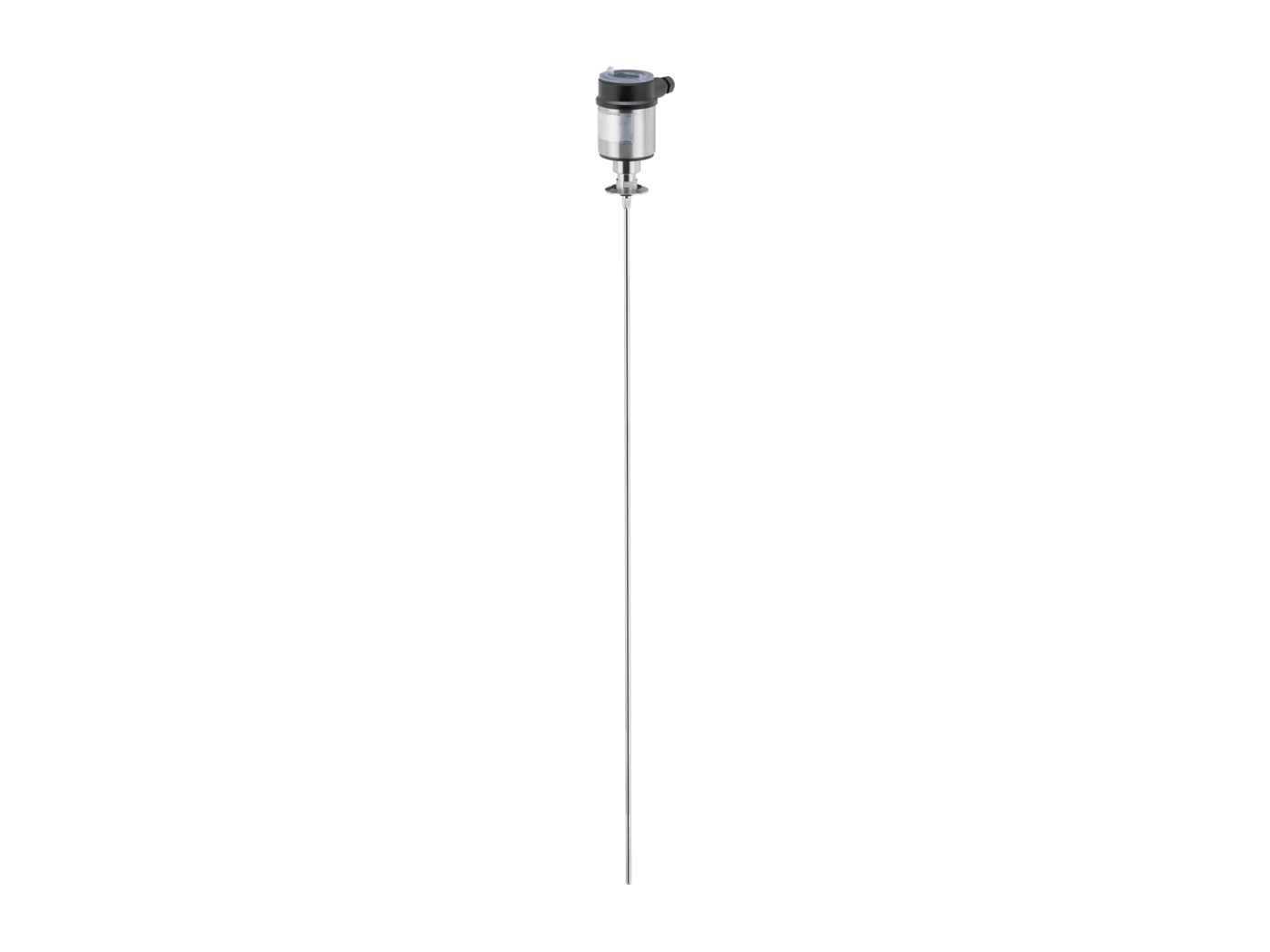
The Eclipse Model 706 for hygienic applications is a loop-powered, 24 VDC guided wave radar (GWR) level transmitter. It is used in the chemical, life science and food and beverage industries, for example on demineralisation tanks, fermenter anti-foam vessels, high fructose corn syrup storage, liquid cream cheese reservoirs and spirit storage.
The transmitter works on the principle of time domain reflectometry (TDR). Electromagnetic pulses are propagated along a waveguide – the probe – and are reflected at the surface of the medium. The transit time of the reflected pulse is measured and converted into the level. The design allows measurement of media with low dielectric constants down to εr 1.2; the configuration distinguishes the dielectric ranges below 1.7, 1.7 to 3.0, 3.0 to 10 and above 10.
Probe lengths from 12 inches to 20 feet (30 cm to 6 m) are available. For hygienic duty the 7yH single hygienic probe with Tri-Clamp connection is used; the probe design is certified by TNO to EHEDG Type EL Class 1. A quick-release probe coupling simplifies installation and removal; the recommended tightening torque is 45 ft-lb (60 Nm). A Model 705 adapter is available.
The output is 4–20 mA with HART communication, and a minimum current of 23 mA is specified. Besides level, a volumetric output can be generated from a 30-point strapping table. The electronics sit in a single-compartment 304 stainless steel housing with a graphic LCD and an intuitive keypad interface. Configuration from a PC is supported through FDT/DTM and PACTware. The transmitter can be mounted integrally on the probe or remotely, with remote distances of 3 ft or 12 ft.
Approvals include intrinsic safety (Ex ia) to ATEX, IEC and CCOE, FM and CSA intrinsically safe and non-incendive, EAC (GOST) for Ex and metrology, and PESO. The device is SIL 2/3 certified and conforms to the Pressure Equipment Directive 2014/68/EU and Part 15 of the FCC rules.
When requesting an offer, please state the medium and its dielectric constant, the tank height and required probe length, the process connection, integral or remote mounting and the approvals needed.
57-643
Identify the vessel height, nozzle position and surface conditions. A point alarm and a continuous level reading require different outputs.
For an installed instrument, copy the complete ordering code and its suffixes from the nameplate. Identify the part that will remain in service and the part that needs to be replaced. A photograph of the connection face or terminal markings helps resolve differences between versions that share the same housing.
For a new installation, describe what the instrument must measure or control and where the reading will be used. Give the normal operating conditions separately from short peaks. Include units with every numerical value. A drawing with the available space, orientation and access for removal gives the supplier a practical starting point.
Add the quantity for each position and identify any accessories that belong with it. Where a particular drawing, material certificate or calibration record is required, mention it with the line item. Submit the list with the destination country so that the response can cover the requested configuration and delivery.