Landis+Gyr
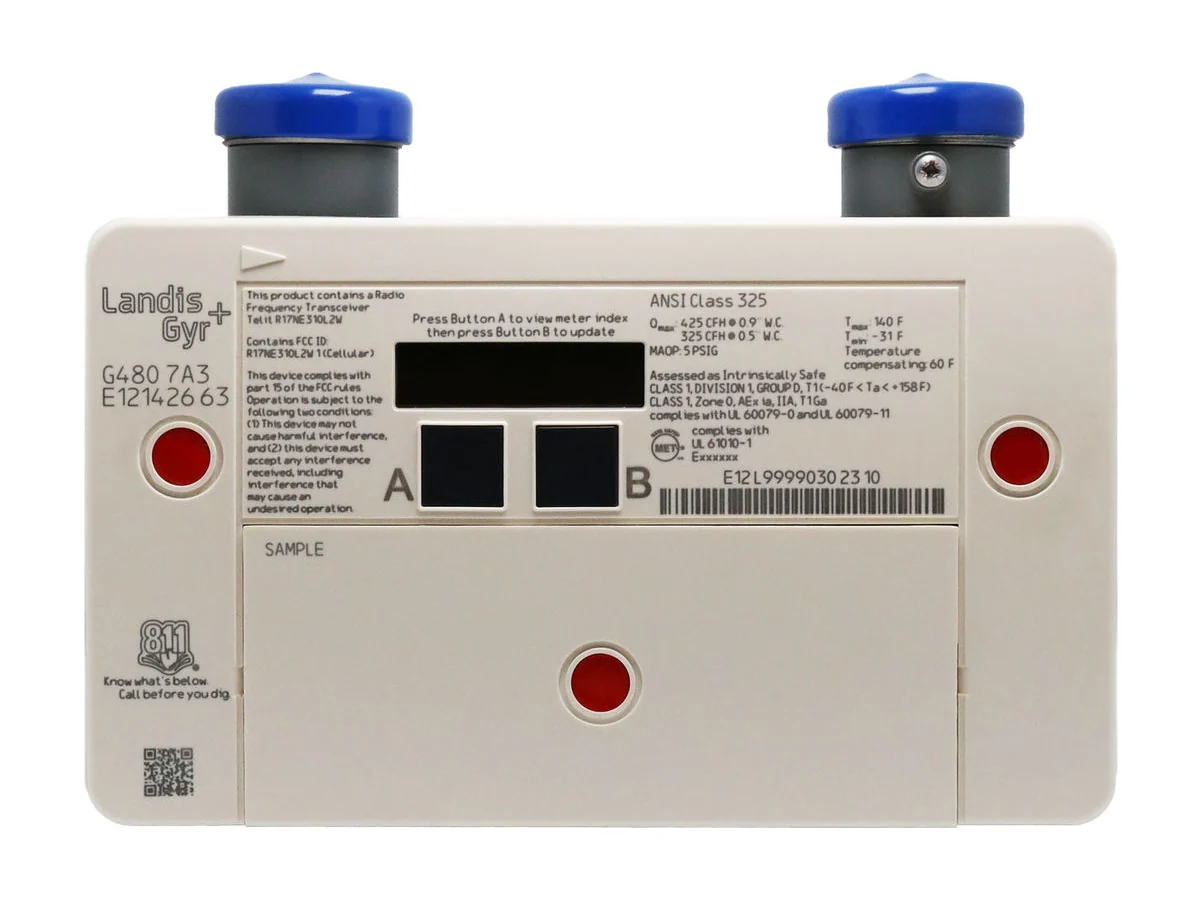
Surent G480
Flow
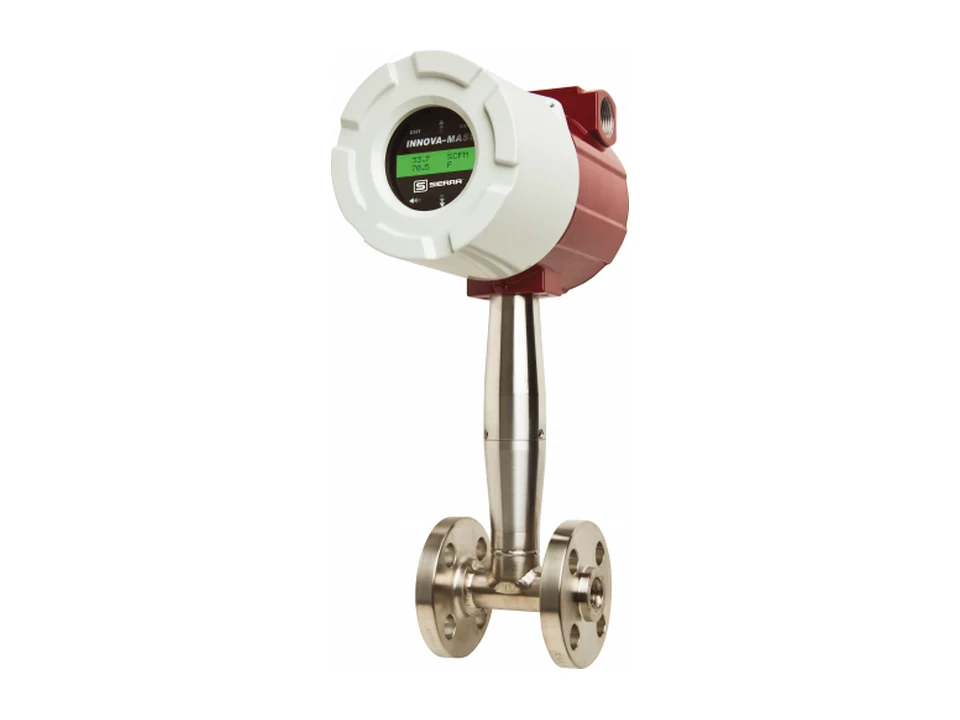
Vortex flowmeters
InnovaMass 240S is a multivariable vortex flow meter for saturated and superheated steam, gases and liquids. With a single process connection it measures five variables at the same time: mass flow, volumetric flow, temperature, pressure and density.
A bluff body in the flow generates vortices whose frequency is proportional to the flow velocity. The meter detects this frequency and combines it with the integrated temperature and pressure measurements to calculate density and mass flow. The flow body is all-welded from 316 stainless steel without gaskets, so there are no leak paths, and the meter has no moving parts.
Accuracy for mass flow is ±1 % of reading for liquids and ±1.5 % for gas and steam; for volumetric flow ±0.7 % and ±1 % respectively. Repeatability is ±0.2 % for mass and ±0.1 % for volume. Temperature is measured to ±0.1 °C, pressure to ±0.05 % of full scale and density to ±0.1 % of reading. The meter can be ranged down to a Reynolds number of 5000. Velocity ranges are 0.3 to 9.1 m/s for liquids and 3 to 91 m/s for gas and steam. Standard process temperature is −200 to 260 °C, and a high-temperature version reaches 400 °C.
Inline versions are available for pipe sizes from 0.5 to 8 inches, including reducer versions, and an insertion probe version covers large pipes up to 72 inches. The electronics provide a flow totaliser, alarms and energy (BTU) monitoring for real-time consumption of steam and heating systems. The meter is loop-powered or supplied with 100–240 V AC or DC and communicates via RS-485, Modbus RTU, HART or BACnet. It is configured and validated in the field. Housings are rated IP66 / NEMA 4X, and versions are approved to FM, CSA, ATEX and IECEx for hazardous areas.
Typical applications are steam metering and energy monitoring in power and energy plants, facilities management, petrochemical plants, mining and materials, pulp and paper, and other hazardous areas. Please state the fluid, pipe size, pressure, temperature and required output so that the meter can be sized.
240S, 241S
State the minimum, normal and peak flow with units. Pipe bore, fluid properties and the available straight run affect the choice of measuring principle.
For an installed instrument, copy the complete ordering code and its suffixes from the nameplate. Identify the part that will remain in service and the part that needs to be replaced. A photograph of the connection face or terminal markings helps resolve differences between versions that share the same housing.
For a new installation, describe what the instrument must measure or control and where the reading will be used. Give the normal operating conditions separately from short peaks. Include units with every numerical value. A drawing with the available space, orientation and access for removal gives the supplier a practical starting point.
Add the quantity for each position and identify any accessories that belong with it. Where a particular drawing, material certificate or calibration record is required, mention it with the line item. Submit the list with the destination country so that the response can cover the requested configuration and delivery.