Bürkert Fluid Control Systems
Type 8189
Level
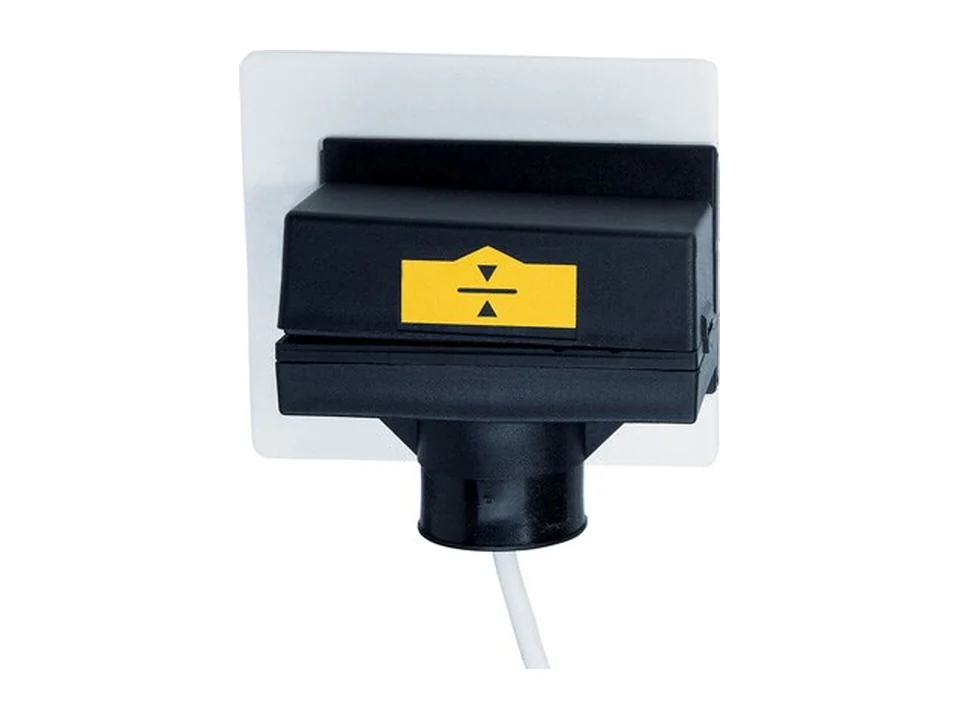
Capacitive level sensors
The LVP51 series are non-intrusive RF capacitance sensors for detecting liquid through the wall of a plastic or fibreglass tank. The sensor is fixed to the outside of the vessel, so no opening has to be made and the sensor never touches the liquid. This makes it suitable for level detection in non-metallic tanks and for sanitary and ultrapure processes, where any penetration of the vessel is undesirable.
The sensor generates a high radio-frequency signal from an exterior electrode. When liquid is present behind the tank wall, the dielectric value seen by the electrode changes, and the electronics detect this change. Liquids with dielectric constants between 10 and 80 at 1 MHz can be detected, through walls up to 1 in (25.4 mm) thick.
After mounting, the switch is calibrated to the particular tank wall and liquid. An LED gives feedback during calibration and afterwards shows the liquid status, so the function can be checked at a glance. The output is an SPST relay rated 1 A at 60 or 120 V AC/DC, which can be set as normally open or normally closed to match the alarm or control logic.
The sensor is powered from 12 to 30 V DC and draws 25 mA. Wiring is 22 AWG, and extended cable lengths of 25 ft and 50 ft are available. The enclosure is rated IP65 / NEMA 4, the sensor operates down to −40 °C and it is CE marked. Materials include plastic and polysulfone.
Installation uses a weld-on fitting attached to the tank with an engineered adhesive; the electrical connection enters through a 1/2″ NPT conduit entrance. Mounting fittings in polyethylene (PE) or polypropylene (PP) are available as LVP-91 and LVP-92, so the fitting can be matched to the tank material.
Please tell us the tank material and wall thickness, the liquid to be detected, the required switching logic and cable length when you request a quotation.
LVP-51-R, LVP-91, LVP-92
Identify the vessel height, nozzle position and surface conditions. A point alarm and a continuous level reading require different outputs.
For an installed instrument, copy the complete ordering code and its suffixes from the nameplate. Identify the part that will remain in service and the part that needs to be replaced. A photograph of the connection face or terminal markings helps resolve differences between versions that share the same housing.
For a new installation, describe what the instrument must measure or control and where the reading will be used. Give the normal operating conditions separately from short peaks. Include units with every numerical value. A drawing with the available space, orientation and access for removal gives the supplier a practical starting point.
Add the quantity for each position and identify any accessories that belong with it. Where a particular drawing, material certificate or calibration record is required, mention it with the line item. Submit the list with the destination country so that the response can cover the requested configuration and delivery.