ifm electronic
VVB3
Mechanical & physical measurement
Humidity & air temperature
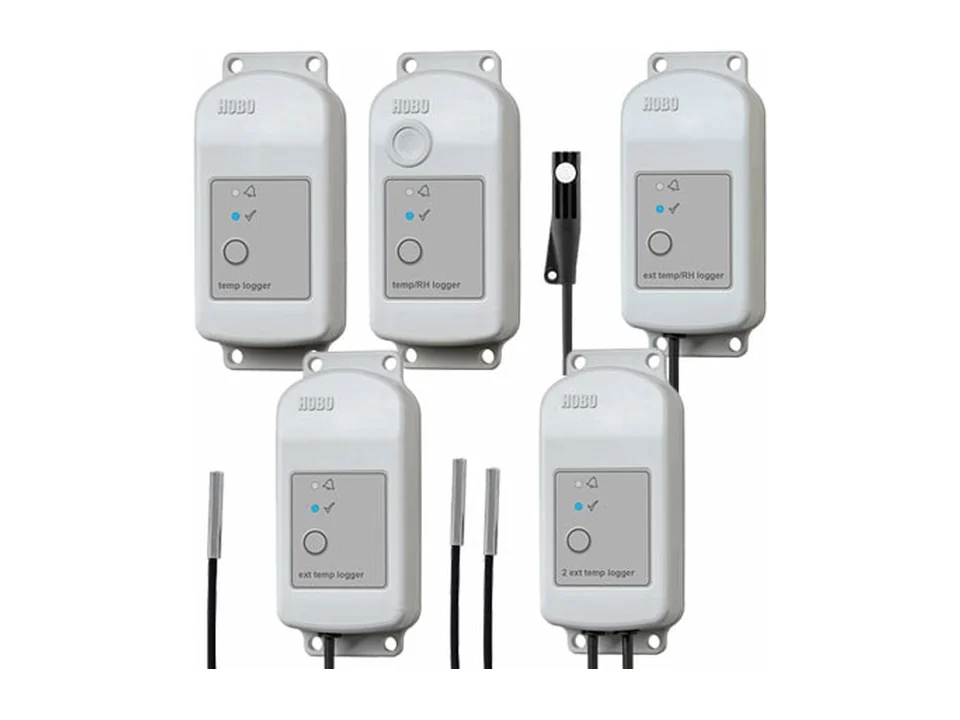
The MX2300 series are weatherproof data loggers with Bluetooth Low Energy (BLE) for outdoor temperature and humidity monitoring. They are set up and read out wirelessly from a mobile device, so no laptop or data shuttle needs to be taken into the field.
The loggers record measurements at a selectable interval from 1 second to 18 hours and store up to 84,650 measurements in 128 KB of internal memory. Data is transmitted over BLE up to 30.5 m (100 ft) line of sight to compatible iOS mobile devices running the mobile app, which is also used for configuration. The app requires iOS 8.3, 8.4 or 9.0 and Bluetooth 4.0 or later.
The temperature measuring range is −40 to 100 °C with an accuracy of ±0.2 °C. Models with humidity sensing cover 0 to 100 % RH with an accuracy of ±2.5 % RH. The loggers operate from −40 to 70 °C.
Power is supplied by a 2/3 AA lithium battery with a typical life of two years. The housing is weatherproof to IP67 and NEMA Type 6, and the loggers are suitable for outdoor and condensing environments. They are mounted on a wall or other flat surface. Each logger measures 10.8 × 5.08 × 2.24 cm and weighs 2.66 oz. CE and RoHS conformity is stated.
Five models differ by sensor type. MX2301A has internal temperature and RH sensors, MX2302A has an external temperature/RH sensor, MX2303 has two external temperature sensors, MX2304 has a single external temperature sensor and MX2305 measures internal temperature only.
Applications named for the series are outdoor temperature monitoring, combined temperature and humidity logging, agricultural research, forest ecology studies and monitoring of soil, water and wall conditions. Please tell us which measurements you need, whether internal or external sensors are required and how many loggers you plan to install, and we will confirm the right models.
MX2301A, MX2302A, MX2303, MX2304, MX2305
Include the sensing target, mounting clearance and direction of travel or force. Record the connector pinout from the existing device.
For an installed instrument, copy the complete ordering code and its suffixes from the nameplate. Identify the part that will remain in service and the part that needs to be replaced. A photograph of the connection face or terminal markings helps resolve differences between versions that share the same housing.
For a new installation, describe what the instrument must measure or control and where the reading will be used. Give the normal operating conditions separately from short peaks. Include units with every numerical value. A drawing with the available space, orientation and access for removal gives the supplier a practical starting point.
Add the quantity for each position and identify any accessories that belong with it. Where a particular drawing, material certificate or calibration record is required, mention it with the line item. Submit the list with the destination country so that the response can cover the requested configuration and delivery.