BAUR
DTL C
Electrical test & measurement
Power quality analysers
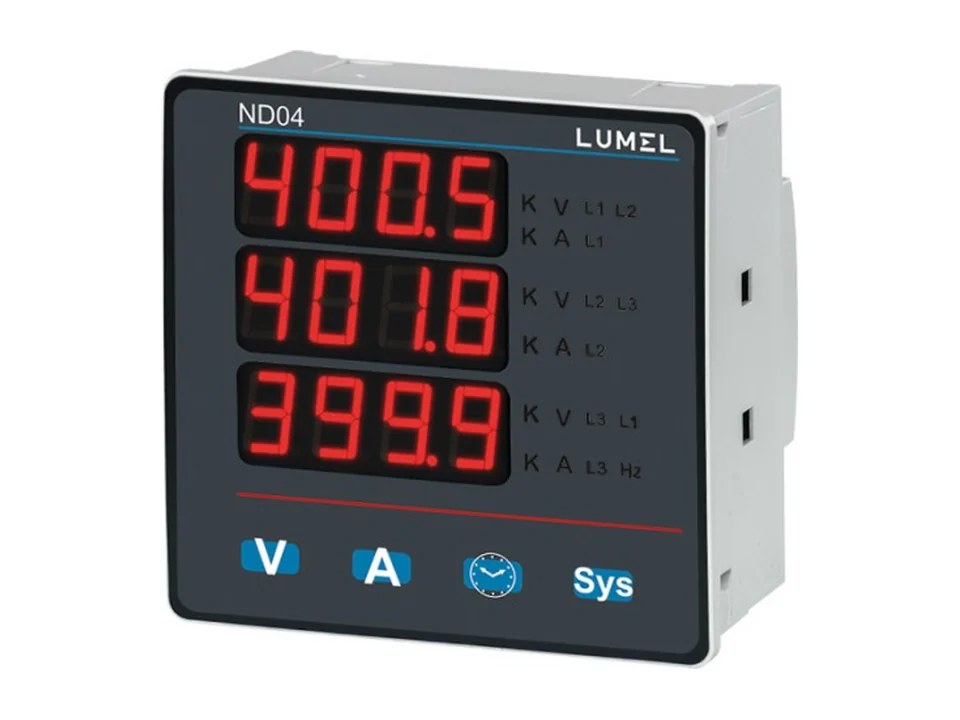
The ND04 is a power network meter for measuring the basic network parameters of single-phase networks and three-phase networks with three or four wires. It shows the measured values locally on a bright LED display and is adapted to the installation on site, without hardware changes.
Measurement is true RMS and includes harmonic content up to the 15th harmonic. A true RMS meter calculates the effective value of the actual waveform instead of assuming a pure sine wave, so voltage and current readings stay correct when the waveform is distorted.
Stated accuracy is ±1 % of range for voltage in the band from 20 to 100 % of the nominal value, ±1 % of range for current from 10 to 100 % of the nominal value, and ±0.5 % of the mid frequency for frequency.
The user selects the network type, three-phase 3-wire or 4-wire, directly on the meter. Ratios of voltage and current transformers (PT/CT) and the ranges of the inputs are also programmed on site, so one meter can be used with different transformer sets and nominal values.
Values are shown on a three-line, four-digit ultra-bright LED display with readings up to 9999, so three parameters are visible at the same time. The user can choose on site whether the display scrolls automatically through the parameters or stays on a fixed screen. The meter stores the minimum and maximum values of the measured parameters, so extreme values can be reviewed later.
The ND04 is rail mounted and is supplied with an EU Declaration of Conformity.
When requesting a quotation, please state the network type, the nominal voltage and current, the transformer ratios to be programmed and the number of meters required.
Match the instrument to the circuit and measurement category. Include the wiring arrangement and ratios of any external current or voltage transformers.
For an installed instrument, copy the complete ordering code and its suffixes from the nameplate. Identify the part that will remain in service and the part that needs to be replaced. A photograph of the connection face or terminal markings helps resolve differences between versions that share the same housing.
For a new installation, describe what the instrument must measure or control and where the reading will be used. Give the normal operating conditions separately from short peaks. Include units with every numerical value. A drawing with the available space, orientation and access for removal gives the supplier a practical starting point.
Add the quantity for each position and identify any accessories that belong with it. Where a particular drawing, material certificate or calibration record is required, mention it with the line item. Submit the list with the destination country so that the response can cover the requested configuration and delivery.