BAUR
DTL C
Electrical test & measurement
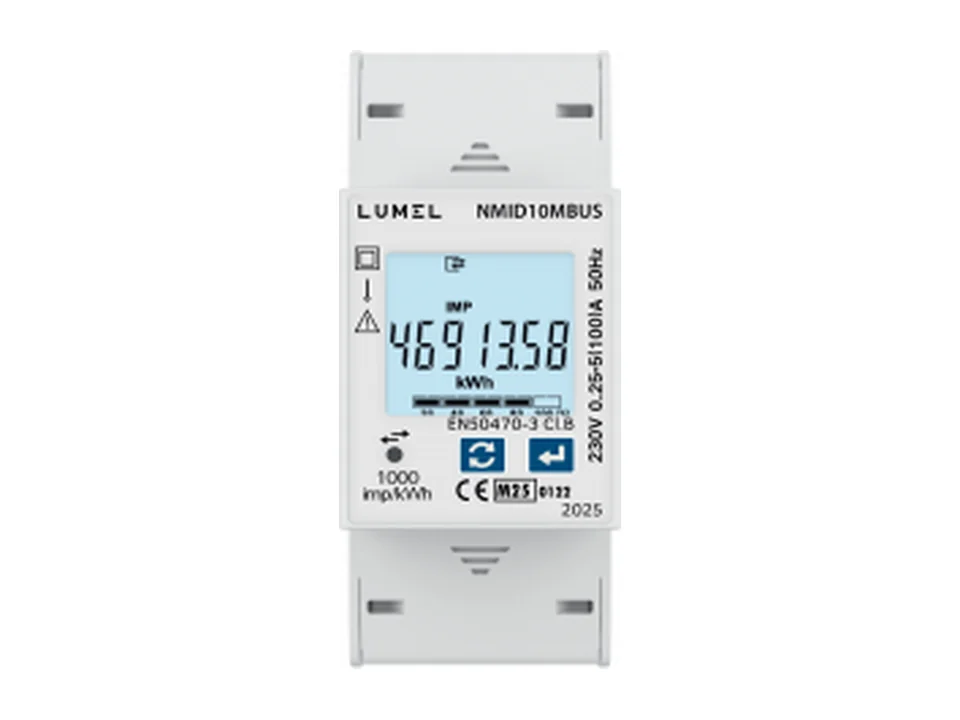
Energy meters
The NMID10LITE is a single-phase digital electricity meter for direct energy measurement in single-phase networks. It is designed for residential buildings, commercial facilities and light industry, where it can be used for billing-grade metering thanks to its MID certificate.
The meter is connected directly into the circuit and measures currents up to 100 A without external current transformers. It is self-powered, taking its supply from the measuring circuit, so no separate auxiliary supply is required. Measurement is true RMS (TRMS), and the meter registers energy in both directions, import and export. Maximum demand is recorded as well.
Accuracy corresponds to class B according to EN 50470-3 and class 1 according to IEC 62053-21 for active energy and IEC 62053-23 for reactive energy. The meter also refers to IEC 61557-12 for performance measuring and monitoring devices. It carries the MID certificate and CE marking.
Measured values are presented on a backlit LCD. Two configurable pulse outputs transmit energy pulses to external counting devices. One digital input is provided for tariff control, allowing the meter to register consumption in different tariffs.
The meter mounts on a standard DIN rail in the distribution board. Its terminals can be sealed to prevent unauthorised access after installation, as required for metering points used for billing.
The base product is supplied as NMID10LITE. In one DIN-rail device it combines direct measurement up to 100 A, bidirectional true-RMS energy registration, maximum demand, a backlit display, two configurable pulse outputs, a tariff input and sealable terminals. Typical installations named for the meter are residential buildings, commercial facilities and light industrial premises, with recording of both consumed and exported energy.
Please state the quantity required and, if applicable, how the pulse outputs and tariff input are to be used in your installation when sending an enquiry.
NMID10LITE
Match the instrument to the circuit and measurement category. Include the wiring arrangement and ratios of any external current or voltage transformers.
For an installed instrument, copy the complete ordering code and its suffixes from the nameplate. Identify the part that will remain in service and the part that needs to be replaced. A photograph of the connection face or terminal markings helps resolve differences between versions that share the same housing.
For a new installation, describe what the instrument must measure or control and where the reading will be used. Give the normal operating conditions separately from short peaks. Include units with every numerical value. A drawing with the available space, orientation and access for removal gives the supplier a practical starting point.
Add the quantity for each position and identify any accessories that belong with it. Where a particular drawing, material certificate or calibration record is required, mention it with the line item. Submit the list with the destination country so that the response can cover the requested configuration and delivery.