BAUR
DTL C
Electrical test & measurement
Energy meters
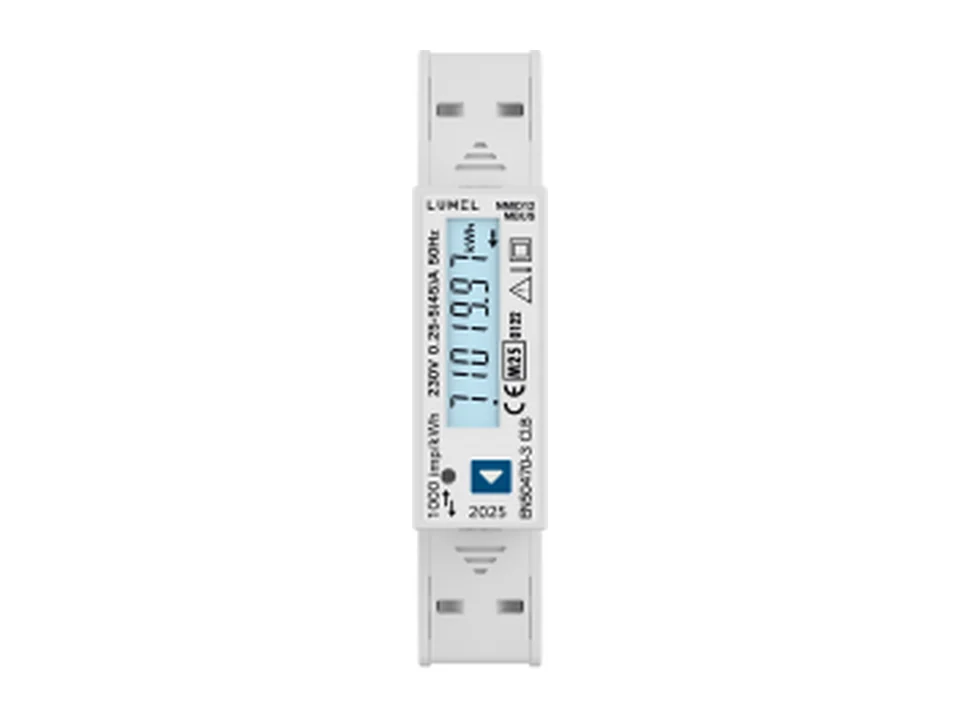
The NMID12 is a single-phase electricity meter for direct measurement, intended for residential buildings, commercial facilities and light industry. It carries MID certification under the European Measuring Instruments Directive and connects directly to circuits with a current of up to 45 A, without external current transformers.
The meter is self-powered: it takes its supply directly from the measuring circuit, so no separate auxiliary supply has to be wired. It measures with true RMS (TRMS) technology. Energy is measured bidirectionally, with separate registration of imported and exported energy. The multi-tariff function allows energy to be registered in several tariffs.
Measuring accuracy corresponds to Class B according to EN 50470-3:2022 and to Class 1 according to IEC 62053-21.
Readings are shown on a backlit LCD, so the registers can be read on site. For remote reading, the meter has an RS-485 interface with the Modbus RTU protocol. In addition, an S0 pulse output provides a pulse train proportional to the measured energy.
The meter is designed for mounting on a standard DIN rail. It is CE marked in addition to the MID certification. In one DIN rail housing, the NMID12 thus combines direct connection up to 45 A, bidirectional TRMS measurement, multi-tariff registers, a backlit LCD, an RS-485 Modbus RTU interface and an S0 pulse output.
Two further versions are available in the same family: the NMID12MBUS with an M-Bus interface instead of RS-485 Modbus RTU, and the NMID12LITE as a lite version. The choice depends mainly on the communication system into which the meter is to be integrated.
Typical places of use are residential buildings, commercial facilities and light industry, where single-phase consumers or sub-circuits up to 45 A are to be metered directly.
With your enquiry, please state the quantity required, the communication interface (Modbus RTU or M-Bus) and whether the full or lite version is needed.
NMID12
Match the instrument to the circuit and measurement category. Include the wiring arrangement and ratios of any external current or voltage transformers.
For an installed instrument, copy the complete ordering code and its suffixes from the nameplate. Identify the part that will remain in service and the part that needs to be replaced. A photograph of the connection face or terminal markings helps resolve differences between versions that share the same housing.
For a new installation, describe what the instrument must measure or control and where the reading will be used. Give the normal operating conditions separately from short peaks. Include units with every numerical value. A drawing with the available space, orientation and access for removal gives the supplier a practical starting point.
Add the quantity for each position and identify any accessories that belong with it. Where a particular drawing, material certificate or calibration record is required, mention it with the line item. Submit the list with the destination country so that the response can cover the requested configuration and delivery.