BAUR
DTL C
Electrical test & measurement
Insulation & earth testers
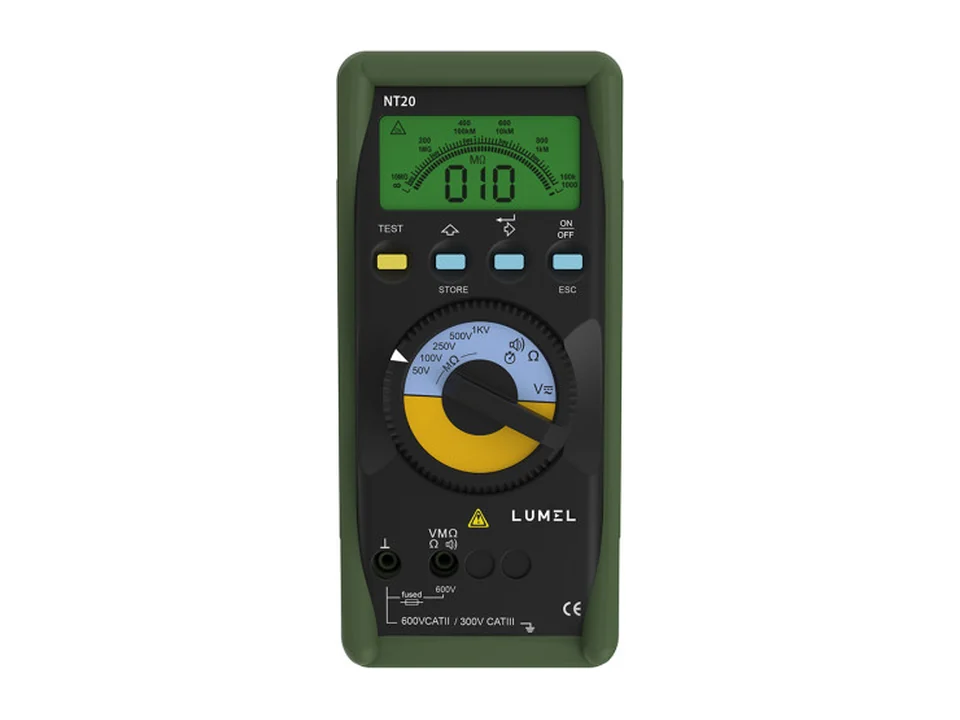
NT20 is an insulation and continuity tester for measuring insulation resistance with test voltages up to 1000 V. It is used for testing motors, transformers, generators and switchgear, where the condition of winding and cable insulation and the continuity of conductors and protective connections have to be checked.
For insulation measurement, the instrument applies a selected DC test voltage between the conductor and earth or between conductors and measures the resulting leakage current, from which the insulation resistance is calculated. Test voltages from 50 V to 1000 V are available, and insulation resistance is measured from 10 kΩ to 2 GΩ. After the test, capacitive circuits such as long cables or windings are discharged automatically.
The instrument has a combined analogue and digital display. The analogue scale for insulation is logarithmic, which shows the very wide resistance range clearly and makes trends during the test visible, while the digital display gives the exact value. A user-selectable backlight helps in poorly lit locations.
Low resistances are measured from 0.01 Ω to 99.9 Ω for continuity testing, and a hands-free continuity test mode allows the operator to keep both hands on the test probes. Voltages from 25 V to 600 V AC/DC can be measured. Live circuit detection warns when the circuit under test is energised, and a blown fuse indication shows when the protective fuse has to be replaced.
MIN and MAX values can be stored, and the memory keeps the last 10 readings. A stopwatch function is built in, which can be used for timed insulation tests. An external mains adapter is available as an option.
With these functions the NT20 covers routine insulation and continuity checks on electrical machines and switchgear with a single handheld instrument. Please tell us the number of instruments required and whether the external mains adapter should be included in the quotation.
Match the instrument to the circuit and measurement category. Include the wiring arrangement and ratios of any external current or voltage transformers.
For an installed instrument, copy the complete ordering code and its suffixes from the nameplate. Identify the part that will remain in service and the part that needs to be replaced. A photograph of the connection face or terminal markings helps resolve differences between versions that share the same housing.
For a new installation, describe what the instrument must measure or control and where the reading will be used. Give the normal operating conditions separately from short peaks. Include units with every numerical value. A drawing with the available space, orientation and access for removal gives the supplier a practical starting point.
Add the quantity for each position and identify any accessories that belong with it. Where a particular drawing, material certificate or calibration record is required, mention it with the line item. Submit the list with the destination country so that the response can cover the requested configuration and delivery.