Bürkert Fluid Control Systems
Type 8189
Level
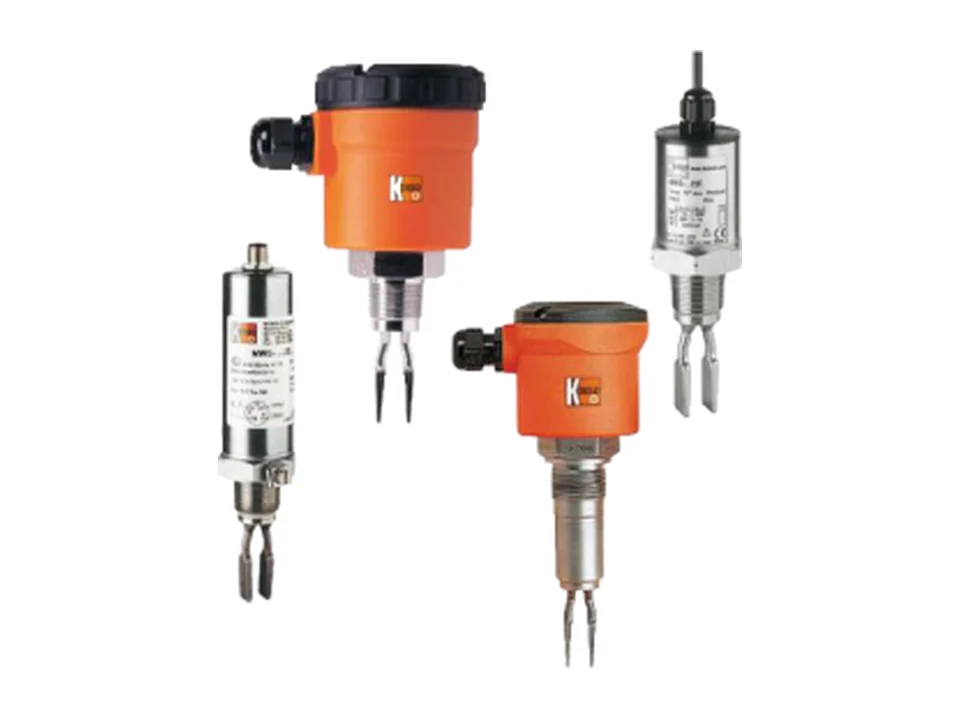
Vibrating level switches
NWS is a tuning fork level switch for universal use in vessels and pipelines. It detects the presence or absence of liquid at a defined point and switches an output accordingly, which makes it suitable for overfill protection, dry-run protection and minimum or maximum level detection in tanks and pipes. The wetted parts are made of stainless steel, and hygienic versions are available for sterile processes and CIP cleaning.
A piezoelectric crystal excites the fork to oscillate at its resonance frequency in air. When the fork is immersed in liquid, the oscillation frequency changes; the electronics detect this change and switch the output signal. The device has no moving parts and is insensitive to plant vibrations. The switch point is repeatable to ±1 mm, and a minimum immersion depth of 12 mm is needed for switching.
The maximum operating pressure is 45 bar. The NWS-… 200 version is rated for medium temperatures from −20 to 130 °C, the other versions from −20 to 90 °C, and all can withstand short CIP cycles at 150 °C. The medium must have a density of at least 800 g/l and a viscosity of no more than 5000 mm²/s. The ambient temperature range is −20 to +70 °C.
Electrically, NWS can work as a 2-wire switch in series with the load or be connected to a PLC through a third terminal. The NWS-… 200 version is supplied with up to 240 V AC/DC (50/60 Hz) in 2-wire connection or 24 V DC in 3-wire connection; the NWS-… 23/24 versions in stainless steel run on 24 V DC. The NWS-… 2E version has a NAMUR interface to IEC 60947-5-6 for use with intrinsically safe circuits and is marked II 1G Ex ia IIC T6 Ga (ATEX) and Ex ia IIC T6 Ga (IECEx).
Fork and process connection are made of stainless steel 1.4404. The NWS-… 200 has a glass-fibre-reinforced PAG housing with a window and a cover that can be rotated by 330°; all other types have a stainless steel 1.4301 housing. Protection is IP65 for the plastic housing, IP67 for the stainless housing with M12 × 1 plug and IP68 with permanently connected cable. Process connections include R ¾ and R 1 pipe threads to DIN EN 10226-1, NPT threads, Tri-Clamp, DIN 11851 sanitary and DIN 11864 aseptic connections, DIN and ANSI flanges; sensor lengths from 60 mm to 3000 mm can be ordered.
Listed media include oils, water, paints, sauces, milk and carbonated liquids, in vessels, pipelines and CIP processes. Please send the medium, temperature, pressure, process connection, sensor length and required electrical version with your enquiry.
NWS-R20, NWS-R25, NWS-N20, NWS-N25, NWS-F25, NWS-F50, NWS-A25, NWS-A50, NWS-T40, NWS-T50, NWS-L40, NWS-L50, NWS-H50, NWS-D1Z, NWS-YYY
Identify the vessel height, nozzle position and surface conditions. A point alarm and a continuous level reading require different outputs.
For an installed instrument, copy the complete ordering code and its suffixes from the nameplate. Identify the part that will remain in service and the part that needs to be replaced. A photograph of the connection face or terminal markings helps resolve differences between versions that share the same housing.
For a new installation, describe what the instrument must measure or control and where the reading will be used. Give the normal operating conditions separately from short peaks. Include units with every numerical value. A drawing with the available space, orientation and access for removal gives the supplier a practical starting point.
Add the quantity for each position and identify any accessories that belong with it. Where a particular drawing, material certificate or calibration record is required, mention it with the line item. Submit the list with the destination country so that the response can cover the requested configuration and delivery.