Bürkert Fluid Control Systems
Type 8203
Liquid analysis
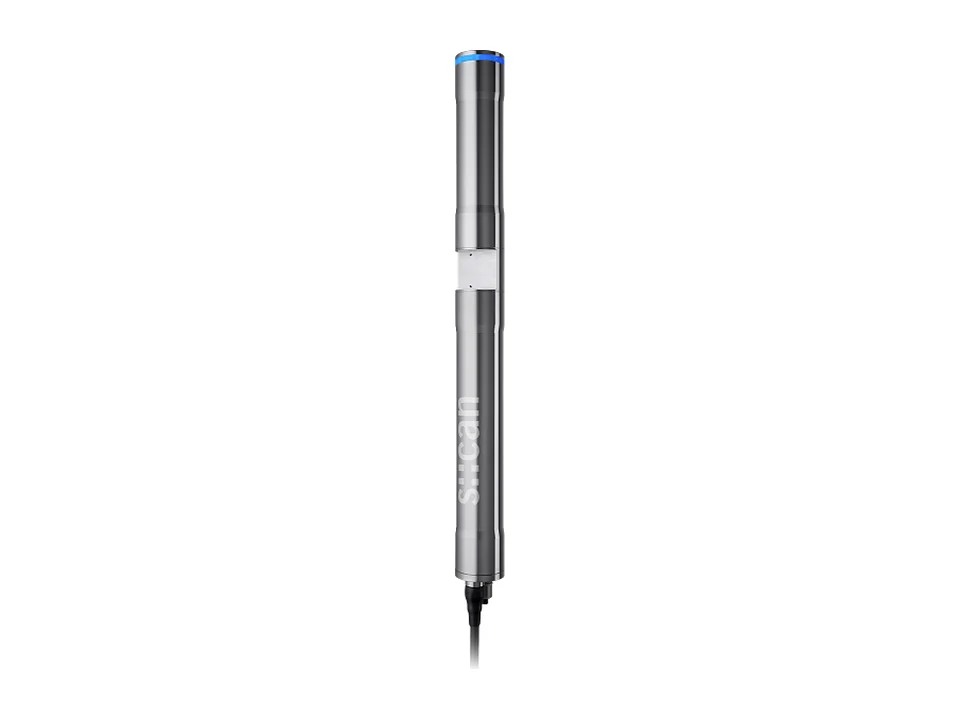
Dissolved oxygen, chlorine & ozone sensors
The ozo-lyser V3 is an ozone spectrometer probe designed for online and in situ measurement of dissolved ozone in water. It is an alternative to classical electrochemical sensors and belongs to a family of spectrometer probes. Besides dissolved ozone, the probe measures temperature, total suspended solids or total solids (TSS/TS) and turbidity.
The probe uses UV-Vis spectrometry over the total range from 200 to 720 nm. Ozone absorbs light in the ultraviolet range, so its concentration can be determined from the measured absorption spectrum. The probe measures directly in the medium, without sample transport, and delivers a new measurement every 30 seconds with minimal maintenance.
The parameters to be measured can be selected to suit the application. Automatic cleaning features help keep the optical path clean, and a sleep mode reduces energy consumption between measurements.
The probe has a built-in web server and IoT capabilities. It communicates directly with mobile devices via WLAN for configuration and data access.
The ozo-lyser V3 is offered in a submersible version for installation in the water and in a portable version.
Applications listed for the probe are drinking water treatment, environmental monitoring, wastewater treatment, industrial wastewater and industrial processes. In each of these, dissolved ozone is measured online at the point of installation, with temperature, TSS/TS and turbidity available as additional parameters from the same probe.
The main features of the ozo-lyser V3 are UV-Vis spectrometry over 200 to 720 nm, measurements every 30 seconds, a built-in web server with IoT capabilities, WLAN communication with mobile devices, customisable parameter selection, a low-energy sleep mode and automatic cleaning.
Please state the application, the expected ozone concentration range, the installation type (submersible or portable) and the parameters required in your enquiry.
Record the sample temperature, expected concentration and how the probe is mounted. Identify the mating transmitter when replacing a sensor.
For an installed instrument, copy the complete ordering code and its suffixes from the nameplate. Identify the part that will remain in service and the part that needs to be replaced. A photograph of the connection face or terminal markings helps resolve differences between versions that share the same housing.
For a new installation, describe what the instrument must measure or control and where the reading will be used. Give the normal operating conditions separately from short peaks. Include units with every numerical value. A drawing with the available space, orientation and access for removal gives the supplier a practical starting point.
Add the quantity for each position and identify any accessories that belong with it. Where a particular drawing, material certificate or calibration record is required, mention it with the line item. Submit the list with the destination country so that the response can cover the requested configuration and delivery.