Landis+Gyr
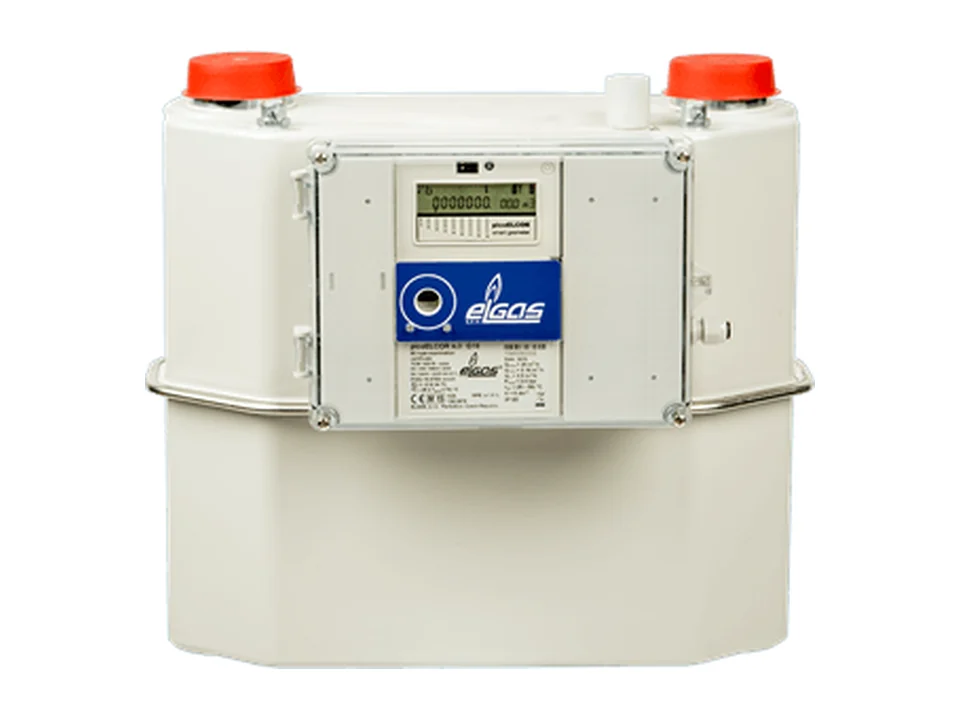
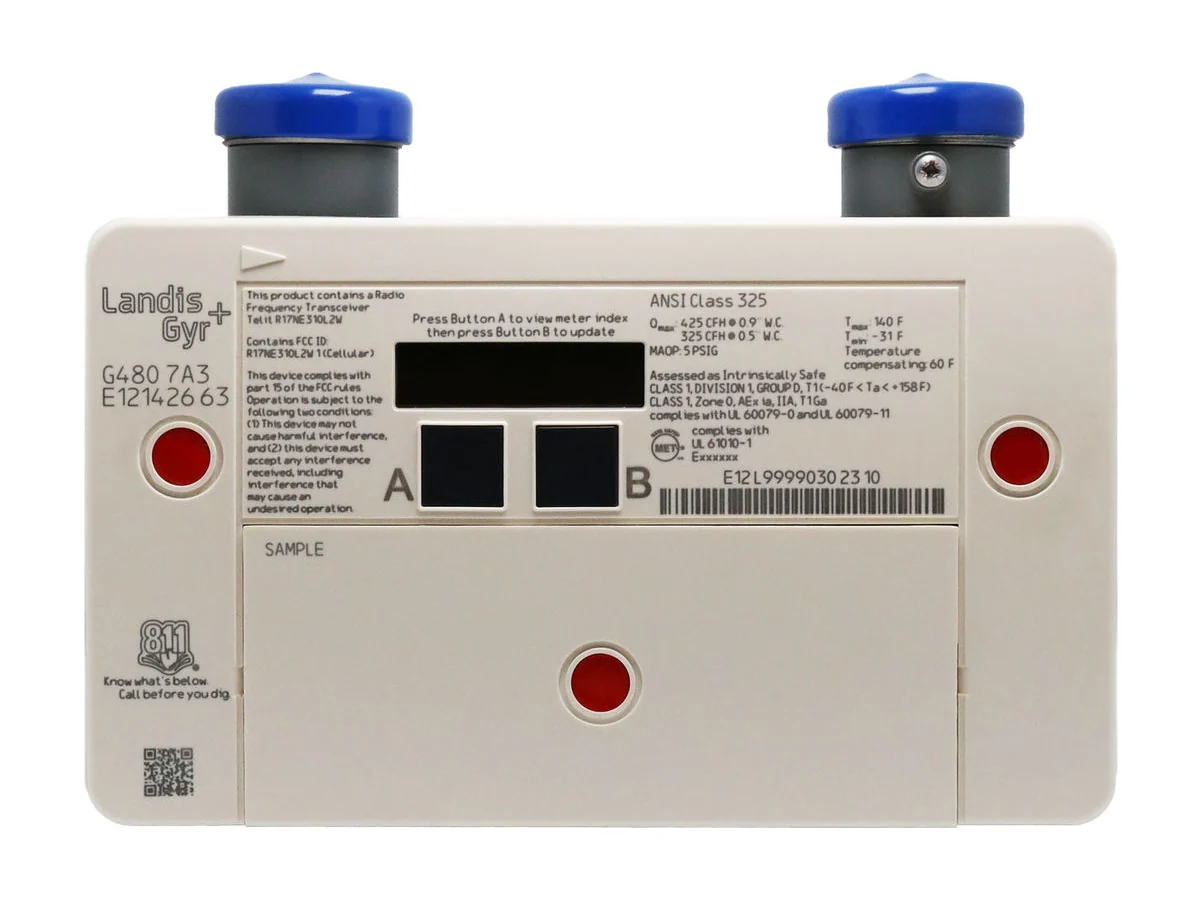
Surent G480
Flow
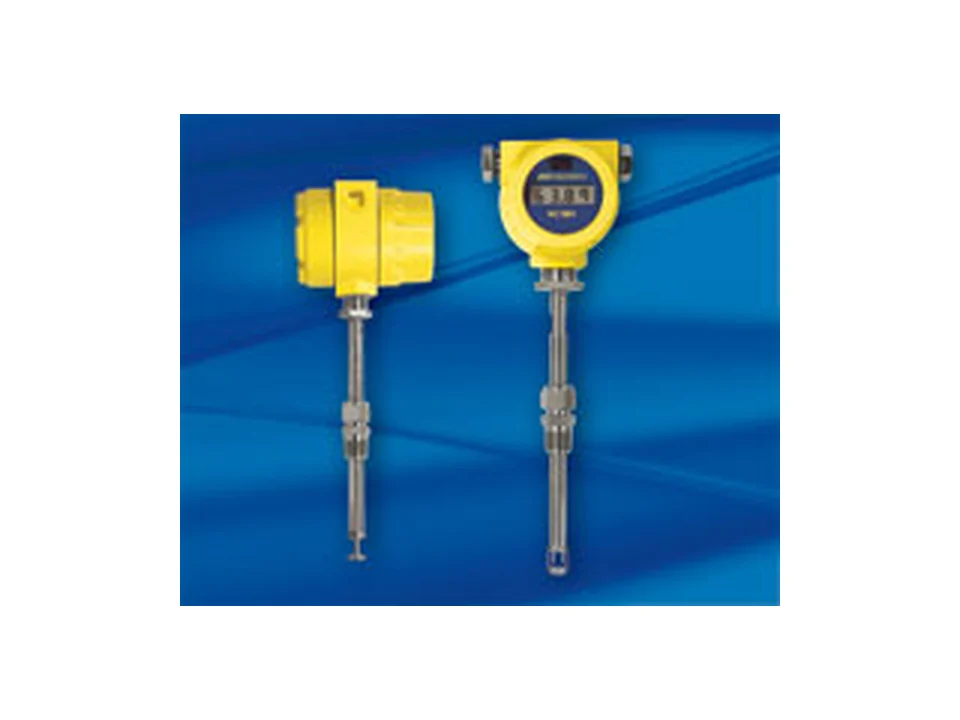
Thermal mass meters & flow controllers
The ST50 is a compact insertion-type thermal mass flow meter for air, compressed air and nitrogen. It has no moving parts and is designed for pipes and ducts from 2 to 24 in (51 to 610 mm).
The meter works on the thermal dispersion principle. Precision platinum RTDs are mounted in small-diameter, equal-mass, all-metal thermowells; the heat carried away by the gas flow is evaluated to determine mass flow directly, providing accurate measurement with a fast response.
The flow range is 0.75 to 400 SFPS (0.23 to 122 m/s) with a turndown of up to 100:1. Standard accuracy is ±2 % of reading ±0.5 % of full scale; optional accuracy is ±1 % of reading ±0.5 % of full scale. Repeatability is ±0.5 % of reading.
Two 4–20 mA analogue outputs comply with NAMUR NE43, and a 0–500 Hz pulse output for a totaliser is optional. An RS-232C port is provided for communication. The LCD shows ±9999 counts and can be scaled to flow rate engineering units or 0–100 %. The meter is powered from 18–36 VDC or 85–265 VAC (CE marking approval from 100 to 240 VAC).
The flow element has a 316 stainless steel body with Hastelloy C thermowell sensors and a 316 stainless steel compression fitting with a Teflon or stainless steel ferrule. With the stainless steel ferrule it is rated 500 psig (34 bar g) and 0 to 250 °F (−18 to 121 °C); with the Teflon ferrule 150 psig (10 bar g) and 0 to 200 °F (−18 to 93 °C). Process connections are 1/2 in or 3/4 in MNPT, and field-adjustable insertion lengths are 1–6 in, 1–12 in or 1–18 in. The NEMA 4X (IP67) enclosure is polyester powder-coated low-copper aluminium, or stainless steel as an option. The transmitter operates from −18 to 60 °C and can be integral or remote, up to 15 m away.
Approvals include FM/CSA Class 1, Div. 2, Groups A, B, C, D, T4, CE marking and EAC. Options include extended temperature compensation and ball valves in standard-duty (025172-09, 1/2 in; 025172-10, 3/4 in) and heavy-duty (011144-05, 3/4 in) versions.
Applications named are wastewater aeration control, burner and furnace air control, HVAC duct and damper control, blower and dryer air flow, lake, pond and aquaculture aeration, and compressed air distribution.
Please state the gas, line size, flow range, pressure, temperature, supply voltage and mounting when enquiring.
State the minimum, normal and peak flow with units. Pipe bore, fluid properties and the available straight run affect the choice of measuring principle.
For an installed instrument, copy the complete ordering code and its suffixes from the nameplate. Identify the part that will remain in service and the part that needs to be replaced. A photograph of the connection face or terminal markings helps resolve differences between versions that share the same housing.
For a new installation, describe what the instrument must measure or control and where the reading will be used. Give the normal operating conditions separately from short peaks. Include units with every numerical value. A drawing with the available space, orientation and access for removal gives the supplier a practical starting point.
Add the quantity for each position and identify any accessories that belong with it. Where a particular drawing, material certificate or calibration record is required, mention it with the line item. Submit the list with the destination country so that the response can cover the requested configuration and delivery.