ELGAS s.r.o.
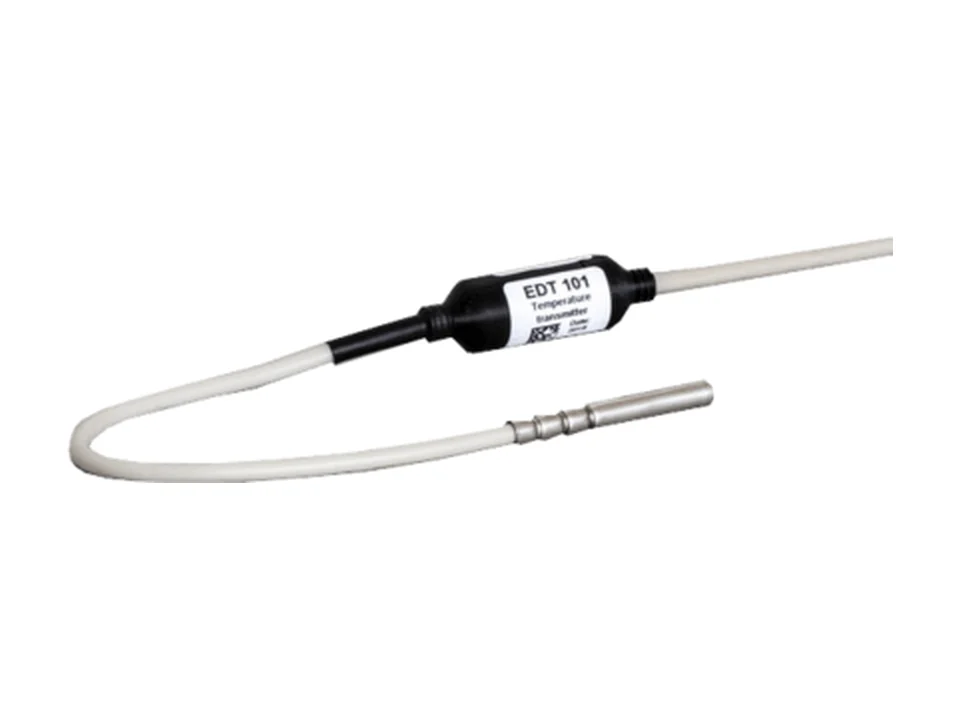
EDT 101
Temperature
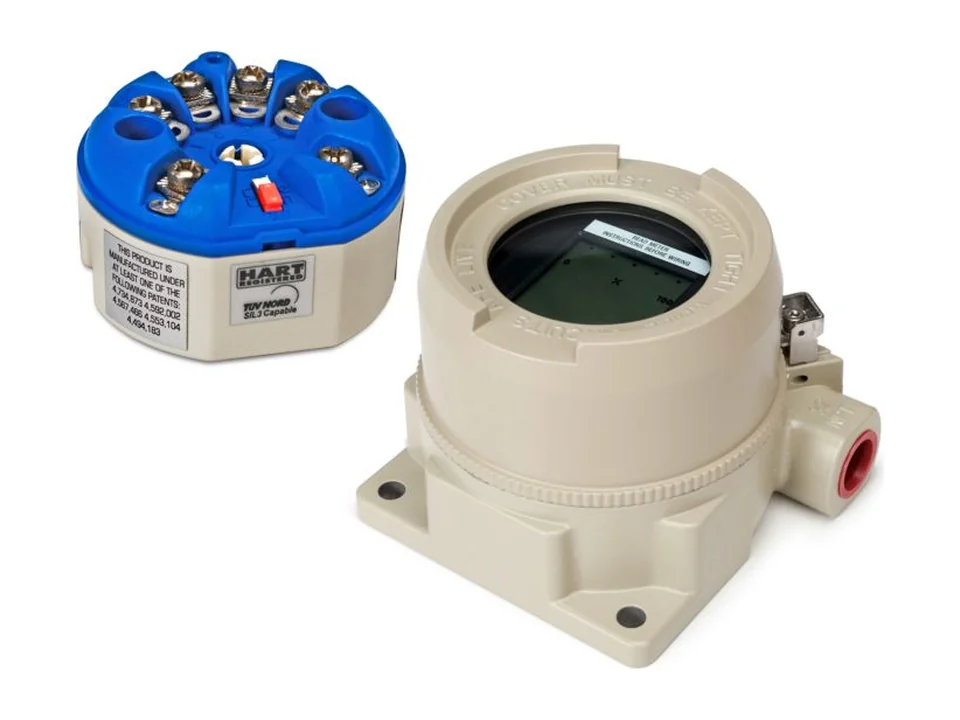
Temperature transmitters
The STT170 series is a family of programmable temperature transmitters for cost-effective temperature monitoring in industrial plants. The transmitters are mounted in a DIN form B connection head and convert low-level signals from RTDs and thermocouples into 4–20 mA current signals that can be transmitted over long distances in electrically noisy environments.
Three models are offered. STT171 is an RTD-only transmitter, STT173 has a universal input for RTD, thermocouple, resistance and millivolt signals, and STT17H provides single or dual sensor input with HART communication on the 4–20 mA loop. The transmitters automatically linearise the temperature output signal, and high or low limit alarms can be programmed for sensor failure, with a sensor error response according to NAMUR NE43. Inputs and outputs are galvanically isolated.
Supported sensors are Pt100, Pt1000 and Ni100 RTDs and thermocouple types B, E, J, K, L, N, R, S, T, U, W3 and W5, as well as resistance and mV signals, depending on model. Accuracy is ±0.1 °C for Pt100 and Ni100 inputs; for thermocouples it depends on the type. Response time is programmable from 0.33 to 60 s on the STT171 and from 1 to 60 s on the STT173 and STT17H; the update time is 135 ms for the STT171 and 440 ms for the STT17H.
The STT171 is supplied with 8 to 30 V DC, the STT173 and STT17H with 8 to 35 V DC. The permissible load resistance is up to (supply voltage − 8 V) / 0.023 A. The transmitters operate at ambient temperatures from −40 to 85 °C and 0 to 95 %RH non-condensing and withstand vibration up to 4 g from 25 to 100 Hz. The housing measures Ø 44 × 20.2 mm.
Approvals include ATEX, IECEx, FM, CSA, UL and CE, with versions for Class I Division 2, Zone 2 and Zone 0/1, and references to IEC 61508, IEC 60751 and IEC 584. Configuration is done with the STT17C PC-based configuration tool, which is used in non-hazardous areas.
Stated fields of use are process plants, power plants, oil and gas, mining and offshore. Please send the sensor type, measuring range, required output (analogue or HART) and any hazardous-area approval required.
STT171, STT173, STT17H, STT17C
Match the sensing element, insertion length and wiring to the existing input. Separate the process temperature from the ambient temperature at the connection head.
For an installed instrument, copy the complete ordering code and its suffixes from the nameplate. Identify the part that will remain in service and the part that needs to be replaced. A photograph of the connection face or terminal markings helps resolve differences between versions that share the same housing.
For a new installation, describe what the instrument must measure or control and where the reading will be used. Give the normal operating conditions separately from short peaks. Include units with every numerical value. A drawing with the available space, orientation and access for removal gives the supplier a practical starting point.
Add the quantity for each position and identify any accessories that belong with it. Where a particular drawing, material certificate or calibration record is required, mention it with the line item. Submit the list with the destination country so that the response can cover the requested configuration and delivery.