Bürkert Fluid Control Systems
Type 8189
Level
Float & magnetic level indicators
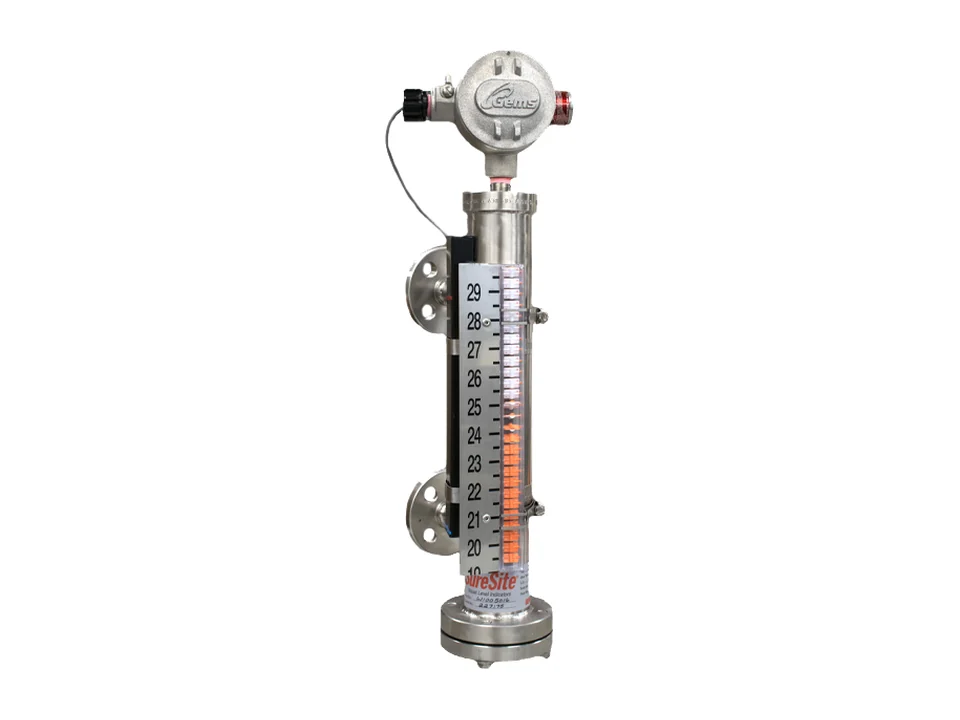
SureSite Standard Alloy is a visual level gauge of rugged, welded alloy construction with a 2-1/2 in (64 mm) diameter chamber. It gives a clear local indication of the liquid level, and it is built for a long service life both indoors and outdoors. Certified explosion-proof models are available for hazardous environments.
The gauge works with a float and flag mechanism. The float inside the welded chamber follows the liquid level, and the flags of the indicator rise and fall with it, so the level can be read along the full length of the scale. Two flag materials are offered according to temperature: plastic flags for up to 300 °F (148.9 °C) and aluminium flags for up to 750 °F (399 °C).
The gauge is suitable for temperatures up to 750 °F (399 °C) and pressures up to 700 psi (48 bar). Indication lengths of up to 240 in (610 cm) are available, and liquids with a specific gravity as low as 0.39 can be indicated.
The primary material of construction is 316L stainless steel; 316 stainless steel, Carpenter 20 and Hastelloy C276 are also listed. Process connections are configurable as NPT or flanges, in top/bottom or side arrangements, and mounting styles Type AA, BA, CA and DA are available. Special requirements are handled by consulting the factory. The listed weight of the standard configuration is 17.75 lb (8.05 kg).
The visual gauge can be extended with level transmitters for low or high temperatures, which convert the level into an electrical signal, and with switch modules in SPST, SPDT or DPDT design for alarms and control functions. Indicating scales are available as accessories. Signal output and process connection are configurable when ordering.
Listed applications are indoor and outdoor installations and hazardous environments.
For a quotation, please send the medium and its specific gravity, operating temperature and pressure, centre-to-centre distance or indication length, connection type and arrangement, and whether transmitters, switches or an explosion-proof version are required.
W1110003, W1102919, W1086267, W1114299, W1107250, W1103087, W1095636, W1083957, W1093180, W1087410, W1104907, W995152, W1086729, W1096657, W1097803, W1087412, W1098650, W1094597, W1085948, W1084314, W1106095, W1095996, W1103078, W1087603, W1115186
Identify the vessel height, nozzle position and surface conditions. A point alarm and a continuous level reading require different outputs.
For an installed instrument, copy the complete ordering code and its suffixes from the nameplate. Identify the part that will remain in service and the part that needs to be replaced. A photograph of the connection face or terminal markings helps resolve differences between versions that share the same housing.
For a new installation, describe what the instrument must measure or control and where the reading will be used. Give the normal operating conditions separately from short peaks. Include units with every numerical value. A drawing with the available space, orientation and access for removal gives the supplier a practical starting point.
Add the quantity for each position and identify any accessories that belong with it. Where a particular drawing, material certificate or calibration record is required, mention it with the line item. Submit the list with the destination country so that the response can cover the requested configuration and delivery.