ifm electronic
LDH313
Gas analysis
Process gas analysers & chromatographs
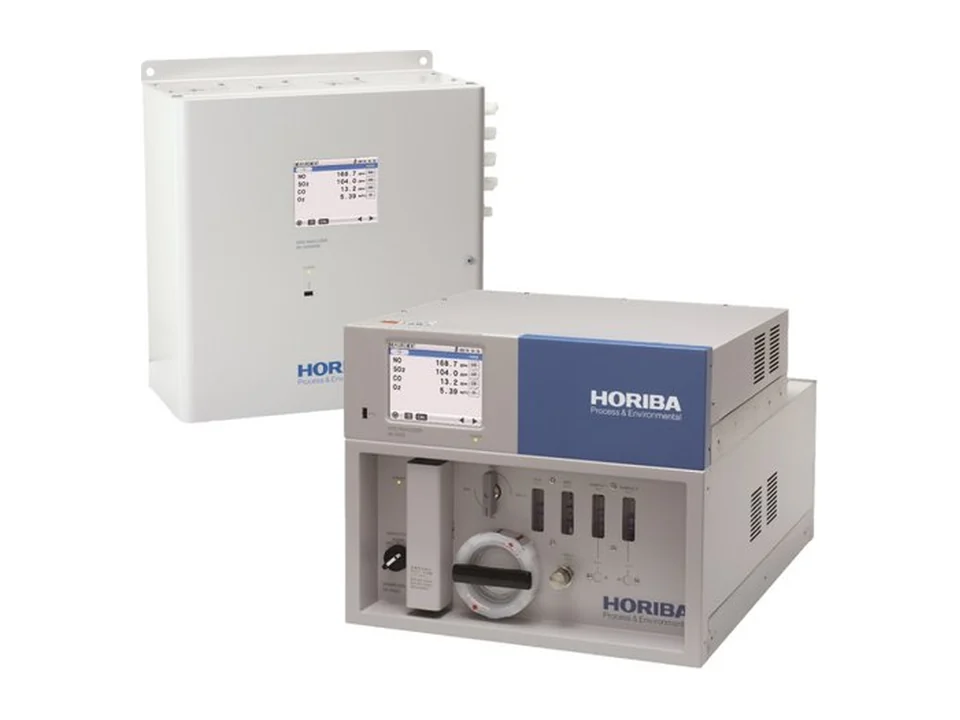
The VA-5000 series is a modular multi-component gas analyser for environmental monitoring, continuous emission monitoring (CEMS), quality control and industrial process measurement. It is available as the VA-5000 for 19-inch panel mounting and as the VA-5000WM for wall mounting, and it accepts up to four detector modules for simultaneous measurement of several components.
Each module uses its own measuring principle. NDIR is used for components such as CO, CO2, CH4, N2O, SO2 and NH3; NO and NOx are measured with a chemiluminescence (CLAM) module that works with a separate deozonator unit; O2 can be measured with a magnetopneumatic, galvanic cell, zirconia or paramagnetic detector. Siloxane is also listed among the measured components. By standard the gas enters through a single inlet and flows from one module to the next; separate inlets for each module are available as an option.
Linearity is ±1.0 % of full scale as standard, or ±2.0 % as an option with a range ratio of 1:20. Response time is 30 s or less (T90) and 40 s or less including dead time; for a single component it is 45 s. Warm-up time ranges from 20 to 120 minutes depending on the module (90 minutes for SO2). Standard sample flow is 0.3 or 0.5 l/min, with 1.0 l/min as an option. The sample must be at ambient temperature, dust-free, with water below 5 °C saturation, at 0 to 490 Pa, and free of corrosive, combustible and explosive gases.
The analyser is operated via a 5.7-inch touch screen and offers auto-calibration and self-diagnosis. Communication is via Ethernet (Modbus TCP), with optional data logging to USB memory. Optional I/O provides up to 4 isolated analogue inputs, 8 isolated analogue outputs (0–16, 4–20 or 0–20 mA or 0–1 V), 16 isolated digital inputs and 16 isolated digital outputs (max. DC 30 V, 1 A). Power supply is 100–240 V AC ±10 %, 50/60 Hz, 100 to 350 VA.
Gas tubing is PTFE, with stainless steel as an option; connections are Rc 1/8 and Ø6/Ø4 mm PTFE joints. Protection is equivalent to IP20. The VA-5000 measures 430 × 380 × 132 mm and weighs 7–18 kg; the VA-5000WM measures 424 × 206 × 484 mm and weighs 14–24 kg. Installation conditions are 0 to 45 °C and up to 90 % RH without condensation, at altitudes up to 3000 m with NDIR modules only or 2000 m with other modules. The analyser complies with RoHS, REACH and EMC. Options include the VS-5000 sample gas conditioning system, slide rails and rack mounting plates.
Applications include CEMS in thermal and biomass power generation, iron and steel, oil refining and petrochemicals, environmental impact assessment, fuel cells, gas from safety testing of rechargeable batteries, N2O monitoring, CFC recovery and medical gas quality control.
Please state the components and ranges, the version and the required I/O.
Identify the target gas, background gas and concentration units. State whether the sampling system is already installed or belongs in the enquiry.
For an installed instrument, copy the complete ordering code and its suffixes from the nameplate. Identify the part that will remain in service and the part that needs to be replaced. A photograph of the connection face or terminal markings helps resolve differences between versions that share the same housing.
For a new installation, describe what the instrument must measure or control and where the reading will be used. Give the normal operating conditions separately from short peaks. Include units with every numerical value. A drawing with the available space, orientation and access for removal gives the supplier a practical starting point.
Add the quantity for each position and identify any accessories that belong with it. Where a particular drawing, material certificate or calibration record is required, mention it with the line item. Submit the list with the destination country so that the response can cover the requested configuration and delivery.