BAUR
DTL C
Electrical test & measurement
Multimeters & clamp meters
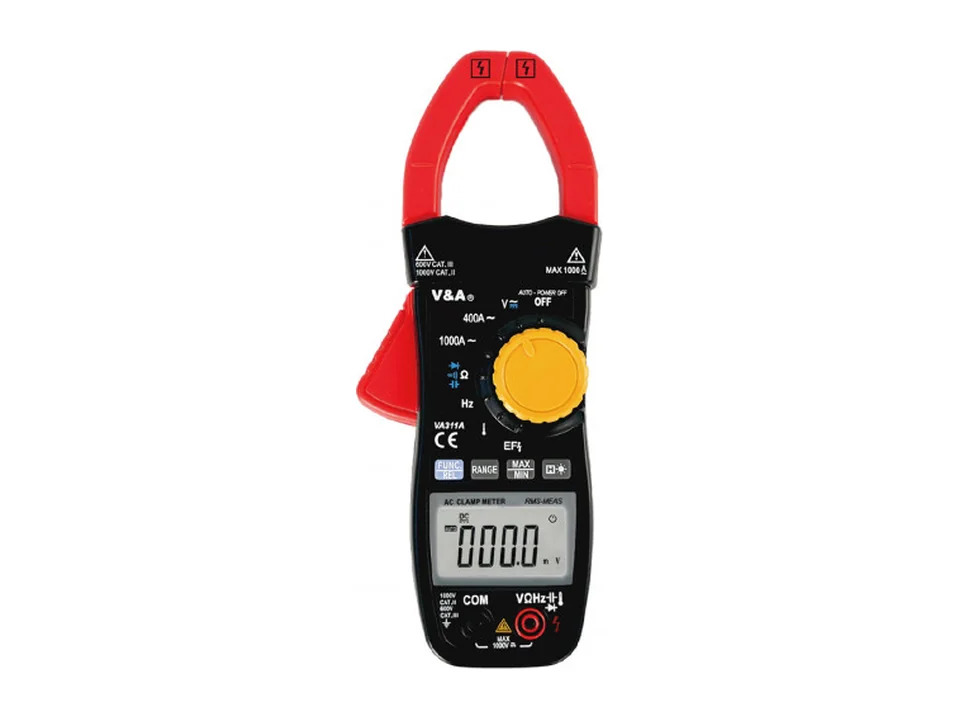
The VA311A is a true-RMS digital AC clamp meter for safe, non-intrusive measurement of alternating current up to 1000 A. The conductor is enclosed by the clamp jaws, which open up to 42 mm, so current can be measured without breaking the circuit. In addition to current, the instrument measures voltage, resistance, capacitance, frequency and temperature, which makes it a general-purpose tool for electrical work.
The meter has a 3¾-digit display with 3999 to 4000 counts. AC current is measured in the 400.0 A and 1000 A ranges at frequencies from 40 to 400 Hz. Both AC and DC voltage can be measured up to 1000 V; AC voltage is measured at frequencies from 40 to 1000 Hz. Because AC readings are true RMS, the value is measured correctly also for signals that are not purely sinusoidal.
Further ranges cover resistance up to 40 MΩ, capacitance up to 4 mF and temperature from −200 to 1200 °C. Logic and linear frequency measurement is available over a wide range. Diode testing and an audible continuity test with a threshold of 50 Ω or less support quick checks of components and wiring.
A non-contact voltage detection function (NCV / EF) indicates the presence of AC voltage audibly and visually before work begins. Recording of maximum and minimum values (MAX/MIN), relative measurement (REL) and Data Hold (HOLD) make it easier to capture and compare readings in difficult positions.
The instrument is rated CAT II 1000 V and CAT III 600 V, which defines the installation categories and voltage levels in which it may be used. The ratings should be observed according to the point of measurement in the installation.
The VA311A is intended for power engineering, electrical maintenance, electrical installation work and industrial servicing. Please state the required quantity in your enquiry, and mention any test leads or temperature probes you would like included, so that a complete quotation can be prepared.
VA311A
Match the instrument to the circuit and measurement category. Include the wiring arrangement and ratios of any external current or voltage transformers.
For an installed instrument, copy the complete ordering code and its suffixes from the nameplate. Identify the part that will remain in service and the part that needs to be replaced. A photograph of the connection face or terminal markings helps resolve differences between versions that share the same housing.
For a new installation, describe what the instrument must measure or control and where the reading will be used. Give the normal operating conditions separately from short peaks. Include units with every numerical value. A drawing with the available space, orientation and access for removal gives the supplier a practical starting point.
Add the quantity for each position and identify any accessories that belong with it. Where a particular drawing, material certificate or calibration record is required, mention it with the line item. Submit the list with the destination country so that the response can cover the requested configuration and delivery.