Bürkert Fluid Control Systems
Type 8203
Liquid analysis
Conductivity & resistivity sensors
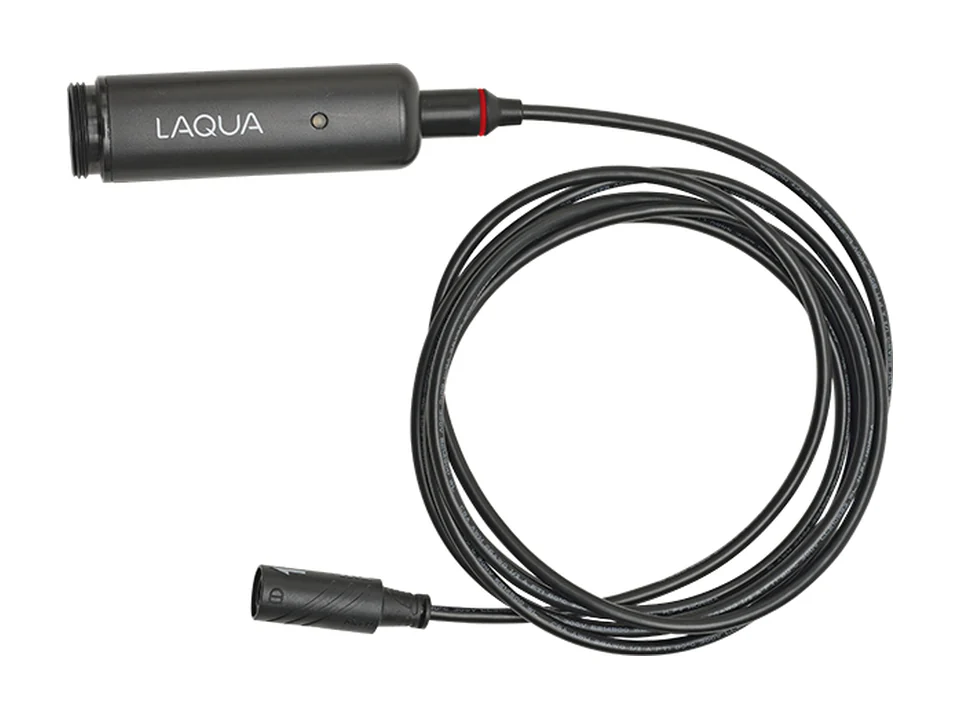
The 300-C-2 and 300-C-5 are conductivity sensor heads for the 300-4C-C conductivity sensor cartridge system. One sensor head provides measurement of conductivity, salinity, total dissolved solids (TDS) and resistivity, together with temperature. The two models differ only in cable length: 2 m for the 300-C-2 and 5 m for the 300-C-5.
The sensor uses auto-ranging to give a resolution of up to four significant digits across a wide measuring range. Calibration can be carried out with up to four points automatically or up to five points manually. Temperature compensation refers the reading to a reference temperature selectable from 15 to 30 °C, with a temperature coefficient adjustable from 0.00 to 10.00 %/°C.
Conductivity is measured in the ranges 0.000 to 200.0 μS/cm, 2.00 to 2000 mS/cm and 0.0 to 200.0 S/m, in the units S/cm or S/m. Accuracy is ±0.5 % of full scale of each range, and ±1.5 % of full scale above 200 mS/cm (20.0 S/m).
Salinity is measured from 0.00 to 80.00 ppt (0.000 to 8.000 %) with a resolution of 0.01 ppt and an accuracy of ±0.5 % of reading or ±0.01 ppt, whichever is greater, using either the NaCl or the seawater curve (UNESCO 1978). TDS covers 0.01 mg/L to 200,000 mg/L with an accuracy of ±0.5 % of reading or ±0.1 mg/L and curves for a linear factor (0.40 to 1.00), EN 27888, 442 and NaCl. Resistivity is displayed from 0.1 to 2000 in Ω·cm, kΩ·cm, MΩ·cm, Ω·m or kΩ·m. Temperature is measured from −30.0 to 130.0 °C (−22.0 to 266.0 °F) with a resolution of 0.1° and an accuracy of ±0.5 °C (±0.9 °F).
The body is made of ABS and polycarbonate and measures 85 mm in length and 30 mm in diameter. The sensor head conforms to RoHS and REACH, and a calibration option is offered.
Applications named for the sensor head include drinking water utilities, automotive manufacturing, semiconductor manufacturing processes and research and testing laboratories.
When enquiring, please state the required cable length (2 m or 5 m), the quantity and whether the 300-4C-C cartridge is also needed.
300-C-2, 300-C-5
Record the sample temperature, expected concentration and how the probe is mounted. Identify the mating transmitter when replacing a sensor.
For an installed instrument, copy the complete ordering code and its suffixes from the nameplate. Identify the part that will remain in service and the part that needs to be replaced. A photograph of the connection face or terminal markings helps resolve differences between versions that share the same housing.
For a new installation, describe what the instrument must measure or control and where the reading will be used. Give the normal operating conditions separately from short peaks. Include units with every numerical value. A drawing with the available space, orientation and access for removal gives the supplier a practical starting point.
Add the quantity for each position and identify any accessories that belong with it. Where a particular drawing, material certificate or calibration record is required, mention it with the line item. Submit the list with the destination country so that the response can cover the requested configuration and delivery.