BAUR
DTL C
Electrical test & measurement
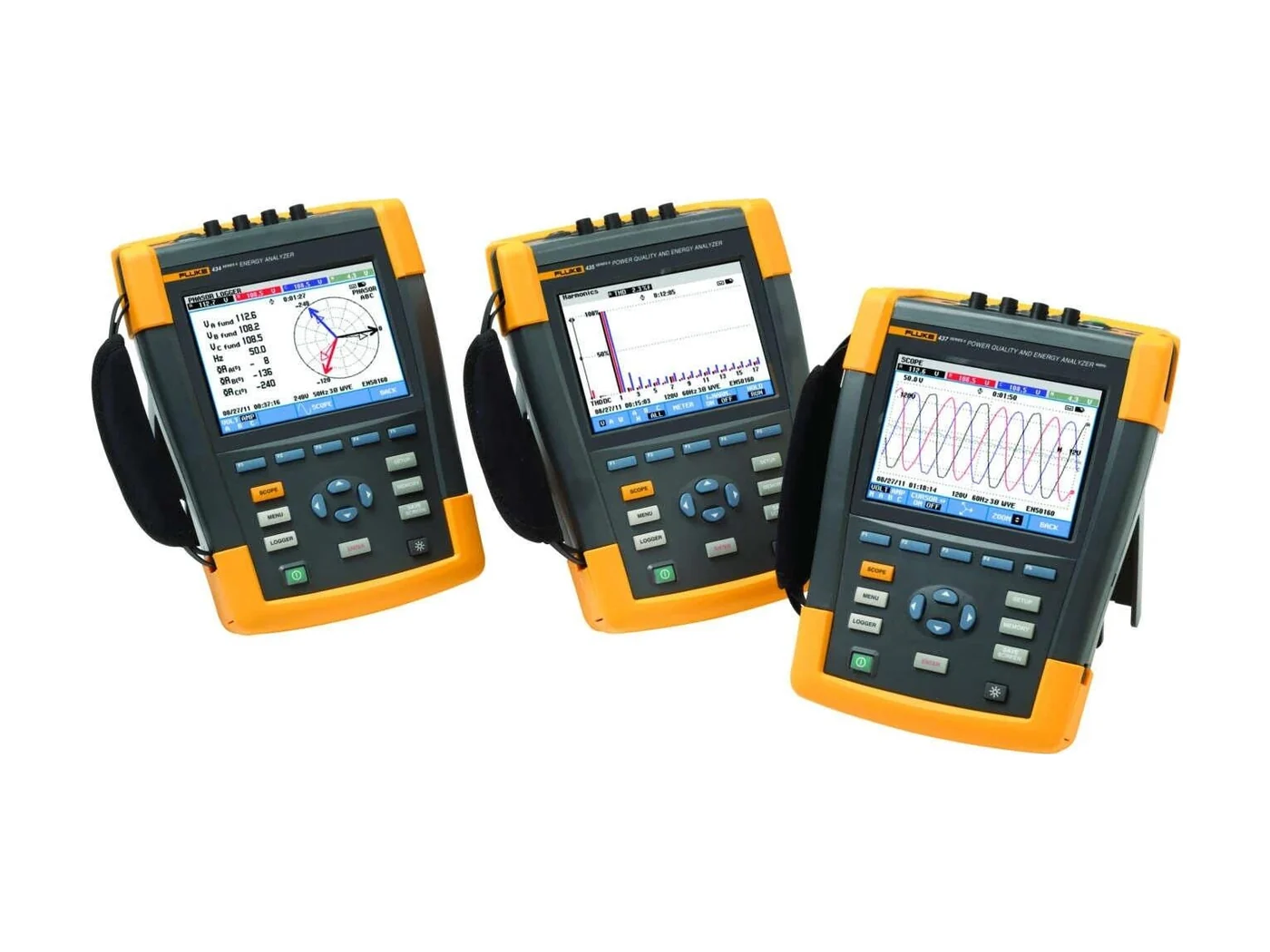
Power quality analysers
The 437 Series II is a portable power quality monitor and energy analyser for three-phase and single-phase power distribution systems. Its distinctive feature is measurement at a nominal frequency of 400 Hz in addition to 50 Hz and 60 Hz, which makes it suitable for avionic, military and shipboard power systems as well as for general troubleshooting of power quality problems.
The instrument samples voltage and current with a 16-bit analogue-to-digital converter at 200 kS/s and captures waveforms and events. Power quality parameters, including harmonics, unbalance and energy losses, are calculated by the Unified Power Measurement (UPM) method. Measurements are fully Class A compliant to IEC 61000-4-30 and evaluated against EN 50160 and IEEE 1459-2000; a shipboard mode analyses power according to MIL-STD 1399. Transients up to 6 kV are captured. A power quality health screen shows the state of the system at a glance, and the energy loss calculator and an inverter efficiency mode are included.
Voltage is measured from 1 V to 1000 V phase to neutral (1 to 1400 Vpk). With flexible current probes the current range is 5 A to 6000 A (0.5 A to 600 A at 10× sensitivity); with 1 mV/A clamps it is 5 A to 2000 A. Frequency is measured from 340 Hz to 460 Hz at 400 Hz nominal, and from 42.5 to 57.5 Hz or 51 to 69 Hz at 50/60 Hz. Harmonics and interharmonics are analysed up to the 50th order to IEC 61000-4-7. Flicker, mains signalling and monitor mode are not supported at 400 Hz.
The analyser covers many wiring configurations, from single phase with neutral and split phase to three-phase wye and delta systems, including open delta and two-wattmeter connections. Data are stored on an SD card (8 GB, up to 32 GB) and transferred via an isolated mini-USB port; the instrument is compatible with a mobile app via a Wi-Fi SD card. The safety rating is 600 V CAT IV / 1000 V CAT III and operating temperature is 0 to 40 °C.
Versions are available with or without flexible current probes, as an international version with an 8 GB SD card, and with options such as a motor analysis firmware upgrade, a GPS time synchronisation module, a DC clamp for inverter efficiency, a double-capacity battery and hard or soft carrying cases.
Typical uses include avionic and military power, shipboard systems, power electronics, generator start-ups and UPS switching.
When enquiring, please state whether current probes are required, the desired accessories and the quantity.
437 Series II 400Hz, 430-II/MA, 437-II, 437-II/INTL
Match the instrument to the circuit and measurement category. Include the wiring arrangement and ratios of any external current or voltage transformers.
For an installed instrument, copy the complete ordering code and its suffixes from the nameplate. Identify the part that will remain in service and the part that needs to be replaced. A photograph of the connection face or terminal markings helps resolve differences between versions that share the same housing.
For a new installation, describe what the instrument must measure or control and where the reading will be used. Give the normal operating conditions separately from short peaks. Include units with every numerical value. A drawing with the available space, orientation and access for removal gives the supplier a practical starting point.
Add the quantity for each position and identify any accessories that belong with it. Where a particular drawing, material certificate or calibration record is required, mention it with the line item. Submit the list with the destination country so that the response can cover the requested configuration and delivery.