BAUR
DTL C
Electrical test & measurement
Current & voltage transducers
These AC current sensors convert the current in a conductor into a proportional, loop-powered 4–20 mA signal for PLCs, building management systems, data loggers and energy monitoring systems. The conductor is simply passed through the sensor; there is no electrical connection to the measured circuit, and 2200 V AC isolation separates the signal from the power wiring.
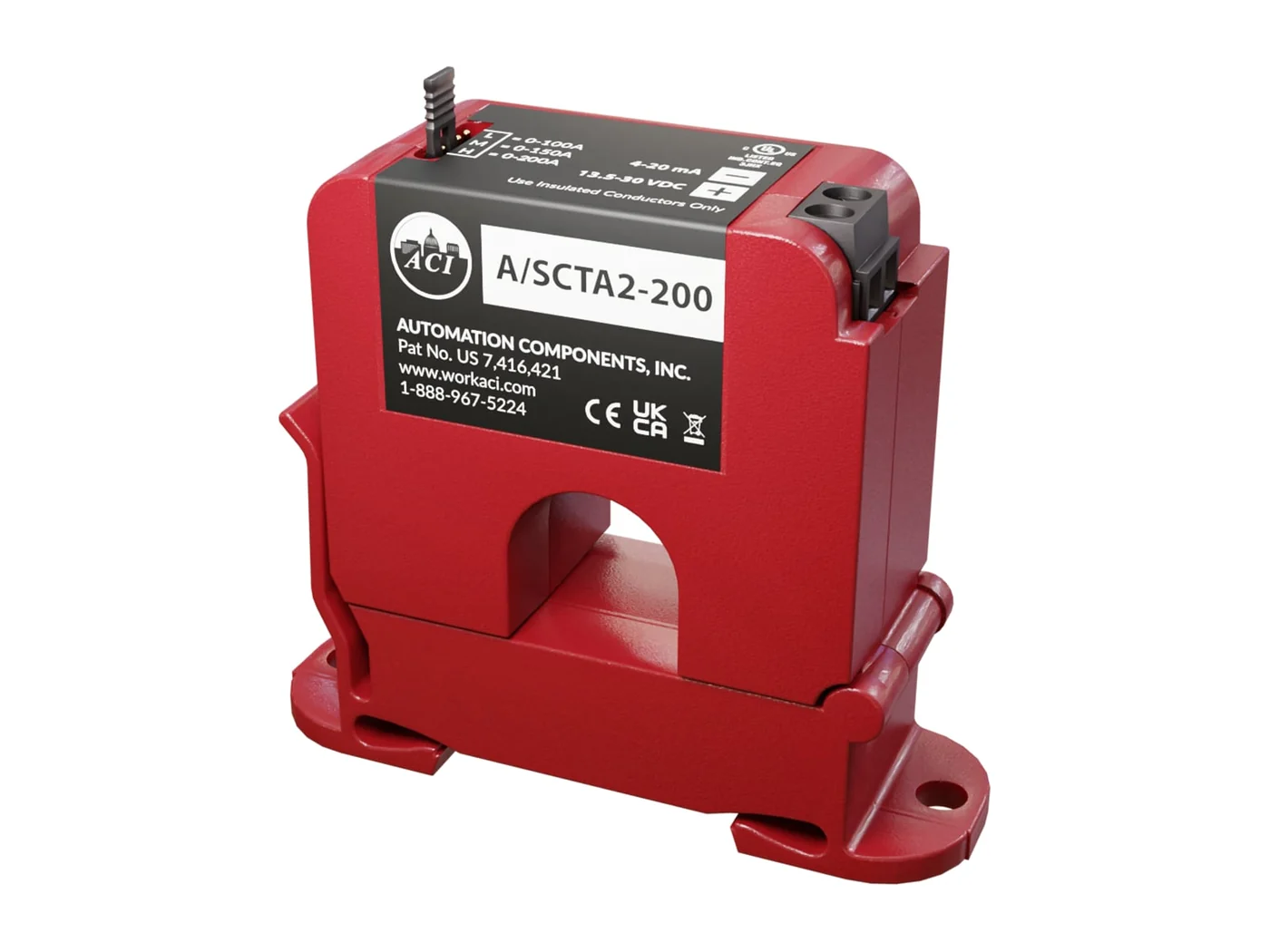
Two mechanical designs are available. Solid-core sensors (A/CTA2) are installed when the conductor can be threaded through the opening during installation, for example in new panels. Split-core sensors (A/SCTA2) open and close around an existing cable, so they can be retrofitted without disconnecting the load, which is the usual choice for upgrading existing installations.
The measurement method is selected according to the load. Average-responding models are intended for pure sinusoidal currents. True-RMS models measure correctly also with distorted waveforms produced by variable-frequency drives, switching power supplies, electronic ballasts and computer loads. Measuring ranges are selectable on the sensor, for example 0–10, 0–20 or 0–50 A, 0–100, 0–150 or 0–200 A and 0–100, 0–200 or 0–250 A depending on the model, so one sensor type covers a range of motor and feeder sizes. Accuracy is ±1 % of the selected range; one true-RMS model has a reduced accuracy of ±2 % at very low frequencies between 15 and 20 Hz.
The housings are made of ABS and polycarbonate with a UL94 V-0 flammability rating, and wiring is made on screw terminals with shielded signal cable. The sensors mount on a 35 mm DIN rail. They operate in ambient temperatures from about −15 to 40 °C and humidity from 0 to 95 % RH, non-condensing, and are CE and UKCA marked.
Typical applications are load trending and basic power monitoring, monitoring of pumps, compressors and fans, variable-speed loads, data centres, preventive maintenance, energy projects and documentation of savings, and process control. Please tell us the conductor size, maximum current and type of load, and we will select the sensor and range.
A/SCTA2-50, A/SCTA2-200, A/CTA2-50-RMS, A/CTA2-250-RMS, A/SCTA2-50-RMS
Match the instrument to the circuit and measurement category. Include the wiring arrangement and ratios of any external current or voltage transformers.
For an installed instrument, copy the complete ordering code and its suffixes from the nameplate. Identify the part that will remain in service and the part that needs to be replaced. A photograph of the connection face or terminal markings helps resolve differences between versions that share the same housing.
For a new installation, describe what the instrument must measure or control and where the reading will be used. Give the normal operating conditions separately from short peaks. Include units with every numerical value. A drawing with the available space, orientation and access for removal gives the supplier a practical starting point.
Add the quantity for each position and identify any accessories that belong with it. Where a particular drawing, material certificate or calibration record is required, mention it with the line item. Submit the list with the destination country so that the response can cover the requested configuration and delivery.