Bürkert Fluid Control Systems
Type 8203
Liquid analysis
pH & ORP electrodes
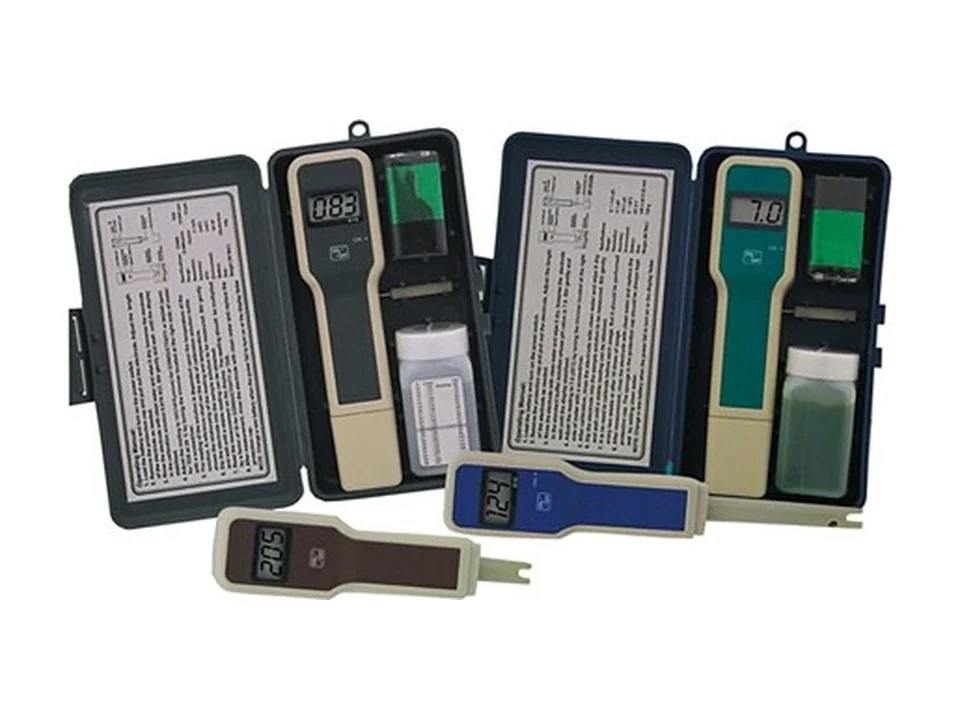
The CDH5021 series consists of economical, portable handheld test kits for measuring pH, ORP, conductivity and TDS in liquid samples. Each model is dedicated to one measurement, and each kit includes a carrying case, a battery and calibration solution, so that measurements can be started straight away.
The meters use telescoping electrodes that extend to 80 mm (3.1 in) for insertion into the sample. Results are shown on an LCD. Depending on the model, automatic temperature compensation (ATC) is provided over 0 to 50 °C. The instruments run on 9 V or 1.55 V batteries.
Five models are available. CDH-5021 measures conductivity in the high range from 10 to 9990 µS/cm, and CDH-5022 in the low range from 0 to 999 µS/cm; conductivity accuracy is ±1 % of full scale. TDH-5031 is a TDS tester covering 10 to 9990 ppm with 10 ppm resolution. PHH-5012 is a pH tester with ATC, measuring 0 to 14.0 pH with 0.02 pH resolution and an accuracy of ±0.01 pH at 25 °C. ORP-5041 is an ORP meter without ATC, measuring ±999 mV with 1 mV resolution and ±5 % of full scale accuracy.
The meters measure 152 × 40 × 34 mm (6 × 1.6 × 1.3 in) and weigh 120 g, and the carrying case measures 165 × 100 × 40 mm. The products carry CE marking and are RoHS compliant. The kits are designed to be easy to use, which also makes them suitable for demonstration and training.
Because each model covers one parameter, the right kit is chosen according to the measurement task: pH assessment, ORP evaluation, conductivity testing or TDS monitoring. Several models can be combined if more than one parameter is needed.
Listed applications are general liquid analysis, educational demonstration and training programmes, conductivity testing, TDS monitoring, pH assessment and ORP evaluation.
Please tell us which parameters and ranges you need to measure and how many kits are required, and we will confirm the matching models in our quotation.
CDH-5021, CDH-5022, TDH-5031, PHH-5012, ORP-5041
Record the sample temperature, expected concentration and how the probe is mounted. Identify the mating transmitter when replacing a sensor.
For an installed instrument, copy the complete ordering code and its suffixes from the nameplate. Identify the part that will remain in service and the part that needs to be replaced. A photograph of the connection face or terminal markings helps resolve differences between versions that share the same housing.
For a new installation, describe what the instrument must measure or control and where the reading will be used. Give the normal operating conditions separately from short peaks. Include units with every numerical value. A drawing with the available space, orientation and access for removal gives the supplier a practical starting point.
Add the quantity for each position and identify any accessories that belong with it. Where a particular drawing, material certificate or calibration record is required, mention it with the line item. Submit the list with the destination country so that the response can cover the requested configuration and delivery.