BAUR
DTL C
Electrical test & measurement
Current & voltage transducers
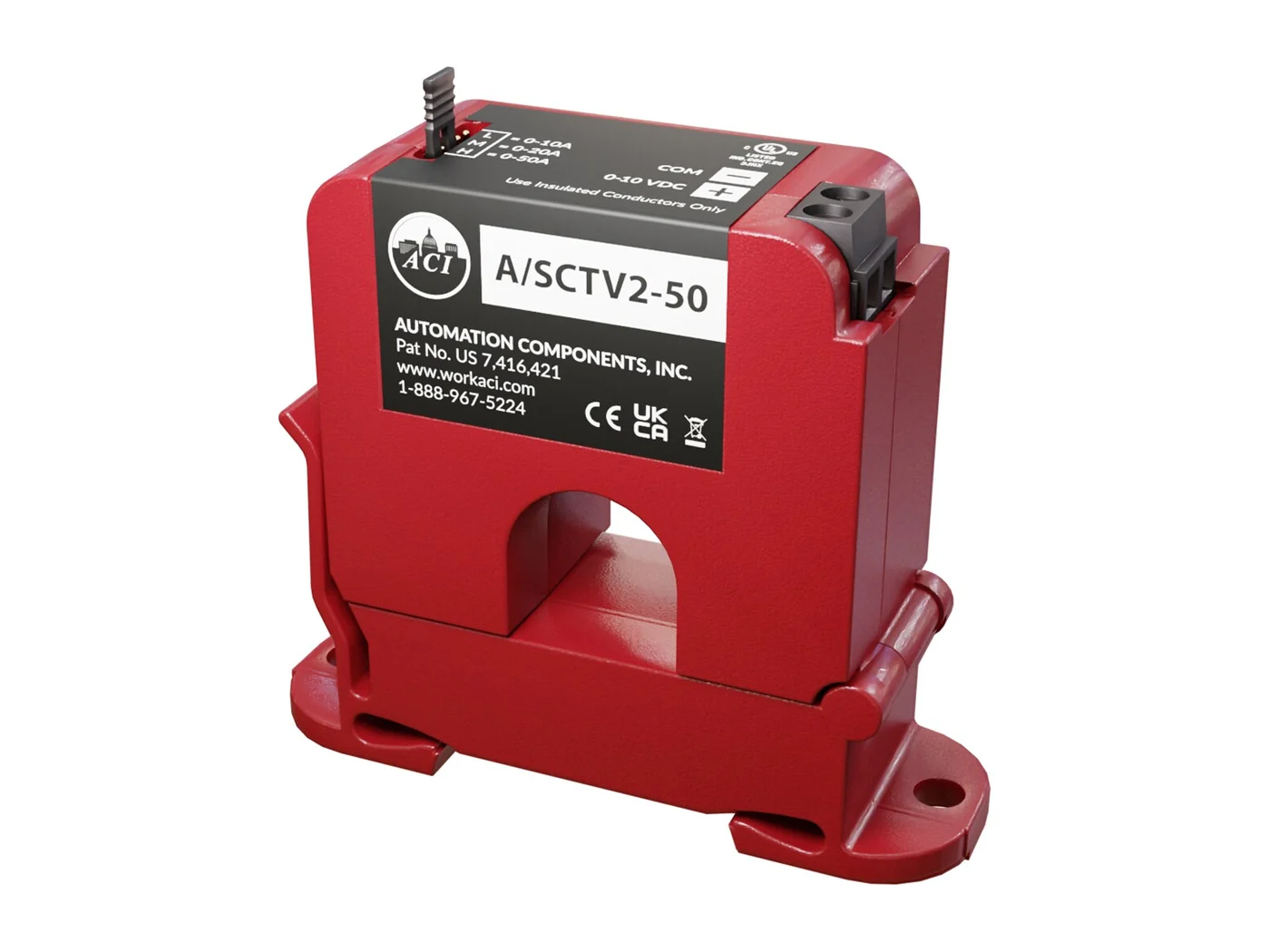
The CTE2, SCTE2, CTV2 and SCTV2 are analogue AC current sensors with a voltage output, designed for monitoring applications in which the operation of equipment is tracked. They are used for load trending, monitoring of single-speed loads such as pumps, compressors and fans, preventive maintenance, LEED projects, project justification by calculating return on investment, and process control.
The sensors are powered by induction from the monitored conductor, so no external power supply is needed; they work on insulated conductors only. The conductor is passed through the sensor, and the current is measured with an average-responding method intended for pure sinusoidal AC waveforms. The sensor delivers a linear DC voltage proportional to the current over a 2-wire connection: 0–5 V DC for the E models (CTE2, SCTE2) and 0–10 V DC for the V models (CTV2, SCTV2).
The amperage range is field selectable. Three range groups are available: 0–10/20/50 A, 0–50/100/150 A and 0–100/200/250 A. Accuracy is ±1 % to ±2 %, the frequency range 50 to 600 Hz and the response time below 300 ms. Isolation is 2200 V AC.
Solid-core models (CTE2, CTV2) have a closed opening through which the conductor is passed; split-core models (SCTE2, SCTV2) can be opened and fitted around a conductor. The housing is made of ABS and polycarbonate rated UL94 V-0. Wiring is made on screw terminals for 24 to 18 AWG wire, with a tightening torque of 0.5 to 0.6 Nm.
The sensors are mounted with an integrated 35 mm DIN rail mounting foot, or on a panel with #8 × 1/4″ Tek screws through the base holes. The operating temperature range is 5 to 104 °F, at 0 to 95 % RH non-condensing. The sensors are UL listed to UL 508 and carry CE and UKCA marks.
Please state the current range, the required output (0–5 V or 0–10 V), and whether solid-core or split-core versions are needed in your enquiry.
A/CTE2-50, A/CTE2-150, A/SCTE2-50, A/SCTE2-150, A/SCTE2-250, A/CTV2-50, A/CTV2-150, A/SCTV2-50, A/SCTV2-150, A/SCTV2-250, 142389, 142388, 142385, 142384, 142383, 142387, 142386, 142382, 142381, 142380
Match the instrument to the circuit and measurement category. Include the wiring arrangement and ratios of any external current or voltage transformers.
For an installed instrument, copy the complete ordering code and its suffixes from the nameplate. Identify the part that will remain in service and the part that needs to be replaced. A photograph of the connection face or terminal markings helps resolve differences between versions that share the same housing.
For a new installation, describe what the instrument must measure or control and where the reading will be used. Give the normal operating conditions separately from short peaks. Include units with every numerical value. A drawing with the available space, orientation and access for removal gives the supplier a practical starting point.
Add the quantity for each position and identify any accessories that belong with it. Where a particular drawing, material certificate or calibration record is required, mention it with the line item. Submit the list with the destination country so that the response can cover the requested configuration and delivery.