BAUR
DTL C
Electrical test & measurement
Power quality analysers
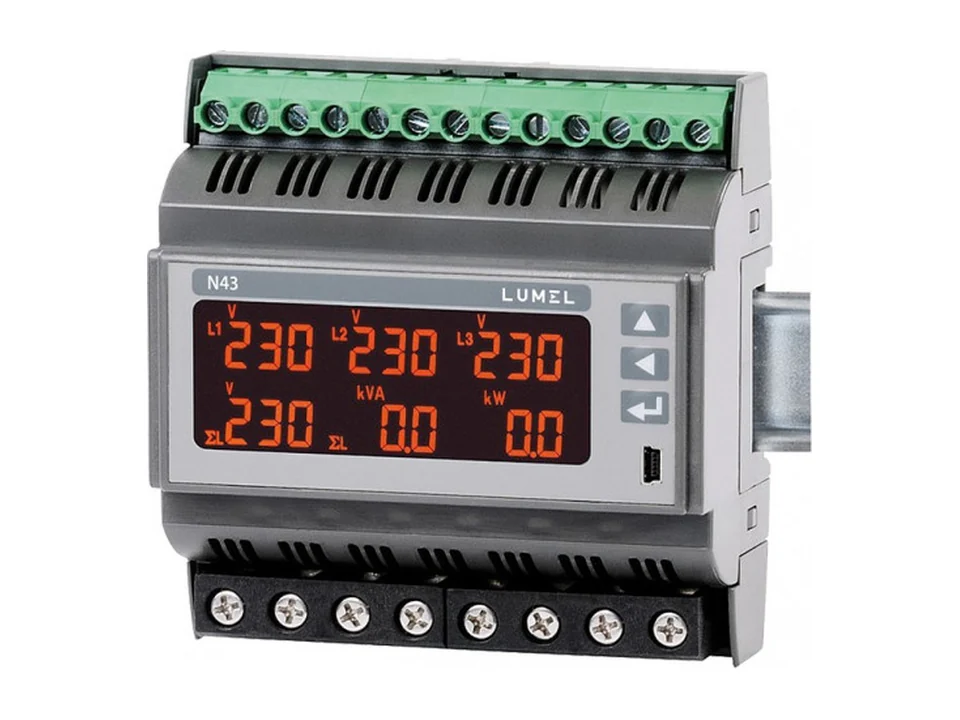
The N43 is a rail-mounted three-phase power network meter for direct and indirect measurements in three-phase four-wire and three-wire systems, balanced or unbalanced. Currents up to 63 A can be connected directly; higher currents are measured indirectly through instrument transformers, with programmable current and voltage ratios, so that the readings refer to the primary values of the transformers.
The meter measures the RMS values of voltage and current, active, reactive and apparent power, active and reactive energy, power factors, frequency and total harmonic distortion (THD). Power is covered in all three forms – active, reactive and apparent – and energy is registered as active and reactive energy.
Measured values are shown on a backlit LCD with 12 programmable screens, so the user can define which quantities are displayed on each page. Alarm and pulse outputs are configurable. Analogue outputs are available through the optional S4AO module, which provides four analogue outputs.
For integration into supervisory, building management or energy monitoring systems, the N43 has an RS-485 interface with the Modbus protocol. Configuration is carried out via USB with free configuration software. The meter therefore has two separate ports: USB for setting the parameters, such as transformer ratios, screens and outputs, and RS-485 for transmitting the measured data to the master system.
The housing is 6 modules wide and is mounted on a 35 mm rail. External dimensions are 105 × 110 × 60 mm. The meter is intended for installation in modular switchgear according to EN 62208.
The application named for the N43 is direct (up to 63 A) and indirect measurement of electrical quantities in three-phase four-wire and three-wire networks with balanced or unbalanced loads.
When enquiring, please state the network type, whether direct or transformer connection is needed, the transformer ratios, whether the S4AO analogue output module is required and the quantity.
N43
Match the instrument to the circuit and measurement category. Include the wiring arrangement and ratios of any external current or voltage transformers.
For an installed instrument, copy the complete ordering code and its suffixes from the nameplate. Identify the part that will remain in service and the part that needs to be replaced. A photograph of the connection face or terminal markings helps resolve differences between versions that share the same housing.
For a new installation, describe what the instrument must measure or control and where the reading will be used. Give the normal operating conditions separately from short peaks. Include units with every numerical value. A drawing with the available space, orientation and access for removal gives the supplier a practical starting point.
Add the quantity for each position and identify any accessories that belong with it. Where a particular drawing, material certificate or calibration record is required, mention it with the line item. Submit the list with the destination country so that the response can cover the requested configuration and delivery.