BAUR
DTL C
Electrical test & measurement
Power quality analysers
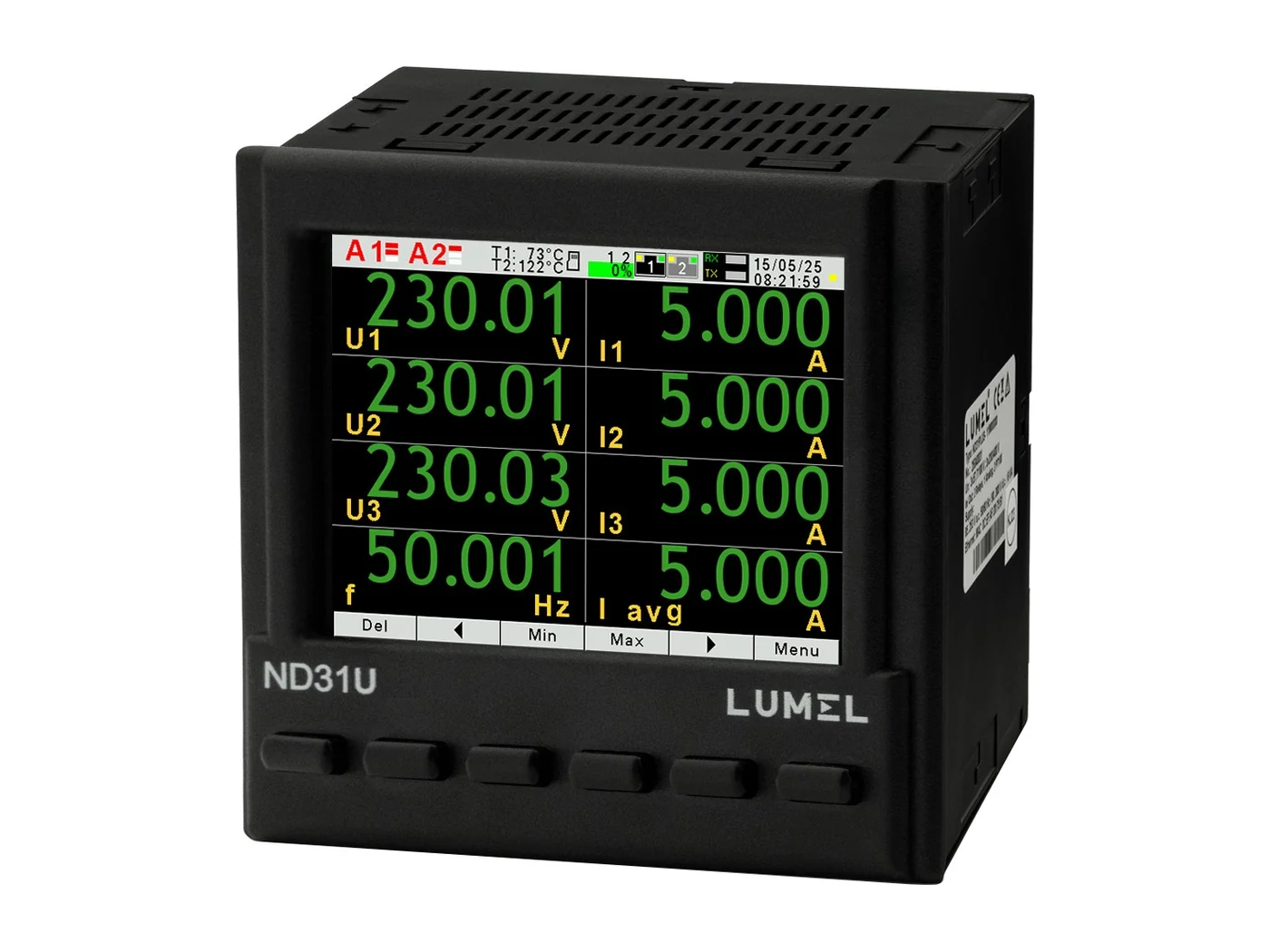
ND31U is a programmable digital meter for measuring the parameters of power networks. It is designed for balanced or unbalanced 1-phase systems with 2 or 3 wires and 3-phase systems with 3 or 4 wires, and is intended for large switchboards, production lines and energy installations, where energy consumption and supply quality have to be monitored and transmitted to supervisory systems.
The meter measures 54 power network parameters, including current and voltage harmonics up to the 63rd order. Active energy is measured to accuracy class 0.2S. A Time of Use (ToU) function allows energy to be recorded in different tariff periods. Readings are shown on a 3.5-inch TFT colour display with 640 × 480 pixels, and an internal 8 GB memory archives up to 32 parameters.
A particular feature is the pair of RJ45 Ethernet ports (10Base-T/100Base-TX, 10/100 Mbit/s). They support daisy-chain topology, so several meters can be connected in series without external Ethernet switches. Communication can be configured for MQTT, BACnet/IP and Modbus TCP/IP, and HTTP and FTP are also supported. An RS-485 port provides a serial interface.
Additional I/O extends the meter beyond pure measurement: an analogue output of 0/4–20 mA retransmits a selected value, a Pt100 input measures a temperature, and two configurable alarm outputs signal limit violations. The housing has a 96 × 96 mm front and a depth of 77 mm for panel mounting. The meter carries a UL approval, and a configuration for the U.S. and Canadian markets is available.
Free configuration software is provided for programming the meter, and free visualisation software is available for displaying the measured data on a PC.
Please tell us the network type, nominal voltage and current, the current transformer ratio and the protocol you will use, and we will specify the meter for your switchboard.
ND31U
Match the instrument to the circuit and measurement category. Include the wiring arrangement and ratios of any external current or voltage transformers.
For an installed instrument, copy the complete ordering code and its suffixes from the nameplate. Identify the part that will remain in service and the part that needs to be replaced. A photograph of the connection face or terminal markings helps resolve differences between versions that share the same housing.
For a new installation, describe what the instrument must measure or control and where the reading will be used. Give the normal operating conditions separately from short peaks. Include units with every numerical value. A drawing with the available space, orientation and access for removal gives the supplier a practical starting point.
Add the quantity for each position and identify any accessories that belong with it. Where a particular drawing, material certificate or calibration record is required, mention it with the line item. Submit the list with the destination country so that the response can cover the requested configuration and delivery.