BAUR
DTL C
Electrical test & measurement
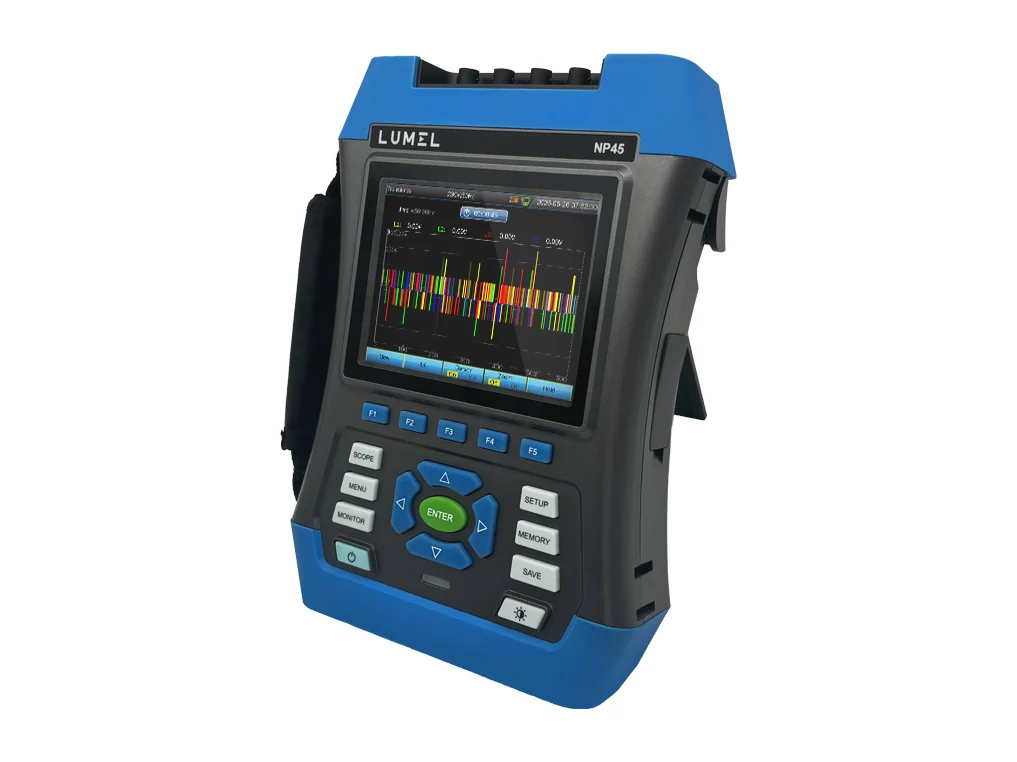
Power quality analysers
The NP45 is a professional portable instrument for analysing the quality of electrical power systems. It is used to assess harmonics and power data and to log network parameters over long periods, both for troubleshooting and for evaluation of supply quality against EN 50160.
The analyser measures voltage, current, harmonics, power and energy in single-phase and three-phase systems with three or four wires. All measurements are true RMS (TRMS), so values remain correct for distorted waveforms. With additional current probes, currents up to 6000 A can be measured.
Measurement data are stored in 32 GB of internal memory. Recording time can be set from 2 hours up to one year, which covers both short checks and long-term monitoring campaigns. Values, waveforms and results are displayed on a 5.6 inch TFT colour screen with a resolution of 640 × 480 pixels.
For data handling the instrument has an Ethernet interface, which also allows remote operation, and a USB host port for data transfer. Software for evaluation is supplied on CD.
The NP45 is designed to EN 61010-1 and rated CAT III 1000 V and CAT IV 600 V, so it can be connected at the origin of a low-voltage installation within these limits. It is listed with a UL approval.
Accessories include additional probes for currents up to 6000 A, voltage test leads, a set of five alligator clips and a DC power adapter. The set of current probes should be chosen according to the conductor sizes and current levels at the measuring point.
Applications named for the analyser are power system quality analysis, harmonics analysis and long-term power system logging. Please state the network type, the current levels to be measured and the probes you require in your enquiry, so that a complete measuring set can be offered.
NP45
Match the instrument to the circuit and measurement category. Include the wiring arrangement and ratios of any external current or voltage transformers.
For an installed instrument, copy the complete ordering code and its suffixes from the nameplate. Identify the part that will remain in service and the part that needs to be replaced. A photograph of the connection face or terminal markings helps resolve differences between versions that share the same housing.
For a new installation, describe what the instrument must measure or control and where the reading will be used. Give the normal operating conditions separately from short peaks. Include units with every numerical value. A drawing with the available space, orientation and access for removal gives the supplier a practical starting point.
Add the quantity for each position and identify any accessories that belong with it. Where a particular drawing, material certificate or calibration record is required, mention it with the line item. Submit the list with the destination country so that the response can cover the requested configuration and delivery.