BAUR
DTL C
Electrical test & measurement
Multimeters & clamp meters
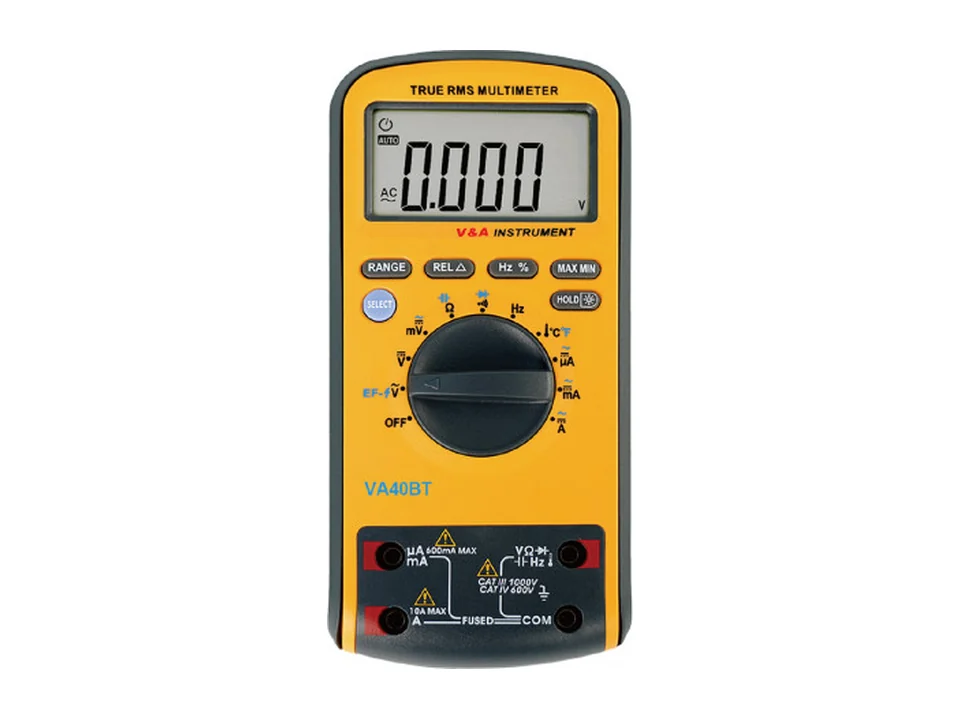
The VA40BT V2 is a professional true-RMS digital multimeter with a 5999-count display and exclusively wireless data transmission over Bluetooth. It has no wired USB interface: measured data are sent either to a Windows PC or to a smartphone or tablet. The meter measures AC and DC voltage and current, resistance, capacitance, frequency and temperature in industrial applications.
AC voltage and current are measured as true RMS values, which gives correct readings on non-sinusoidal waveforms. For data transfer, the meter connects to Windows PCs in SPP mode with PC-Link software, or to Android and iOS smartphones and tablets in BLE mode, paired by scanning a QR code.
Voltage is measured up to 1000 V AC/DC and current up to 10 A AC/DC. Further ranges cover resistance up to 60 MΩ, capacitance up to 60 mF, frequency up to 1 MHz and temperature from −200 °C to +1200 °C. A non-contact voltage detection function (NCV/EF) indicates AC voltage from about 50 V without touching the conductor.
The backlit LCD has 3 5/6 digits with a digit height of 21.3 mm. Data hold, relative measurement (REL) and MAX/MIN recording are available, and the meter switches itself off automatically to save the battery.
The meter is rated CAT IV 600 V and CAT III 1000 V. The current inputs are protected by fuses F 0.63 A / 1000 V and F 10 A / 1000 V. Power is supplied by a 9 V battery of type 6F22.
The listed application is industrial measurement of AC/DC voltage, current, resistance, capacitance, frequency and temperature, with wireless transfer of the readings to a PC or mobile device.
Please state the required quantity when requesting a quotation.
VA40BT V2
Match the instrument to the circuit and measurement category. Include the wiring arrangement and ratios of any external current or voltage transformers.
For an installed instrument, copy the complete ordering code and its suffixes from the nameplate. Identify the part that will remain in service and the part that needs to be replaced. A photograph of the connection face or terminal markings helps resolve differences between versions that share the same housing.
For a new installation, describe what the instrument must measure or control and where the reading will be used. Give the normal operating conditions separately from short peaks. Include units with every numerical value. A drawing with the available space, orientation and access for removal gives the supplier a practical starting point.
Add the quantity for each position and identify any accessories that belong with it. Where a particular drawing, material certificate or calibration record is required, mention it with the line item. Submit the list with the destination country so that the response can cover the requested configuration and delivery.